English
What is Exchange-Grade Liquidity Aggregation for Crypto Exchanges?
ExchangeLiquidity

In the competitive landscape of cryptocurrency trading platforms, liquidity has evolved from being a “competitive advantage” to a critical infrastructure that determines a platform’s survival. Whether it’s a newly launched exchange or a mature platform expanding its trading pairs and market depth, all face the same fundamental question:
How can a crypto exchange achieve long-term, scalable, and controllable deep liquidity without building a large, costly, and high-risk market-making infrastructure?
This is precisely where exchange-grade liquidity aggregation (Institutional-Grade Liquidity Aggregation) comes into play.
This article explains, from the perspective of crypto exchanges and institutional traders:
- What exchange-grade liquidity aggregation is
- Why single market makers or single upstream liquidity sources are insufficient
- How liquidity aggregation solves slippage, shallow order books, and wide bid-ask spreads
- Key components to consider when building an enterprise-level liquidity aggregation architecture
1. What is Exchange-Grade Liquidity Aggregation?
Exchange-grade liquidity aggregation refers to the system architecture of a crypto exchange that connects, consolidates, and intelligently routes multiple external liquidity sources, including professional market makers, upstream centralized exchanges (CEX), and OTC liquidity providers, into a single unified order book with continuous, stable, and deep liquidity.
Put simply, it’s not about “buying from one exchange.” Instead, the system simultaneously monitors prices and depth across dozens of liquidity sources and automatically selects the optimal execution path for trades.
The core goals of liquidity aggregation go beyond merely “adding liquidity” and focus on:
- Consolidating fragmented liquidity
- Optimizing price discovery
- Reducing trading costs and slippage
- Ensuring stable and continuous matching
In institutional-grade scenarios, effective liquidity aggregation systems usually share these characteristics:
- Serving centralized exchanges (CEX) or institutional trading platforms
- Built on an order book matching model
- Relying on high-performance matching engines, risk-control systems, and low-latency infrastructure
- Supporting multiple market makers for competitive pricing
2. Why Crypto Exchanges Cannot Rely on a Single Liquidity Source
Many early-stage exchanges start with a single market maker or mirror one large exchange. However, as trading volumes grow, the limitations of single-source liquidity become apparent:
2.1 Single Market Maker = Single Point of Risk
- Market maker withdrawal or risk control: If a market maker reduces positions or exits, the platform’s order book depth can drop sharply, disrupting trade continuity and weakening user trust in liquidity.
- Uncontrolled quote quality: With only one liquidity provider, bid-ask spreads and slippage tend to widen, reducing overall trading experience.
- No negotiating power: Without alternative liquidity sources, the exchange has limited leverage, leaving market-making costs and terms dictated by the counterparty.
2.2 Single Upstream Exchange = Follower Market
- No independent price discovery: Pricing depends entirely on the upstream exchange, limiting market autonomy.
- Severe slippage in volatile markets: Shallow depth can be quickly depleted during high volatility, causing executed prices to deviate from expected levels.
- Perceived as a “secondary market”: Professional users may view the platform as a price relay rather than an independent exchange, reducing brand credibility and institutional appeal.
The essence of exchange-grade liquidity aggregation is to systematically eliminate single-point dependency risks.
3. How Crypto Exchanges Achieve Deep Liquidity Through Aggregation
3.1 Multi-Market-Maker Liquidity Aggregation: Parallel Access and Competitive Quotes
Leading exchanges integrate multiple professional crypto market makers, OTC liquidity providers, and high-frequency trading firms through API, FIX, or WebSocket connections.
Dynamic weighting and prioritization of liquidity sources based on quote quality, depth contribution, system latency, and stability ensure continuous competitive pricing.
3.2 Upstream Exchange Liquidity Aggregation and Depth Consolidation
For certain trading pairs, exchanges may also integrate top-tier exchange spot or futures liquidity, supplemented by regional exchanges.
The aggregation layer merges multiple market depths and optimizes price routing, so that even if one market faces issues, overall trading continuity remains unaffected.
3.3 Smart Order Routing and Depth Fusion: Reducing Slippage and Improving Execution
Effective liquidity aggregation is not merely concatenating multiple order books.
It requires depth fusion algorithms, price- and quantity-prioritized matching, cross-source order splitting, and real-time slippage control, providing users with a single high-quality market experience, rather than visible multiple liquidity sources.
4. How Liquidity Aggregation Solves Slippage, Shallow Depth, and Wide Spreads
- Slippage: By splitting large orders into smaller chunks across multiple sources, intelligent routing minimizes market impact.
- Shallow depth: Small or emerging exchanges often have thin order books. Aggregating liquidity from top-tier exchanges (e.g., Binance, Bybit, OKX, Coinbase) and professional market makers (e.g., Wintermute, GSR) significantly increases effective market depth.
- Wide bid-ask spreads: Aggregation systems dynamically select sources with optimal spreads and can leverage cross-market arbitrage to continuously tighten spreads.
No trader stays long on platforms where “orders sit unfilled” or “large trades eat the order book.” For hedge funds, family offices, and quantitative teams, liquidity quality is the first criterion before participation. Exchanges without aggregation struggle to accommodate institutional capital.
5. How to Build an Exchange-Grade Liquidity Aggregation Architecture
A mature system typically includes the following core modules:
5.1 Multi-Source Connectors
- Support for major CEX APIs (REST + WebSocket)
- Private API integration with professional market makers (typically via FIX protocol)
- Optional integration of additional liquidity sources (on-chain DEXes can be supplementary)
5.2 Real-Time Order Book Fusion Engine
- Synchronize Level 2/3 data from multiple sources
- Timestamp alignment and out-of-order handling
- Construct a unified Virtual Order Book
5.3 Smart Order Routing and Execution Algorithms (SOR)
- Decision-making based on price, depth, fees, and latency
- Supports advanced order types: TWAP, VWAP, Iceberg
- Auto-downgrade or exclude underperforming liquidity sources
5.4 Risk Control and Monitoring
- Single-source anomaly detection (e.g., flash crashes)
- Global circuit breakers and protection mechanisms
- Post-trade slippage and PnL analysis
5.5 Low-Latency Infrastructure and Matching Optimization
- Node deployment near major exchanges’ core regions
- Matching engine implemented in C++/Rust for millisecond-level latency
Exchange-Grade Liquidity Aggregation vs. Crypto Liquidity Pools
This distinction is often misunderstood but critical for enterprise decision-making.
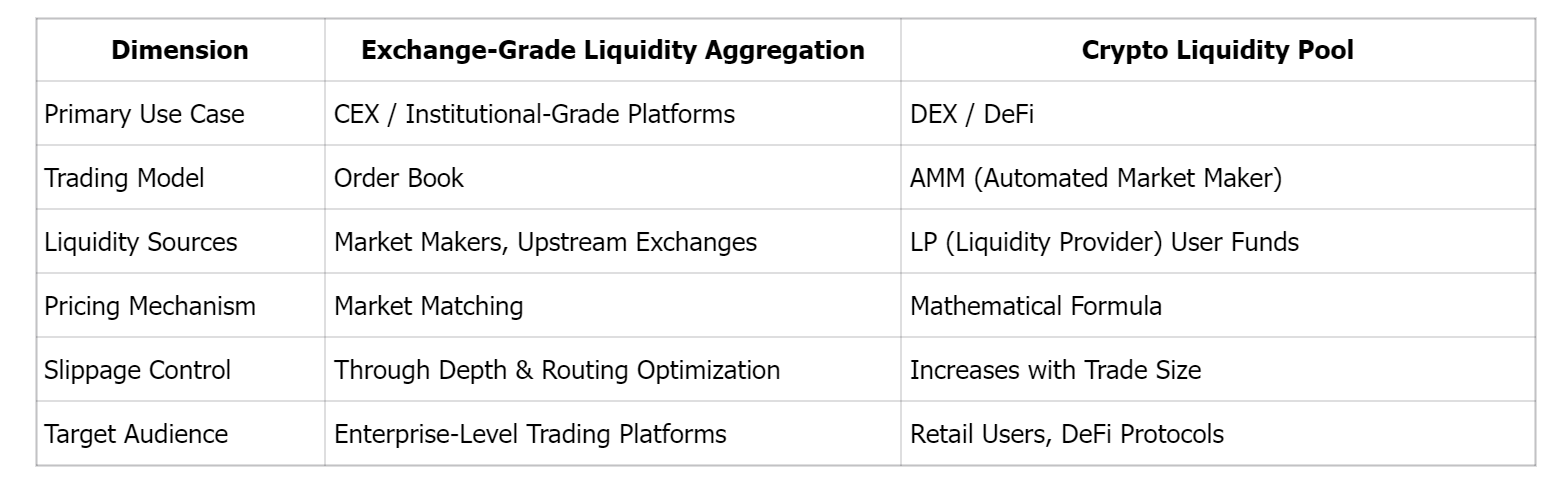
Key point: For institutional-grade or professional trading exchanges, the primary liquidity solution should be exchange-grade aggregation, not simple liquidity pools.
* For liquidity pools, please read “What Is a Crypto Liquidity Pool? A Deep Dive into DeFi’s Core Mechanism”.
Conclusion: Liquidity Aggregation – The True “Moat” of a Crypto Exchange
UI can be outsourced, coins can be copied, and marketing strategies can be imitated, but a stable, scalable, and reliable liquidity system cannot be replicated overnight.
Exchange-grade liquidity aggregation is no longer optional—it is the standard infrastructure for modern trading platforms.
For exchanges, brokers, or fintech companies aiming for long-term global competitiveness, planning and deploying a high-performance, scalable liquidity aggregation architecture early is essential to gain institutional trust, handle large-scale capital, and achieve sustainable growth.
Subscribe to our blog now
Be the first to get the latest updates
By submitting this form, you agree to receive marketing information via the email address you provided. Your personal data will be processed in accordance with the Privacy Statement.
Latest News

Exposing common low-cost white-label traps to help you select a truly reliable exchange SaaS.
- Exchange
- White Label Solution
June 1, 2026
- Exchange
- White Label Solution
June 1, 2026
Analyzing the 2026 global exchange SaaS reshuffle and how high-ROI solutions empower Web3 startups.
- White Label Solution
- Exchange
June 1, 2026