English
What Is a Crypto Liquidity Pool? A Deep Dive into the Core Mechanism of DeFi
ExchangeLiquidity
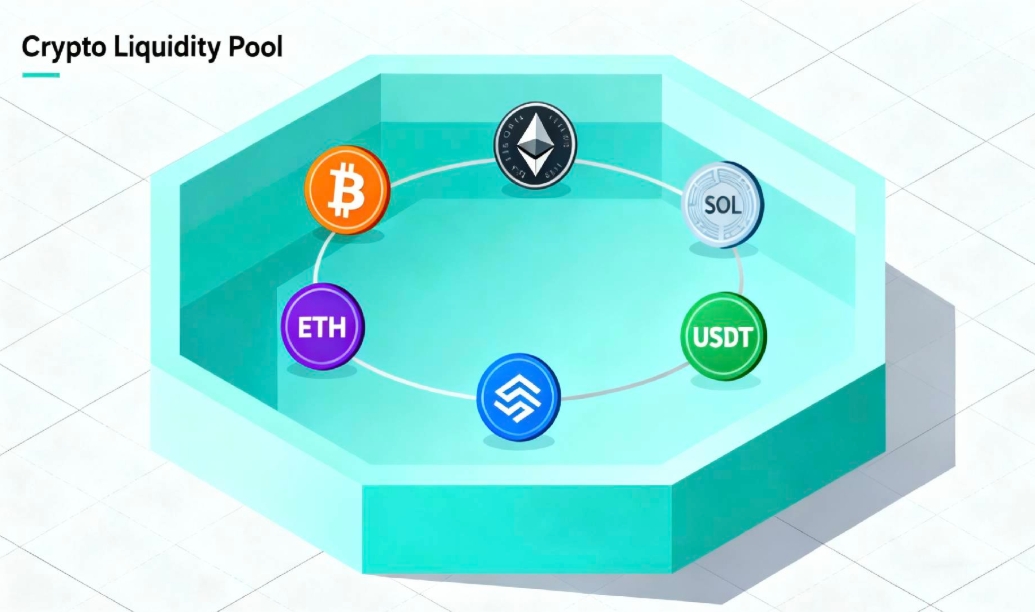
As decentralized finance (DeFi) continues to mature, crypto liquidity pools have become one of the most critical pieces of infrastructure powering on-chain financial systems.
From decentralized exchanges (DEXs) and automated market makers (AMMs) to lending protocols, derivatives, stablecoins, and yield aggregation platforms, liquidity pools underpin nearly every major DeFi use case.
For end users, liquidity pools determine whether trades can be executed smoothly and whether slippage remains acceptable.
For platforms and enterprises, they directly impact liquidity depth, capital efficiency, system complexity, and long-term scalability.
So what exactly is a crypto liquidity pool? How does it work, and why has it become a core architectural choice in DeFi?
This article provides a systematic explanation from the perspectives of mechanism design, pricing models, operational metrics, and enterprise applications.
What Is a Crypto Liquidity Pool? Definition and Core Mechanism
A crypto liquidity pool is a collection of digital assets locked in a smart contract, designed to provide instant liquidity for on-chain trading, swapping, or other financial activities.
Unlike traditional trading platforms that rely on matching buy and sell orders through an order book, assets in a liquidity pool are pre-deposited into a smart contract. Traders do not transact with another counterparty; instead, they trade directly against the pool.
In simple terms:
A liquidity pool is a smart contract–managed shared pool of assets that continuously provides liquidity for decentralized trading and financial protocols.
This model enables permissionless, automated trading without centralized intermediaries.
The Core Value of Liquidity Pools for Platforms and Users
For Platforms and Protocol Builders
- Reduced system complexity: No need for high-throughput matching engines or centralized infrastructure
- Deterministic trade execution: As long as assets exist in the pool, trades can be executed algorithmically
- Composable financial infrastructure: LP tokens can be reused in staking, lending, yield farming, and structured products
- Easier market bootstrapping: Initial liquidity can be provided without waiting for organic two-sided order flow
For Traders and Liquidity Providers (LPs)
- No counterparty waiting: Trades can execute even in low-activity markets
- Transparent pricing rules: All pricing logic is enforced on-chain and publicly verifiable
- Permissionless market making: Any user can become a liquidity provider and earn fees
How Are Liquidity Pools Priced? AMM Mechanisms and Major Models
Most liquidity pools are powered by automated market maker (AMM) algorithms, which use mathematical formulas rather than order matching to determine prices.
Constant Product Market Maker (CPMM)
Introduced by Uniswap, this is the most widely used AMM model:
x×y=kx
- x and y: quantities of two tokens in the pool (e.g., ETH and USDT)
- k: a constant representing total liquidity
Strengths: Simple, robust, and able to provide liquidity across all price ranges.
Best suited for: Long-tail assets and early-stage markets.
StableSwap Model (Stablecoin-Optimized AMM)
Popularized by Curve, this model is designed for assets with a 1:1 peg (e.g., USDC/USDT).
Strengths:
- Extremely low slippage within a narrow price range
- Deep effective liquidity for large trades
Best suited for: Stablecoin swaps, settlement layers, and liquidation mechanisms.
Concentrated Liquidity Model (CLMM)
Introduced by Uniswap v3, CLMM allows LPs to allocate capital within specific price ranges.
Strengths:
- Significantly higher capital efficiency
- Deeper liquidity with the same total value locked
Trade-offs:
- More complex LP strategies
- Higher demands on platform risk management and UX design
A Critical Clarification
AMM prices are not market quotes. They are the mathematical result of asset ratios inside the pool.
When one asset is heavily bought, its pool balance decreases and the price rises automatically—and vice versa.
Key Operational Metrics: Liquidity Depth and TVL
For platform operators, liquidity depth is one of the most important indicators of protocol health.
- Low slippage execution: Deep liquidity enables large trades without excessive price impact
- Total Value Locked (TVL): Reflects market confidence and capital stickiness
- Incentive design: Trading fees, liquidity mining, and rewards are used to retain long-term liquidity rather than short-term arbitrage capital
Risks and Limitations of Liquidity Pools
Despite their efficiency, liquidity pools come with structural risks that platforms must carefully manage:
- Impermanent loss (IL): LPs may underperform simple holding during high volatility. Platforms often mitigate this through fee structures or incentive programs.
- MEV and sandwich attacks: Poor transaction ordering can expose users to bot-driven extraction.
- Oracle dependencies: Inadequate oracle design can lead to price manipulation, especially via flash loans.
- Slippage at scale: Shallow pools suffer from significant price impact on large trades.
- Reliance on arbitrage: AMMs do not “know” market prices; arbitrageurs are required to keep prices aligned.
Common Use Cases of Liquidity Pools
- Decentralized exchanges (DEXs)
- Stablecoin swaps and cross-asset settlement
- Liquidity aggregation and routing protocols
- On-chain derivatives and prediction markets
- Built-in swap functionality in Web3 wallets
For enterprises, liquidity pools are often deployed as modular DeFi components or on-chain liquidity supplements, complementing centralized or institutional liquidity sources. They are particularly useful for bootstrapping early liquidity, reducing initial market-making costs, and building scalable Web3 financial product stacks.
Should Enterprises Adopt Liquidity Pool Mechanisms?
For enterprises, the decision to adopt liquidity pools is not a philosophical stance on decentralization, but a strategic choice about trading models, target users, and compliance boundaries.
Liquidity pools are generally suitable when:
- Targeting DeFi-native or Web3 users
- Prioritizing non-custodial and on-chain transparency
- Launching new assets or early-stage markets
They require careful evaluation when:
- Serving high-frequency or institutional traders
- Operating under strict regulatory or risk-control frameworks
Conclusion
Crypto liquidity pools are more than a technical component of DeFi—they represent a fundamental rethinking of how liquidity is created, accessed, and priced.
By lowering market entry barriers and improving on-chain capital efficiency, liquidity pools have become a scalable foundation for decentralized financial products and enterprise-grade Web3 infrastructure.
Whether you are an enterprise evaluating DeFi architecture or a user seeking better execution and yield opportunities, understanding how crypto liquidity pools work is a foundational step into the broader Web3 financial ecosystem.
Subscribe to our blog now
Be the first to get the latest updates
By submitting this form, you agree to receive marketing information via the email address you provided. Your personal data will be processed in accordance with the Privacy Statement.
Latest News

Exposing common low-cost white-label traps to help you select a truly reliable exchange SaaS.
- Exchange
- White Label Solution
June 1, 2026
- Exchange
- White Label Solution
June 1, 2026
Analyzing the 2026 global exchange SaaS reshuffle and how high-ROI solutions empower Web3 startups.
- White Label Solution
- Exchange
June 1, 2026