Malay

- Produk

Why Enterprises Need White Label Crypto Solutions to Build Web3 Infrastructure
Lihat MaklumatBursa Aset Digital CEX Dilancar dalam 7 hari dengan sistem dagangan tahap perusahaanDompet Kripto MPC + storan sejuk untuk perlindungan aset menyeluruhKecairan Agregasi kecairan global dengan spread rendahBursa Desentralisasi DEX Dagangan desentralisasi rentas rantaian tanpa kustodiPlatform Dagangan NFT Pelancaran satu klik untuk dagangan NFT pelbagai modPertumbuhan Pengguna Alat pemerolehan dan pengekalan pengguna bersepaduPasaran Ramalan NewSeni bina multi-oracle dengan penyelesaian automatik on-chainRWA Tokenisasi aset dunia sebenar secara patuh - Penyelesaian
- Blog
- Tentang Kami


AI Agents in Crypto: How Autonomous DeFi Could Change Web3
The most important development in AI and crypto may not be another chatbot.
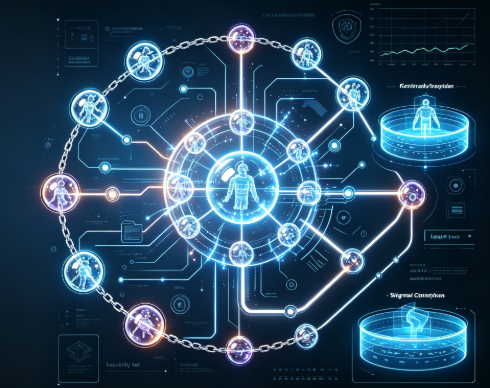
It may be the moment an AI agent stops giving instructions and starts executing them.
That transition is already happening.
On September 16, IRF announced its acquisition of Nomina and its SolverNet intent-execution protocol, a system designed to let AI agents interact with DeFi across multiple chains. SolverNet has reportedly processed more than 7.5 million transactions and supports networks including Ethereum, Arbitrum, Base and Optimism.
The significance is not simply that another DeFi protocol was acquired.
It is that the architecture of DeFi is beginning to adapt to a new type of user:
machines.
Humans Were Never the Perfect DeFi User
Today's DeFi experience assumes a human is sitting behind the wallet.
A user chooses a network.
Selects a token.
Approves a transaction.
Pays gas.
Moves assets.
Repeats the process.
For a human, that is already complicated.
For an AI agent operating continuously across multiple chains, it is inefficient.
An agent does not necessarily need to understand every transaction.
It needs to specify an outcome.
For example:
Move capital to the best available yield opportunity while maintaining predefined risk limits.
That is an intent.
The execution layer handles the complicated steps underneath.
This Could Change How DeFi Is Used
SolverNet's model is based on exactly this idea.
Instead of forcing an agent to execute a long sequence of transactions, an agent expresses the desired outcome and a network of solvers handles the execution.
That sounds like a small UX improvement.
It isn't.
It changes the abstraction layer.
The user no longer interacts with every blockchain operation.
The user — or AI agent — interacts with an objective.
The infrastructure determines how to achieve it.
The Biggest Opportunity Is Also the Biggest Risk
Once AI agents can move capital autonomously, a new question becomes unavoidable:
Who controls the agent?
An AI system making a recommendation is one thing.
An AI system authorized to move assets is something else entirely.
The difference between the two is a permission boundary.
And that boundary becomes critical when transactions happen at machine speed.
Elliptic recently reported that agentic crypto payments had surged 500% over three months and argued that compliance systems must adapt to transactions being originated, authorized and settled at speeds human teams cannot manually review.
That creates a new security problem.
A human can make one bad transaction.
An autonomous agent can potentially make thousands.
The Wallet Is Becoming an Operating System
This is where crypto wallets may begin to evolve.
A wallet for an AI agent cannot simply be a place where private keys are stored.
It needs rules.
Limits.
Permissions.
Identity.
Transaction policies.
Risk controls.
And potentially the ability to revoke an agent's authority automatically.
That makes the wallet less like a bank account and more like a programmable operating system for financial activity.
The Next Crypto User May Not Be Human
This is the deeper implication.
If AI agents can:
- allocate capital
- rebalance positions
- move assets between chains
- search for liquidity
- execute DeFi strategies
- make payments
- interact with protocols
then the number of blockchain transactions may eventually become disconnected from the number of human users.
One person could operate multiple agents.
One company could deploy thousands.
And those agents could interact with each other without a human approving every transaction.
That could fundamentally change the economics of on-chain finance.
Crypto Finally Has Something AI Needs
AI can reason.
But reasoning alone is not enough.
An AI agent that cannot interact with money, markets and digital assets remains largely confined to software.
Crypto provides programmable ownership and settlement.
AI provides autonomous decision-making.
Put them together and something new appears:
software that can make financial decisions and execute them.
That is far more consequential than simply using AI to predict prices.
The real question for the next stage of Web3 may therefore be:
What happens when the users of financial networks are no longer humans?
We may be about to find out.
About SoonTech
SoonTech follows emerging developments across digital assets, AI, DeFi and Web3 to understand how technology is changing the way digital value is created, managed and transferred.
🌐 Build secure and scalable Web3 platforms with SoonTech.
Explore our solutions for White Label Crypto Exchanges, Prediction Markets, MPC Wallets, Matching Engines, Liquidity Integration, and Compliance.