English
What Is Liquidity White Label: Solving the “No Trades After Launch” Issue for CEX/DEX
InfrastructureWhite Label SolutionLiquidity
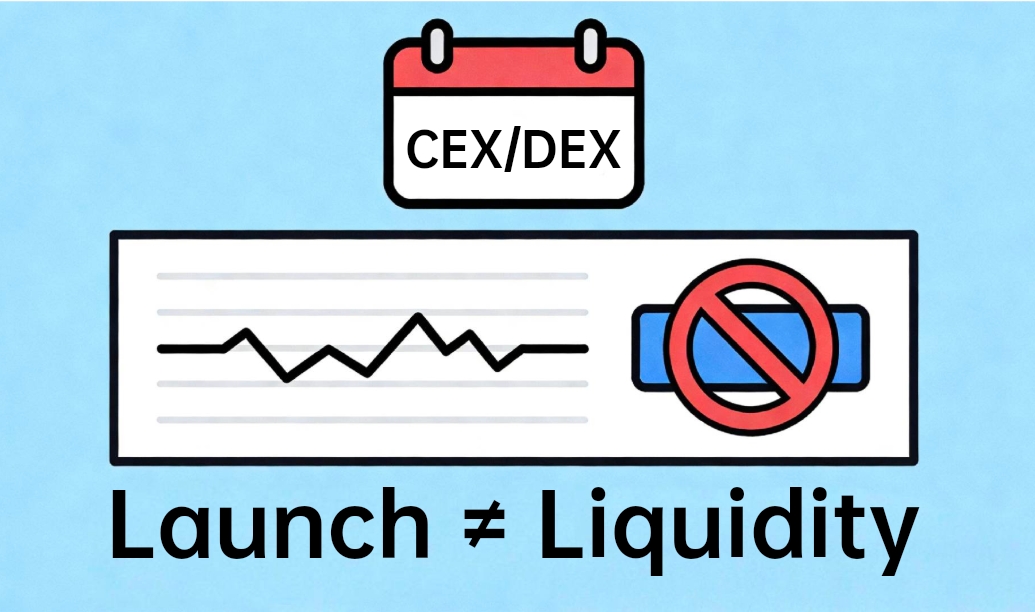
For both centralized exchanges (CEX) and decentralized exchanges (DEX), “launching” does not automatically mean “trading happens.” Many new platforms complete UI development, wallet integration, trading pair setup, and matching engine deployment, but still face a critical issue: no real liquidity. Users place orders but receive no fills, or slippage reaches 10% and the entire order book empties within minutes.
In this situation, a liquidity white label solution becomes the most direct fix. It allows CEX and DEX platforms to obtain usable, scalable, and risk-managed market depth within weeks—without building an in-house market-making team or integrating multiple liquidity providers one by one. The result is a true “trade-ready from Day 1” experience.
Why CEX and DEX Still Need External Liquidity Support
CEX Liquidity Is Hard to Build In-House: Low Depth, High Slippage, High Risk
For a centralized exchange, users expect liquidity and execution quality similar to Binance or OKX. However, new platforms often lack market-making resources and suffer from thin order books, resulting in:
- Users unable to execute at reasonable prices
- Large orders causing extreme slippage
- Poor trading experience → user churn → brand damage
Building liquidity internally requires significant time and investment, including integrating multiple market makers, maintaining routing and matching logic, and establishing risk and hedging systems. It also introduces risks such as partnership failures or market makers exiting.
As a result, liquidity white label solutions have become one of the most effective paths for new CEX platforms.
DEX Liquidity Challenges: Fragmented Depth, High Slippage, Limited Trading Types
For decentralized exchanges, even when using mature AMM models like Uniswap V2/V3, relying solely on community-provided LP funds still presents challenges:
- Liquidity pools for new or long-tail pairs often remain shallow
- Large swaps can trigger high slippage, deterring institutions and high-net-worth users
- Native AMM architecture does not support advanced order types such as limit orders or stop-loss
Additionally, DEX liquidity is frequently fragmented across multiple pools and protocols, making it difficult to consolidate depth for scalable trading. This is a key reason DEX platforms also adopt liquidity white label solutions.
SoonTech Liquidity White Label: Real Market Depth from Day 1
SoonTech’s liquidity white label is not merely an API aggregator. It is an end-to-end intelligent liquidity operating system designed for CEX and DEX platforms. It enables platforms to achieve market depth comparable to top exchanges from Day 1.
Automated Market Making Engine: Continuous Two-Sided Quotes and Order Book Stability
SoonTech’s automated market making engine continuously provides responsive two-sided quotes. It dynamically adjusts spread, order sizes, and price levels based on market conditions. Whether the market is calm or highly volatile, the engine significantly increases order book depth and reduces price gaps, delivering a stable and trustworthy trading experience.
Multi-Source Liquidity Aggregation: Unified and Continuous Order Book View
The system aggregates liquidity from top market makers, major CEXs, and DEX pools in real time. Through intelligent weighting and blending, fragmented quotes are combined into a unified, continuous order book. This increases overall depth and reduces price deviation, ensuring users consistently receive best-market execution.
Smart Order Routing (SOR): Better Execution in Complex Markets
When facing large orders or high-volatility assets, the smart order routing system analyzes price, depth, and slippage cost across channels in real time. It automatically splits orders and selects the optimal execution path—prioritizing internal matching for cost efficiency, and routing to external hedging when necessary. This improves fill rates and execution speed while reducing overall trading costs.
Risk Management & Hedging System: Resilient in Extreme Market Conditions
The platform continuously monitors exposure, delta risk, and volatility. Once thresholds are reached, it automatically triggers hedging or circuit breakers. This proactive risk system ensures the market making engine remains stable and secure even during extreme market conditions.
Monitoring & Parameter Management Dashboard: Visibility, Control, and Optimization
Operators can use a centralized dashboard to view depth heatmaps, spread distribution, and trading activity in real time. The system allows flexible adjustment of market-making parameters such as spread and order sizes. It also provides risk alerts, audit logs, and role-based permissions, ensuring liquidity is visible, controllable, and fully auditable.
FAQ
Q: Do I need to sign a separate market maker contract for liquidity white label?
A: You can choose to sign a separate market maker agreement, or you can connect to SoonTech’s multi-source liquidity through a unified interface and receive continuous two-sided quotes and market depth.
Q: Besides CEX and DEX, who else can benefit from liquidity white label?
A: This solution also suits digital brokerages, OTC platforms, DeFi protocols, smart wallets, derivatives trading platforms, and even market makers themselves—any Web3 or fintech project that requires reliable, scalable liquidity.
Q: Can liquidity strategies be customized?
A: Yes. The management dashboard supports flexible configuration, including “market maker-only liquidity,” “disable specific CEX sources,” or “force RFQ for large orders,” to meet different business stages and risk requirements.
Q: How does liquidity white label go live? What does integration involve?
A: Integration typically includes three steps:
- Define trading pairs and liquidity targets
- Connect via unified interfaces (market data, orders, matching layer, risk, and settlement/reconciliation)
- Conduct depth and slippage verification before launch and adjust parameters
- The process can be completed within weeks, depending on the number of trading pairs and risk requirements.
Q: What capabilities will my platform gain after integration?
A: After integration, your platform will receive end-to-end liquidity capabilities, including automated market making, multi-source aggregation, smart order routing, risk management and hedging, and a monitoring dashboard for ongoing optimization.
Q: How long does integration take?
A: Integration typically takes weeks, depending on trading pair count, risk requirements, and customization level. SoonTech provides standardized interfaces and fast onboarding to significantly shorten the timeline.
Conclusion: Make Real Trading Happen From Day One
The true test for CEX and DEX is whether users actually trade. By integrating SoonTech, your exchange or decentralized platform can achieve real liquidity from Day 1, improve trading experience, and strengthen market competitiveness. Launching should not be a display—it should be the beginning of real trading.
If you are planning to launch a CEX or DEX or searching for a more efficient liquidity solution, connect with SoonTech liquidity experts. We can provide a tailored integration plan and depth verification support based on your trading pair structure, business model, and risk requirements.
Call to Action
📘 Download the “CEX/DEX Liquidity White Label Integration Guide”
💬 Schedule a 1:1 consultation with a SoonTech liquidity expert
🎥Request a liquidity depth demo
Subscribe to our blog now
Be the first to get the latest updates
By submitting this form, you agree to receive marketing information via the email address you provided. Your personal data will be processed in accordance with the Privacy Statement.
Latest News
Explore the concept, mechanisms, and potential impact of “trading attention” in decentralized prediction markets, and its role in digital asset ecosystems and trend quantification.
- Prediction Market
March 9, 2026
Discover why white-label solutions are the fastest, most cost-effective way to launch a cryptocurrency exchange in 2026. Learn about security, compliance, liquidity, AI, and RWA integration.
- Exchange
March 6, 2026
Explore how decentralized exchanges (DEX) are becoming mainstream trading venues, leveraging perpetual contracts and innovative infrastructure to attract capital from centralized exchanges (CEX).
- Exchange
March 5, 2026