English
CEX vs. DEX: How Enterprises Should Choose the Suitable Crypto Exchange Platform
ExchangeWhite Label Solution
As the digital asset market gradually becomes more regulated and institutionalized, more enterprises are looking to enter crypto trading, asset custody, or build financial infrastructure. One of the first decisions in this process is whether to build a centralized exchange (CEX) or a decentralized exchange (DEX).
There is no one-size-fits-all answer to this question. The right choice depends on business objectives, compliance obligations, asset custody model, and long-term development strategy.
This article provides an objective comparison of the core differences between CEX and DEX from an enterprise decision-making perspective, and offers clear guidance on which platform type best fits different business needs.
What Are CEX and DEX?
Before comparing, it is important to clarify their fundamental positioning: platform-based vs. protocol-based.
Centralized Exchange (CEX)
A CEX is a platform-based trading system where the operator centrally holds user assets and matches orders through a centralized matching engine. The platform assumes responsibility for trading, risk control, settlement, and compliance.
Key characteristics include:
- High-performance matching and low-latency trading
- Platform-level asset management and risk control systems
- Support for KYC/AML and regulatory compliance
- Easy integration with institutional liquidity providers and market makers
Decentralized Exchange (DEX)
A DEX is a protocol-based trading system built on blockchain and smart contract protocols. Users retain custody of their assets, and trading is executed via AMM or on-chain order books.
Key characteristics include:
- Non-custodial, no trusted intermediary required
- Fully on-chain and auditable transaction and asset status
- Performance constrained by the underlying blockchain and gas fees
- Limited platform-level risk control and compliance intervention
Core Decision Dimensions for Enterprises Choosing a Trading Platform
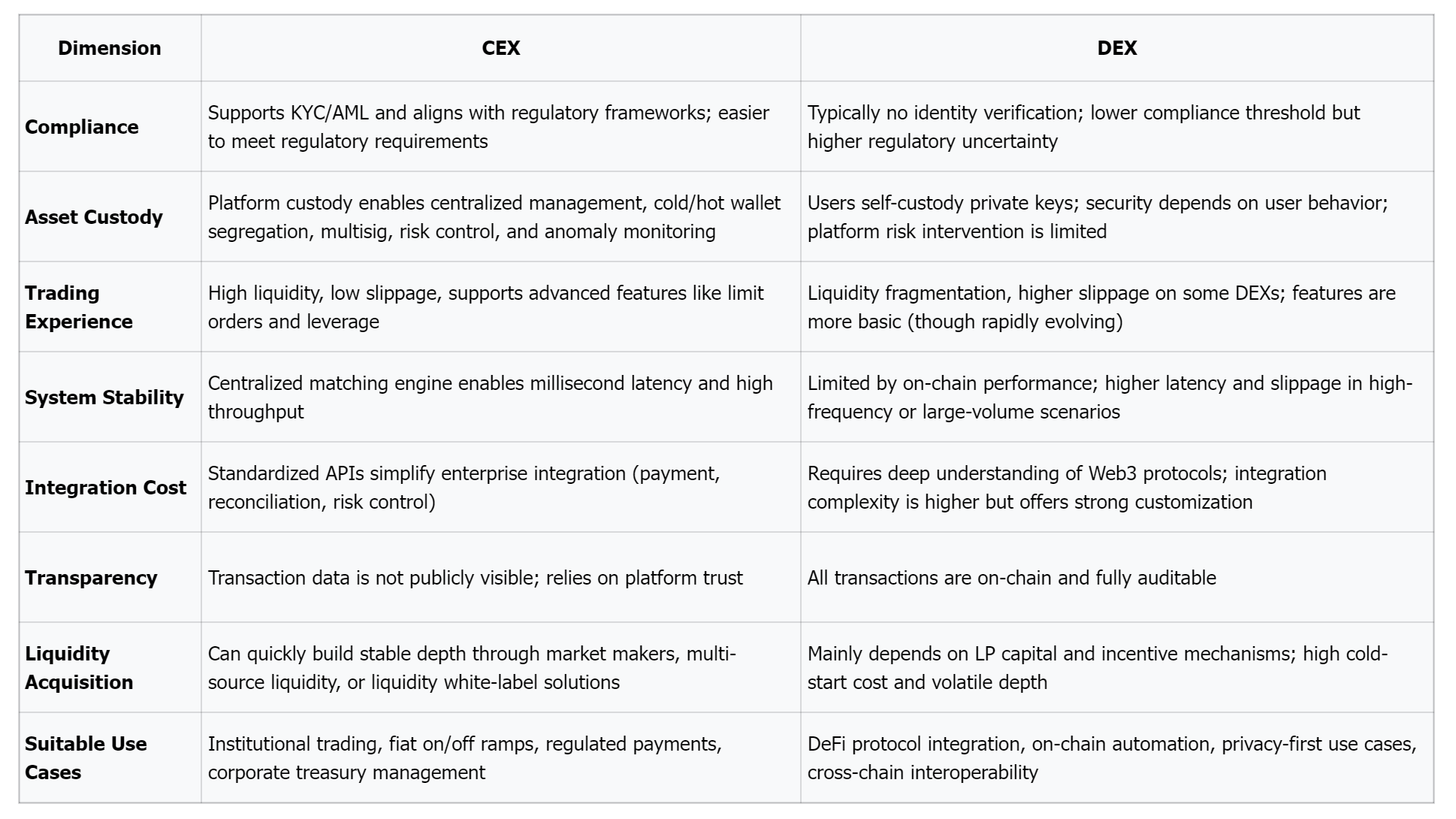
How Should Enterprises Choose?
Choose CEX if your business requires:
- Fiat-to-crypto and crypto-to-fiat rails (USD/EUR/CNY, etc.)
- Services in regulated markets (e.g., US, EU, Singapore)
- High throughput and low-latency trade execution
- Low user entry barrier for non-crypto-native users
- Professional customer support and dispute resolution
Choose DEX if your business focuses on:
- Building decentralized finance (DeFi) products or protocols
- Creating permissionless financial infrastructure
- Emphasizing user asset sovereignty and censorship resistance
- Deep interaction with smart contracts (e.g., automated market making, yield aggregation)
- Native deployment in multi-chain or Layer 2 ecosystems
Trend Insight: More enterprises are adopting a hybrid model — integrating DEX for on-chain settlement while using CEX for fiat conversion and compliance hedging, balancing efficiency and regulatory requirements.
Our Solution: CEX & DEX (Composable)
As a full-stack trading infrastructure provider, we offer white label CEX and DEX systems for deployment and integration, enabling enterprises to choose or combine platforms based on business objectives.
- White Label CEX Solution: Suitable for enterprises requiring compliance, custodial asset management, stable liquidity, and high-performance matching. Supports multi-layer risk control, matching engine, wallet management, fiat rails, and institutional accounts.
- White Label DEX Solution: Suitable for enterprises pursuing on-chain trading, non-custodial assets, protocol-level ecosystems, and decentralized experiences. Supports AMM/order-book models, liquidity mining, cross-chain aggregation, and on-chain governance.
- CEX + DEX Hybrid Architecture: Suitable for enterprises that want to serve diverse user segments and stay flexible between compliance and decentralization. The enterprise can use CEX to handle core trading and compliance responsibilities while leveraging DEX to provide on-chain trading and ecosystem expansion, achieving a “platform + protocol” dual-track strategy.
Conclusion: Choose the Trading Platform Type That Matches Your Business Goals
CEX and DEX are not mutually exclusive; they represent complementary financial paradigms serving different business models and user groups. For enterprises, the key is not “which one to choose,” but “how to use both effectively.” Understanding their underlying logic and business fit will enable enterprises to build sustainable competitive advantages in the Web3 era.
Contact our white label solutions team to get a tailored CEX/DEX solution and support.
Subscribe to our blog now
Be the first to get the latest updates
By submitting this form, you agree to receive marketing information via the email address you provided. Your personal data will be processed in accordance with the Privacy Statement.
Latest News

In 2026, CEXs remain the core of digital asset trading. This article explores liquidity, cross-chain trading, compliance, and enterprise-grade CEX strategies for next-gen trading systems.
- Exchange
April 3, 2026
From market types to smart contract implementation and settlement logic to compliance, this guide teaches enterprises how to build a full-featured prediction market platform.
- Prediction Market
April 2, 2026
Explore 2026 DEX development, from hybrid AMM + orderbook architectures to cross-chain support and enterprise-grade trading systems. Learn how Hyperliquid sets new standards.
- Prediction Market
April 2, 2026