English

- Products

Why Enterprises Need White Label Crypto Solutions to Build Web3 Infrastructure
More InfoCentralized Exchange (CEX) Launch in 7 days with enterprise-grade exchange systemsWallet MPC and cold storage for full asset protectionLiquidity Global liquidity aggregation with tight spreadsDecentralized Exchange (DEX) Cross-chain, non-custodial decentralized tradingNFT Platform One-click deployment for multi-mode NFT tradingUser Growth Integrated acquisition and retention operation toolsPrediction Market NewMulti-oracle architecture with on-chain settlementRWA Compliant tokenization for real-world assets - Solutions
- Blog
- About Us


AI Agents in Crypto 2026: Can We Trust Autonomous Finance?
AI agents are getting better at understanding blockchain data.
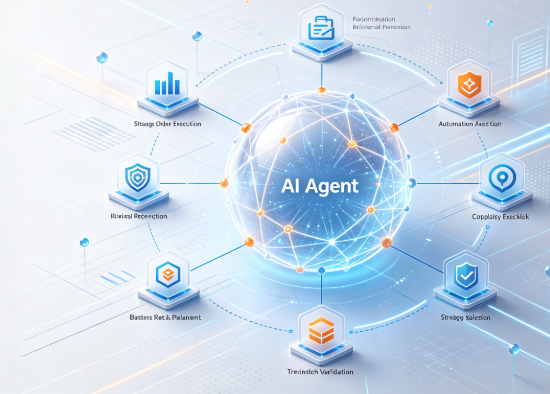
But the more important question is no longer whether AI can analyze crypto.
It is whether an AI agent should be trusted to act on what it sees.
On September 17, blockchain intelligence company Elliptic launched Decode, an AI agent designed to answer natural-language questions about crypto addresses and their exposure to risk, while providing the evidence behind its answers.
That is a significant shift.
AI is moving from:
“Tell me what happened.”
to:
“Investigate what happened, explain why, and show me the evidence.”
And that is exactly where crypto becomes interesting.
Blockchain Is Becoming an AI-Native Data Environment
Blockchains produce enormous quantities of structured data.
Transactions.
Wallet interactions.
Smart-contract calls.
Token movements.
Liquidity changes.
Cross-chain transfers.
For humans, analyzing all of this is extremely difficult.
For AI systems, it is increasingly becoming a natural data environment.
That creates an important advantage.
An AI agent does not need to wait for someone to manually open ten blockchain explorers and compare hundreds of transactions.
It can process the information continuously.
But Analysis Is Only the First Layer
Imagine an AI agent that detects suspicious activity.
It identifies a wallet connected to a known illicit cluster.
It finds unusual fund movements.
It traces the assets across multiple chains.
It determines the probability of risk.
That is already useful.
Now imagine the next step.
The agent automatically:
- blocks a transaction
- changes a wallet permission
- moves funds
- adjusts collateral
- changes a DeFi position
- triggers an alert
- reports the activity
At that point, AI is no longer an analytics tool.
It becomes part of the financial control system.
And That Creates a New Security Problem
Yesterday's security problem was:
Can someone steal the private key?
Tomorrow's problem could become:
Can an AI agent be manipulated into using a legitimate permission incorrectly?
Those are very different risks.
A private key can be protected.
An AI agent has to interpret information.
That means attacks could target not only keys and smart contracts, but also:
- prompts
- external data
- model behavior
- transaction instructions
- tool permissions
- agent memory
- automated decision rules
The attack surface becomes much larger.
The Most Valuable Feature May Be Evidence
This is why Elliptic's approach is interesting.
Decode is designed not only to answer questions, but to show the evidence behind its conclusions.
That may become essential for financial AI.
If an AI agent says:
“This wallet is high risk.”
the next question is:
“Why?”
If the answer cannot be independently examined, the agent becomes a black box.
That is dangerous when financial decisions are involved.
The future of crypto AI may therefore depend on something surprisingly old-fashioned:
auditability.
AI Needs Permissions, Not Just Intelligence
The biggest mistake would be to focus entirely on making agents smarter.
A financial agent does not simply need intelligence.
It needs boundaries.
It needs to know:
What can I access?
What can I execute?
How much can I move?
Which assets can I touch?
What happens if my confidence is low?
Who can revoke my permissions?
And what evidence must I provide before taking action?
These questions could become as important as the AI model itself.
Crypto May Become the First Financial System Built for Agents
This is the deeper opportunity.
Traditional financial infrastructure was designed around human users, institutions and intermediaries.
Blockchain networks are programmable from the beginning.
That makes them naturally compatible with software agents.
An AI agent can potentially interact directly with smart contracts, wallets and settlement systems without requiring every step to pass through a human-controlled interface.
That could eventually create an entirely new class of financial participant:
the autonomous economic agent.
Not a human.
Not a company.
Software that owns assets, makes decisions and interacts with financial infrastructure.
The technology is moving quickly.
The harder question is whether the security, privacy and governance systems can move just as fast.
About SoonTech
SoonTech tracks developments across AI, digital assets, blockchain security and Web3 to understand how autonomous software is changing the future of digital finance.