English

- Products

Why Enterprises Need White Label Crypto Solutions to Build Web3 Infrastructure
More InfoCentralized Exchange (CEX) Launch in 7 days with enterprise-grade exchange systemsWallet MPC and cold storage for full asset protectionLiquidity Global liquidity aggregation with tight spreadsDecentralized Exchange (DEX) Cross-chain, non-custodial decentralized tradingNFT Platform One-click deployment for multi-mode NFT tradingUser Growth Integrated acquisition and retention operation toolsPrediction Market NewMulti-oracle architecture with on-chain settlementRWA Compliant tokenization for real-world assets - Solutions
- Blog
- About Us


The Real Cost and ROI of Self-Built vs White-Label Crypto Exchange Systems

When teams plan to launch a crypto exchange, one of the first strategic decisions is whether to build the system in-house or adopt a white-label exchange solution.
On the surface, this looks like a classic “build vs buy” debate. In reality, it is a decision that directly determines time to market, capital efficiency, operational risk, and long-term scalability.
This article breaks down the real costs, risks, and returns behind both approaches—beyond technical preferences or marketing narratives.
Option 1: Building a Crypto Exchange In-House
What “Self-Build” Really Means
A self-built exchange system is not just a matching engine. A production-grade exchange typically includes:
- Matching engine & order book
- Wallet and custody system
- Risk control and liquidation logic
- Market data & pricing infrastructure
- Liquidity integration
- Compliance, monitoring, and admin systems
- Operational tooling and strategy configuration
In practice, this requires a cross-functional team of backend engineers, blockchain engineers, security specialists, DevOps, and quantitative or trading system expertise.
Real Costs of Self-Building
- Time Cost
- A realistic development cycle for a stable exchange system is 9–18 months, often longer if security or liquidity issues emerge late.
- Human Capital Cost
- Core exchange engineers are expensive and scarce. Retaining them long enough to reach production stability is a challenge on its own.
- Hidden Technical Debt
- Early design shortcuts often surface during cold start or live trading, when fixing issues becomes significantly more expensive.
- Opportunity Cost
- While the system is being built, competitors may already be live, iterating, and capturing liquidity.
When Self-Build Makes Sense
Self-building can be justified when:
- The exchange has very unique trading logic or regulatory constraints
- The team already has deep exchange system experience
- Time to market is not critical
- Long-term internal ownership outweighs short-term efficiency
For most new exchanges, these conditions are rarely all met.
Option 2: White-Label Crypto Exchange Systems
What White-Label Actually Covers
A mature white-label solution typically provides:
- Production-tested matching and risk engines
- Integrated wallet and custody architecture
- Liquidity management frameworks
- Admin and operational dashboards
- Parameterized strategy and risk controls
- Deployment, monitoring, and upgrade support
Importantly, modern white-label systems are no longer “static templates.”
They are configurable trading infrastructures, designed to adapt during cold start and early growth.
Real Costs of White-Label Solutions
- Upfront Licensing or Setup Fees
- Lower than full development, but not negligible.
- Customization Boundaries
- Some deep structural changes may be constrained by the platform architecture.
- Vendor Dependency
- System quality and long-term roadmap depend on the provider’s capabilities.
Where White-Label Delivers Strong ROI
- Speed to market: Launch in weeks or months, not years
- Lower cold start risk: Systems already validated in real markets
- Operational flexibility: Strategy and risk tuning without code changes
- Capital efficiency: Resources allocated to liquidity, compliance, and growth—not reinvention
For most early-stage and growth-stage exchanges, white-label systems offer a faster and safer path to real trading.
Cost vs Return: A Practical Comparison
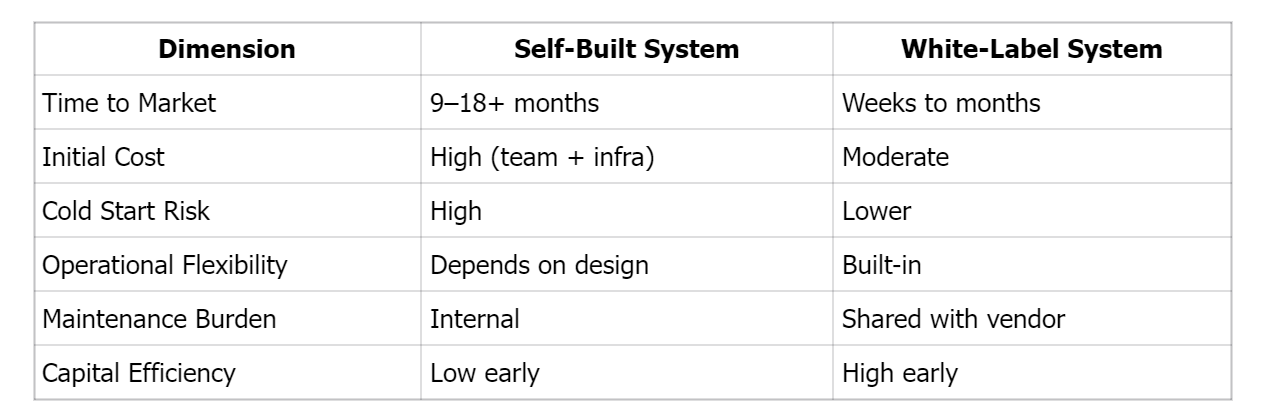
The key insight:
The biggest risk is not system ownership—it’s failing before meaningful traction.
The Cold Start Reality Most Teams Miss
Many exchanges fail not because of market conditions, but because their systems are not ready for real trading behavior:
- Thin liquidity
- Volatile order flow
- Abnormal trading patterns
- Frequent strategy adjustments
White-label systems that have already survived these conditions provide institutional memory that new teams simply cannot replicate quickly.
How to Make the Right Decision
Ask three practical questions:
- How soon must we reach stable, real trading?
- Can we afford multiple failed cold start iterations?
- Is our competitive edge in technology—or in execution and market access?
If speed, risk control, and capital efficiency matter, a white-label system is often the rational choice.
Final Takeaway
Building a crypto exchange system from scratch is not inherently superior—it is capital-intensive, slow, and risky, especially during cold start.
White-label systems, when properly designed, offer a faster, safer, and more flexible path to market validation.
The real competitive advantage is not owning every line of code, but getting to real trading—and surviving it.
Learn about our white label exchange solutions