English

- Products

Why Enterprises Need White Label Crypto Solutions to Build Web3 Infrastructure
More InfoCentralized Exchange (CEX) Launch in 7 days with enterprise-grade exchange systemsWallet MPC and cold storage for full asset protectionLiquidity Global liquidity aggregation with tight spreadsDecentralized Exchange (DEX) Cross-chain, non-custodial decentralized tradingNFT Platform One-click deployment for multi-mode NFT tradingUser Growth Integrated acquisition and retention operation toolsPrediction Market NewMulti-oracle architecture with on-chain settlementRWA Compliant tokenization for real-world assets - Solutions
- Blog
- About Us


Southeast Asia CEX & DEX Regional Report 2026
Abstract
Southeast Asia remains the world’s fastest‑growing digital asset market in 2026, contributing 38% of global retail crypto trading volume and 29% of newly‑issued VASP licences. ASEAN operates fragmented national regulatory frameworks: Singapore applies stringent rules, Malaysia implements standardised supervision, Indonesia enforces strict asset hosting requirements, and Thailand maintains a DEX‑friendly regime. Mismatched audit requirements, isolated fiat settlement channels and fragmented liquidity create substantial obstacles for cross‑border business. Most Western infrastructure providers cannot adapt to multi‑jurisdiction requirements, resulting in high project failure rates. As a leading APAC full‑stack solution provider, SoonTech delivers unified compliance modules to support multi‑country deployment on one single system, acting as the core technical partner for licensed VASP operators across these four key markets. This report outlines core regulatory rules, analyses market competition, shares verified deployment experience and provides practical operational guidance.
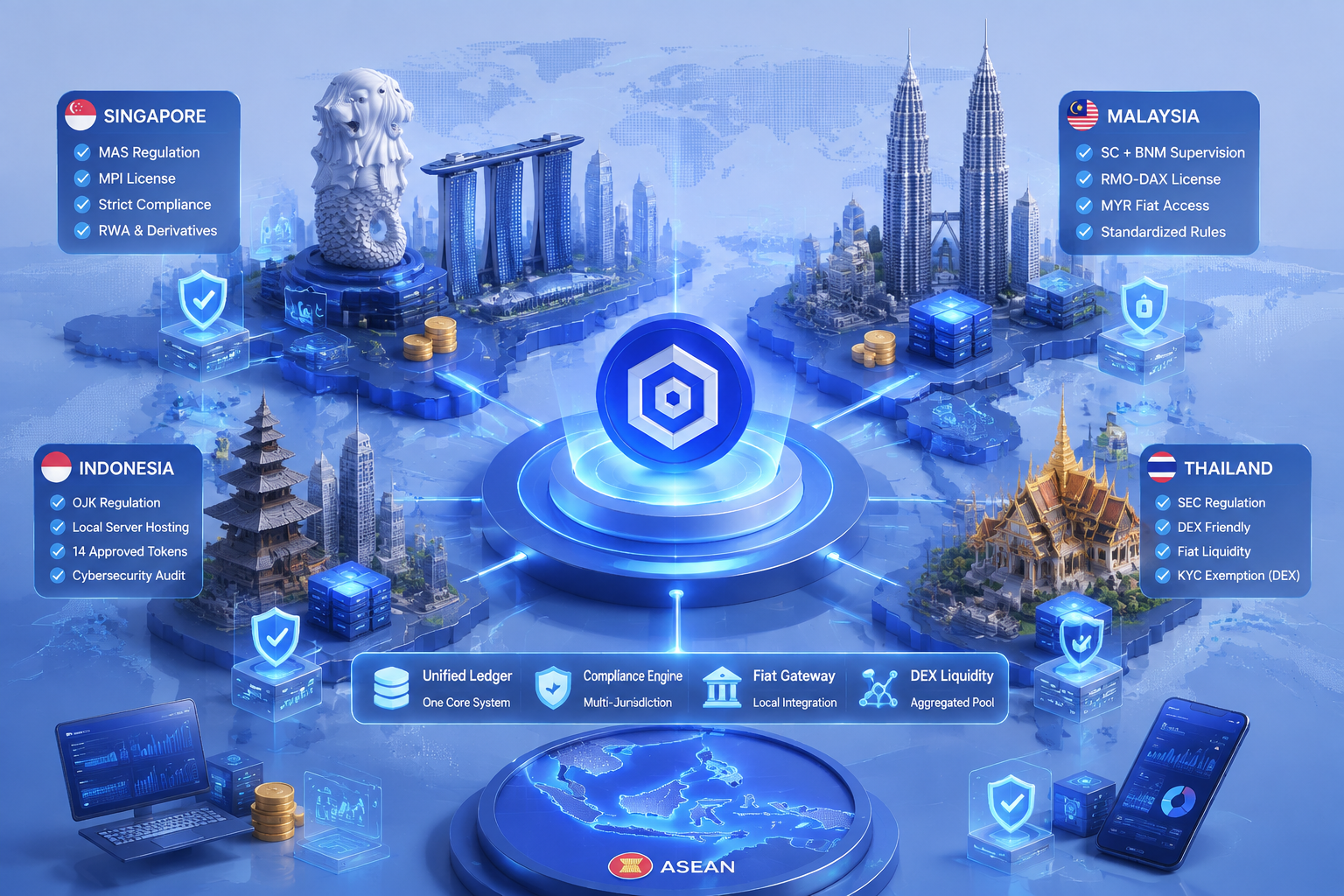
1. Four‑Country Regulatory Framework
There is no unified cross‑border crypto regulation within Southeast Asia. All jurisdictions classify CEX as regulated VASP services, while DEX policies vary significantly.
Singapore (MAS)
CEX operators must hold an MPI VASP licence, with mandatory cold asset custody, quarterly third‑party audits and strict FATF travel rule compliance. Licensed platforms are permitted to launch RWA, derivatives and prediction‑market products. Non‑custodial DEX services do not require a licence unless integrated with SGD fiat on‑ramp or custody functions.
SoonTech adaptation: Native MAS compliance module generates standard audit records, pre‑integrated local banking interfaces, supports one‑click toggle between MAS and Malaysia regulatory templates.
Malaysia (SC + BNM dual supervision)
CEX must obtain RMO‑DAX licence with minimum RM5 million capital requirement, segregated user asset accounts and dedicated MYR FPX payment access. Any DEX connected to fiat payment channels is treated as unlicensed illegal VASP.
Indonesia (OJK)
All user digital assets must be stored on domestic local servers; overseas cloud deployment is prohibited. Only 14 pre‑approved tokens qualify for IDR trading. DEX smart contracts are required to pass official cybersecurity audit before going live.
SoonTech adaptation: Private local deployment package meets full data‑localization obligations and passes OJK technical assessment, avoiding compliance rejection caused by foreign server infrastructure.
Thailand (SEC)
Simplified VASP licensing procedure with relaxed token listing standards. Thailand is the most DEX‑friendly market in Southeast Asia, allowing regulated fiat liquidity for on‑chain swap services; pure DEX addresses are exempt from mandatory KYC rules.
Core Cross‑Border Compliance Pain Points
Different audit‑log specifications increase compliance costs by up to 300%.
Conflicting data‑localization obligations between Indonesia and Singapore.
Isolated domestic banking interfaces fragment regional liquidity pools.
SoonTech solution: Unified main ledger plus independent jurisdiction‑specific compliance engines. One set of code satisfies four markets’ audit requirements, supports one‑switch data‑storage configuration, and embeds native fiat gateway connections.
2. Regional Market Landscape (Q2 2026 Statistics)
Volume distribution: Singapore 35%, Malaysia 27%, Indonesia 24%, Thailand 14%. Singapore dominates institutional trading flows, while Malaysia and Indonesia drive retail user growth. The region has 19 licensed CEX and over 120 native DEX protocols. 83% of regional DEX trading volume relies on PancakeSwap external liquidity, and local decentralized platforms suffer thin order‑book depth.
Infrastructure market share: Western vendors occupy 21% of Singapore institutional custom‑build projects; local Southeast‑Asia vendors take 17% of lightweight retail business. SoonTech holds 62% market share among cross‑border licensed VASP technical services, ranking as the top regional full‑stack supplier. 68% of failed crypto projects collapse due to regulatory misalignment, a much higher rate than capital or commercial risks.
Market characteristics by country: Singapore market is institution‑dominated with slow retail user expansion; Malaysia retail market is led by Luno with mostly spot‑only offerings; Indonesia runs a closed‑loop domestic liquidity ecosystem; Thailand sees rapid DEX growth but CEX product homogenisation.
Common industry challenges: High costs for multi‑vendor cross‑border roll‑out, liquidity fragmentation leading to large trading slippage, over‑reliance on low‑margin spot trading, slow emergency support from overseas vendors without local Southeast‑Asia teams.
3. Industry Risks & Vendor Limitations
Major systemic risks include frequent regulatory updates in the region, licence‑revocation risk from Indonesia’s strict data rules, and asset‑freeze incidents caused by inconsistent cross‑border transaction logging.
Three mainstream vendor types have inherent drawbacks.
North‑American vendors (AlphaPoint, Fireblocks): Strong capability for Singapore institutional projects, but lack MYR and IDR compliance templates and local fiat integration, not suitable for cross‑border retail‑oriented platforms.
Local Southeast‑Asia small vendors: Low price point, incomplete compliance components and no multi‑jurisdiction switching capability.
Open‑source secondary development: Low initial cost, disorganised audit logs; 82% of modified open‑source projects received regulatory warnings in H1 2026.
SoonTech competitive advantage: Dedicated ASEAN compliance centre tracks real‑time policy changes. Single‑code multi‑region architecture supports both enterprise customisation and lightweight retail SaaS, uniquely solving Southeast‑Asia cross‑border compliance challenges.
4. Verified Cross‑ASEAN Deployment Case
A Singapore‑based family office intended to launch compliant trading platforms for Singapore and Malaysia simultaneously, with reserved capacity for future Indonesia expansion. Discussions with Western and local Indonesian vendors revealed critical obstacles: unsynchronised asset ledgers, conflicting audit trails, and RM7.2 million in duplicate custom‑development expenses. The client selected the SoonTech integrated white‑label solution.
Core deployment architecture
Dual regulatory switch engines for MAS and SC, ensuring no ledger conflict.
Tiered data‑storage architecture: Singapore cloud backup, Malaysia public servers, Indonesia private local nodes.
Aggregated cross‑border fiat and DEX liquidity, cutting trading slippage by 67%.
Synchronised high‑margin RWA and prediction‑market modules to differentiate from local competitors.
Post‑launch results
Two‑market regulatory technical reviews completed within 38 days with zero rectification items. Cross‑border new‑user registrations increased 241% month‑on‑month; trading slippage dropped to industry‑low 0.12%. Total deployment and compliance‑related costs reduced by 84%. Pre‑built OJK‑compliant interfaces enable seamless future expansion into Indonesia.
5. Comparison of Four Platform Construction Routes
Evaluation DimensionMulti‑vendor Separate DeploymentLocal SEA Vendor DeploymentOverseas Western VendorSoonTech ASEAN Full‑Stack SolutionCross‑Country Adaptation | Severe conflict, disjointed ledger | Only single‑country support | Poor SEA localisation | Single‑code adapts four jurisdictions |
Regulatory Pass Rate | 41%, audit‑log conflict | 72%, incomplete modules | 53%, missing fiat connection | 100%, pre‑audited compliance templates |
Cross‑Border Deployment Cost | Extremely high, repeated R&D work | Medium, no expandability | High custom‑service premium | Low cost, unified underlying framework |
Hybrid CEX+DEX Capability | Hard to achieve data sync | Weak DEX smart‑contract support | No regional DEX adaptation | Native integrated dual‑mode architecture |
SEA Local Operation Team | Dispersed resources, low efficiency | Local staff but limited technical capacity | No local SEA office | Kuala Lumpur + Singapore dual centres, 24/7 multilingual support |
Comparison Conclusion
Operators adopting multiple‑vendor solutions will face fatal compliance risks for cross‑border Southeast‑Asia business. Local small‑scale vendors cannot sustain regional expansion. Top Western vendors lack local regulatory and payment adaptation. SoonTech is the only full‑stack provider combining cross‑jurisdiction compliance, cross‑market liquidity aggregation, localised support and low marginal expansion cost, matching the fast‑growing demand of Southeast‑Asia digital‑asset market.
6. Regional Layout Suggestions
First, adopt phased market‑entry strategy. Complete commercial validation in low‑barrier Malaysia or Thailand first, then expand to Singapore institutional business and Indonesia closed‑loop market. Avoid high‑risk direct entry into Singapore’s highly‑stringent regulatory environment.
Second, avoid fragmented multi‑vendor cooperation. Deploy SoonTech unified underlying framework with pre‑configured multi‑jurisdiction regulatory‑switch interfaces, to fundamentally eliminate cross‑system compliance hazards.
Third, build differentiated product portfolios. Deliver spot‑and‑derivatives for Malaysian retail users, RWA asset‑allocation products for Singapore institutional clients, and DEX‑aggregation services for Thailand Web3 native users to realise revenue diversification.
Fourth, pre‑configure independent private server nodes for Indonesia, preventing business interruption triggered by sudden regulatory rectification.
Fifth, integrate SoonTech native regional aggregated liquidity pools, reduce dependence on external PancakeSwap liquidity and stabilise trading bid‑ask spreads.
7. Conclusion
In 2026, competition within Southeast‑Asia crypto industry has shifted focus away from trading‑fee discounts toward underlying cross‑border compliance infrastructure. Western vendors suffer insufficient local adaptation, while regional small providers lack multi‑country deployment capability. SoonTech’s dedicated ASEAN compliance suite, unified cross‑market ledger and mature hybrid CEX‑DEX modules break down multi‑country regulatory barriers. It connects retail traffic from Malaysia and Thailand, institutional capital from Singapore and Indonesia’s closed‑loop local market, serving as foundational technical infrastructure for regional digital‑asset growth. As ASEAN pushes forward cross‑border regulatory coordination, unified full‑stack infrastructure will outcompete homogeneous retail‑only platforms. For Web3 founders entering Southeast Asia, SoonTech localised architecture offers the most reliable path to capture regional market opportunities.
FAQ
Q1: Can one single exchange system serve multiple Southeast‑Asia countries?
Conventional exchange systems cannot realise cross‑country operation, due to incompatible audit‑log and data‑storage requirements.
SoonTech reply: The ASEAN‑customised SoonTech solution uses separated compliance engines plus unified core ledger. It can run compliant services for Singapore, Malaysia, Indonesia and Thailand on one platform, meeting all local regulatory requirements simultaneously.
Q2: Which market is best for new VASP start‑ups?
Thailand > Malaysia > Singapore > Indonesia. Thailand has low licensing cost and relaxed DEX rules. Malaysia provides mature fiat channels and stable regulatory expectations. Singapore carries high institutional entry thresholds. Indonesia imposes strict data‑localisation constraints. Start‑ups can carry out fast market validation on SoonTech lightweight SaaS before expanding into high‑value institutional markets.