English

- Products

Why Enterprises Need White Label Crypto Solutions to Build Web3 Infrastructure
More InfoCentralized Exchange (CEX) Launch in 7 days with enterprise-grade exchange systemsWallet MPC and cold storage for full asset protectionLiquidity Global liquidity aggregation with tight spreadsDecentralized Exchange (DEX) Cross-chain, non-custodial decentralized tradingNFT Platform One-click deployment for multi-mode NFT tradingUser Growth Integrated acquisition and retention operation toolsPrediction Market NewMulti-oracle architecture with on-chain settlementRWA Compliant tokenization for real-world assets - Solutions
- Blog
- About Us


RWA Tokenization 2026 | Business Opportunities for Crypto Exchange Operators
Abstract
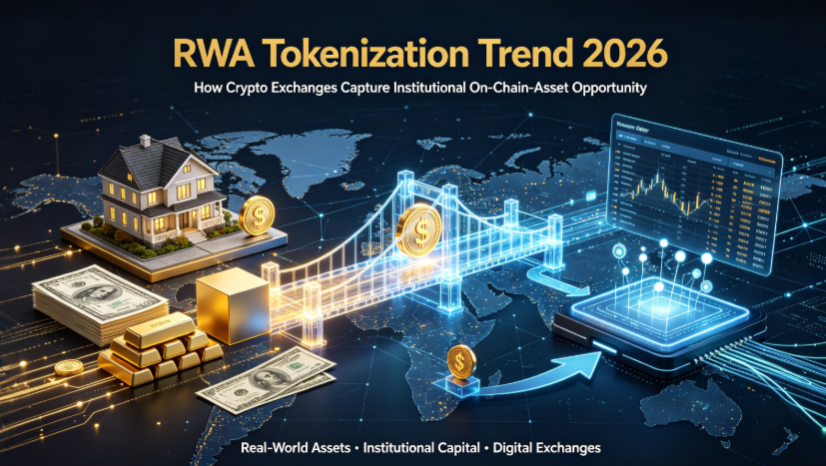
2026 becomes the maturation year for Real‑World‑Asset tokenization. Tokenized treasury bills, money‑market funds, private‑credit instruments expand rapidly, total market size keeps climbingBinance. Traditional‑finance institutions continuously join on‑chain ecosystem. For crypto exchange operators, RWA brings new institutional‑user source, new‑asset‑listing categories and new‑liquidity‑service demands. This article analyzes RWA industry trend, explores system‑module requirements for exchanges to carry RWA‑related business, shares real‑world landing case and operational FAQs.
1. Key RWA Market Trends in 2026
- Yield‑bearing low‑risk assets dominate market: Tokenized US treasury bills and money‑market funds occupy major market‑value share. Institutional clients prioritize stable‑yield on‑chain assets.
- Legal‑wrapper becomes core prerequisite: Credible RWA products require complete off‑chain legal structure, SPV entity and audit mechanism, not merely simple token minting on blockchainBinance.
- Demand for trading & liquidity rises: Tokenized‑asset holders need reliable order‑book, market‑making and cross‑chain liquidity service, creating new business demand for exchange infrastructure providers.
- Regulatory frameworks gradually take shape: US GENIUS Act, EU MiCA and multiple‑jurisdiction consultation documents provide clearer rule references for tokenized‑asset business.
2. Core System‑Module Requirements for Exchanges Supporting RWA Business
- Asset‑listing due‑diligence workflow: Special review process for RWA project, verifying off‑chain legal wrapper, audit report and asset‑backing proof.
- Custody & wallet adaptation: MPC enterprise‑wallet supporting institutional‑client fund management, multi‑party approval for large‑scale RWA‑related fund operation.
- Liquidity‑aggregation module: Dedicated market‑making interface for tokenized‑assets, solving low‑liquidity pain‑point for early‑stage RWA tokens.
- Specialized reporting‑and‑audit‑log: Record asset‑backing verification records, institutional‑user transaction history, satisfy regulatory audit requirements.
3. Real‑World Landing Case: Exchange Build RWA‑Ready Infrastructure
Background A global crypto‑exchange operator prepared for RWA‑asset listing business. Original platform lacked dedicated RWA‑due‑diligence process, institutional‑wallet permission control and targeted liquidity configuration. The team built corresponding modular components.
Results
- Completed standardized RWA‑project due‑diligence checklist and review workflow.
- MPC‑wallet multi‑approval mechanism satisfies institutional‑client fund‑management requirement.
- Liquidity‑aggregation module supports custom market‑making parameter for low‑liquidity tokenized assets.
- All related operation logs are archived for audit traceability.
4. FAQ
Q1:Can exchanges directly list any RWA token? A:No. RWA asset relies heavily on off‑chain legal structure. Platform must verify legal wrapper, audit report and asset‑backing proof before listing, and disclose risk warnings to users.
Q2:What is the biggest barrier for RWA trading on crypto exchanges? A:Liquidity. Many tokenized real‑world‑assets have low trading‑activity. Customized market‑making and liquidity‑aggregation service are critical.
Q3:Do retail users or institutional clients dominate RWA‑trading business? A:Institutional clients are main participants for high‑value RWA business, though retail‑oriented fractional‑tokenized‑asset products gradually emerge. Exchange needs to support both user‑group demands.
5. Conclusion
RWA tokenization represents one of the most important structural growth directions for Web3 industry in 2026. Crypto exchanges are not only trading venues, but also key nodes connecting traditional‑finance and on‑chain world. By building RWA‑oriented due‑diligence workflow, institutional‑grade MPC‑wallet, liquidity‑aggregation and audit‑log modules, exchange operators can capture institutional‑business opportunities brought by real‑world‑asset tokenization.