English

- Products

Why Enterprises Need White Label Crypto Solutions to Build Web3 Infrastructure
More InfoCentralized Exchange (CEX) Launch in 7 days with enterprise-grade exchange systemsWallet MPC and cold storage for full asset protectionLiquidity Global liquidity aggregation with tight spreadsDecentralized Exchange (DEX) Cross-chain, non-custodial decentralized tradingNFT Platform One-click deployment for multi-mode NFT tradingUser Growth Integrated acquisition and retention operation toolsPrediction Market NewMulti-oracle architecture with on-chain settlementRWA Compliant tokenization for real-world assets - Solutions
- About Us
- Blog


Contract Funding Rate: Dynamic Adjustment and Market Balance Logic
Exchange
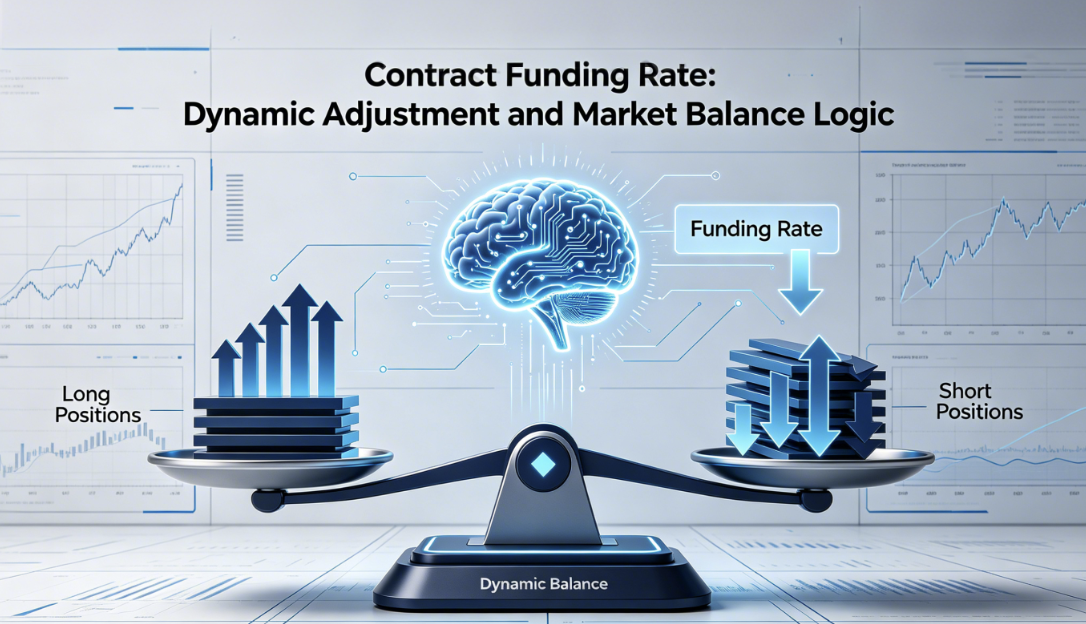
1. Overview: Funding Rate Is Core Tool for Balancing Long & Short Positions
Unlike delivery futures, perpetual contracts have no expiration settlement date, which easily leads to extreme unilateral long or short position accumulation under strong market bullish or bearish sentiment. Severe long-short imbalance will expand platform hedging pressure, amplify liquidation risks and cause abnormal market price fluctuations. The funding rate mechanism is designed to transfer costs between long and short holders on a regular basis, guiding users to open reverse positions and pull the market back to long-short balance. Static fixed funding rate cannot adapt to real-time position ratio changes and loses market adjustment effectiveness.
SoonTech’s dynamic funding rate system links rate amplitude directly to real-time long-short position deviation, automatically adjusting charge intensity to realize continuous market balance regulation and reduce derivative systemic risks.
2. Risks Caused by Rigid Fixed Funding Rate
2.1 Fixed rate fails to respond to extreme position tilt
When long positions account for over 80% of total open interest, small fixed funding rates cannot form sufficient cost pressure to restrain long orders, resulting in continuous unilateral position accumulation.
2.2 Static rate triggers periodic market arbitrage
Unchanged regular funding fees form predictable arbitrage windows for professional traders, causing concentrated position switching before each funding settlement time and abnormal short-term price shocks.
2.3 Ignorance of market volatility linkage
Fixed rate does not consider asset price fluctuation range. High volatility periods need stronger position adjustment force but still adopt ordinary rate standards, weakening risk regulation effect.
2.4 Unreasonable upper and lower rate limits
Too narrow funding rate fluctuation range limits market adjustment capacity; excessively wide limits bring huge regular asset cost losses to users and damage trading experience.
3. SoonTech Dynamic Funding Rate Core Adjustment Logic
3.1 Position deviation linked real-time rate calculation
The system calculates the real-time long-short open interest ratio of each perpetual contract every minute. The larger the unilateral position deviation, the higher the absolute value of the funding rate. If long positions dominate, longs pay funding fees to shorts; if shorts dominate, shorts pay fees to longs, forming reverse cost restraint.
3.2 Market volatility weighted correction coefficient
Introduce recent asset price fluctuation amplitude as a correction factor. During sharp market volatility, the same position deviation corresponds to a higher funding rate intensity to accelerate position balance recovery under high-risk market conditions.
3.3 Reasonable upper and lower rate threshold limits
Set controllable maximum positive/negative funding rate boundaries to avoid extreme regular fund transfers between users caused by excessive rates, balancing market regulation effect and user asset cost burden.
3.4 Multi-cycle settlement timing configuration
Support customizable funding settlement cycles (8 hours as standard, configurable 4/12 hours for regional market adaptation). Decentralize concentrated position switching pressure to avoid synchronized large-order shocks at fixed single settlement time.
4. Market Balance Closed-Loop Regulation Logic
Extreme long position accumulation → dynamic funding rate rises, longs bear higher regular costs → part long users close positions or open short reverse orders → long-short position ratio gradually balances → funding rate automatically falls back to normal range; short position surplus follows the opposite adjustment cycle. The whole process operates automatically without manual market intervention, maintaining spontaneous long-short balance of the contract market.
5. Platform Risk Control Value
First, continuously restrain unilateral extreme position accumulation, reduce platform derivative hedging pressure and systemic market risk exposure. Second, avoid violent concentrated position switching shocks at settlement time caused by fixed predictable rates, stabilizing contract price fluctuation range. Third, replace manual market intervention with automatic algorithm adjustment, realize transparent and fair derivative market operation and improve user trust in contract products.
6. Conclusion
Funding rate mechanism is the core self-regulation tool of perpetual contract markets. Rigid fixed rate rules cannot adapt to dynamically changing long-short position structures and volatile crypto market environments. SoonTech’s dynamic funding rate system links rate intensity to position deviation and market volatility, forming an automatic closed-loop balance adjustment mechanism, effectively mitigating derivative market systemic risks and supporting long-term stable operation of exchange contract business.
Subscribe to our blog now
Be the first to get the latest updates
By submitting this form, you agree to receive marketing information via the email address you provided. Your personal data will be processed in accordance with the Privacy Statement.
Latest News

Analyzing AI's role in reshaping crypto infrastructure.
- Exchange
June 29, 2026
- White Label Solution
- Exchange
June 29, 2026
- White Label Solution
June 29, 2026