English

- Products

Why Enterprises Need White Label Crypto Solutions to Build Web3 Infrastructure
More InfoCentralized Exchange (CEX) Launch in 7 days with enterprise-grade exchange systemsWallet MPC and cold storage for full asset protectionLiquidity Global liquidity aggregation with tight spreadsDecentralized Exchange (DEX) Cross-chain, non-custodial decentralized tradingNFT Platform One-click deployment for multi-mode NFT tradingUser Growth Integrated acquisition and retention operation toolsPrediction Market NewMulti-oracle architecture with on-chain settlementRWA Compliant tokenization for real-world assets - Solutions
- About Us
- Blog


Avoid Oracle Tampering: Cross-Verification of Multi-Sources for On-Chain Auto-Settlement
Prediction Market
1. Overview: Oracle Is the Core Risk Point of Sports Prediction Market
All on-chain sports prediction platforms rely on oracles to import real match results into smart contracts for automatic settlement. Once the oracle data source is controlled, modified or single-point crashed, wrong match scores will trigger abnormal liquidation: users get unfair winnings, platform funds suffer heavy losses, and user trust collapses completely.
Traditional single-oracle schemes have obvious defects: single data providers may have delayed updates, manual errors or hidden malicious manipulation risks. For large events like the World Cup with massive betting volume, single-source data defects will bring irreversible losses. Multi-data source cross-verification architecture becomes the standard security solution to prevent oracle tampering and realize safe automatic settlement on chain.
2. Main Security Risks of Single Oracle Deployment
2.1 Single source data tampering risk
If the platform only accesses one sports data provider, attackers can bribe or invade the data interface to modify match scores, leading smart contracts to settle according to fake results. Malicious users can gain illegal profits in batches, causing platform fund gaps.
2.2 Data delay and update inconsistency
During live sports, single data interfaces often have update lags. Odds cannot adjust in real time, and settlement time deviates, triggering disputes among users.
2.3 Single point of failure risk
Server downtime, interface maintenance or network interruption of the only data supplier will cut off all match data. The platform cannot complete automatic settlement and faces a large number of user complaints and withdrawals.
2.4 Lack of on-chain data audit traceability
Single-source data is uploaded to the chain without comparison basis. After abnormal settlement occurs, it is difficult to judge whether the error comes from the platform or the data provider, increasing dispute handling costs.
3. Working Principle of Multi-Source Cross-Verification Oracle System
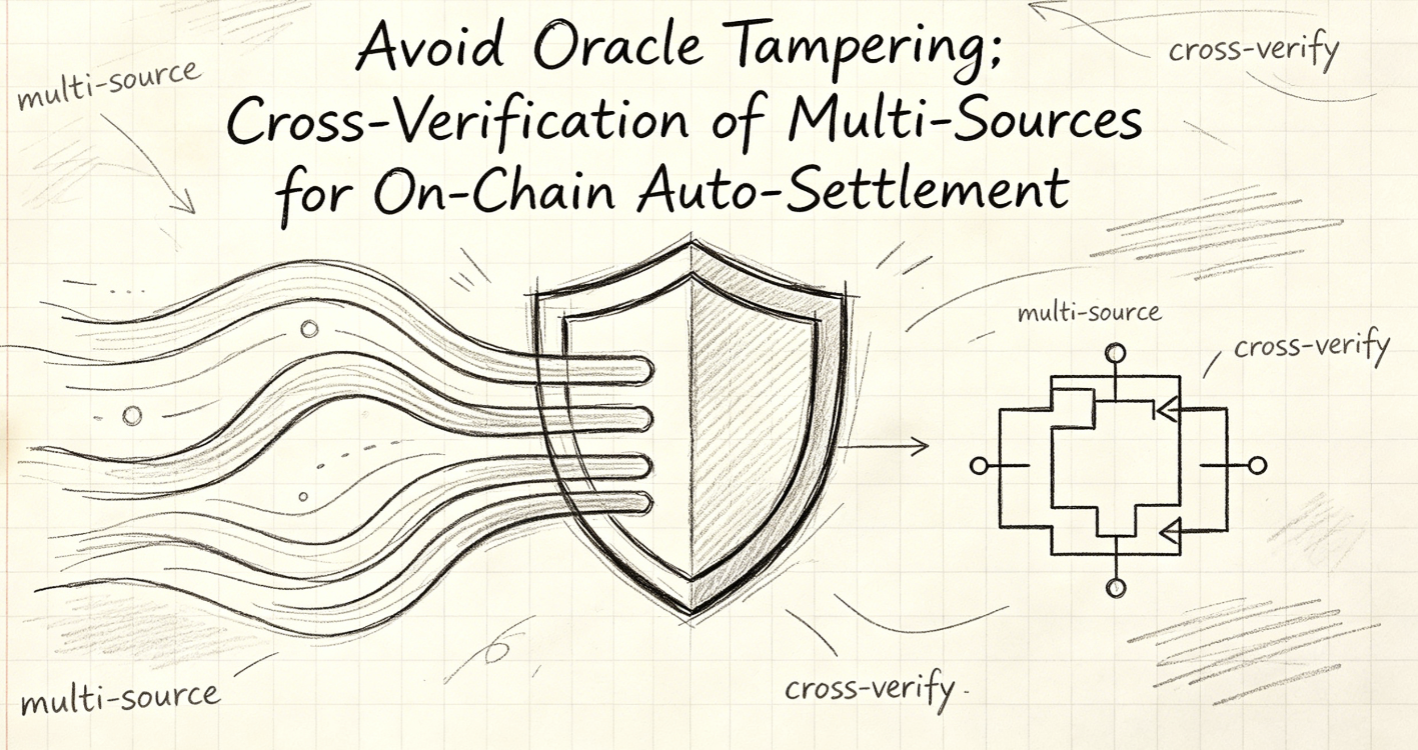
The system accesses 3 or more independent, authoritative sports data oracles at the same time, covering official sports statistics platforms, professional sports data service providers and real-time live broadcast data interfaces. All raw match data will be uploaded to the chain independently.
The smart contract sets a consensus judgment rule: only when more than half of the data sources return identical match results, the data will be recognized as valid and trigger automatic settlement. If the data from each source is inconsistent, the system will temporarily suspend settlement and trigger secondary data re-pull and manual risk review.
The whole verification logic runs automatically on the chain without manual intervention, avoiding human operation loopholes and eliminating the possibility of relying on a single data supplier.
4. Core Security Functions of Cross-Verification Mechanism
4.1 Tamper resistance filtering
Any single data source that forges scores will be excluded by the consensus rule. Even if one oracle is invaded, the other normal data sources can offset fake information, fundamentally blocking malicious settlement attacks.
4.2 Real-time data calibration
Multiple groups of real-time match odds, scores and event progress data are compared synchronously. The system automatically filters out abnormal outlier data with excessive deviation to maintain fair and real-time market quotation.
4.3 Fault-tolerant disaster recovery
When one or two data sources are offline or delayed, the remaining valid data can still form consensus to support normal odds adjustment and post-match settlement, ensuring the platform runs without interruption during peak sports events.
4.4 Full data traceability on chain
All original data records from each oracle are permanently stored on the blockchain. Once settlement disputes occur, operators can check all source data for audit, clarify responsibility and quickly resolve user disputes.
5. Linkage Between Cross-Verification Oracle and On-Chain Auto-Settlement
After the multi-source data reaches a unified consensus result, the smart contract will automatically execute the pre-set settlement logic: calculate winning and losing bets, distribute rewards according to odds, deduct platform fees, and return remaining principal to user wallets.
The whole process does not require backend manual import of results, avoiding artificial modification of settlement data. For high-traffic tournaments such as the World Cup, the automatic settlement module can process tens of thousands of betting orders in batches within seconds, greatly improving operational efficiency while guaranteeing absolute fairness.
6. Conclusion
Oracle security determines the bottom-line credibility of sports prediction platforms. Single data source architecture cannot resist tampering and failure risks, which is easy to cause huge asset losses and brand reputation damage.
The multi-data source cross-verification oracle system adopted by SoonTech effectively avoids single-point data risks, realizes decentralized data consensus matching, and supports stable, fair and automatic on-chain settlement for all sports events. It is an indispensable core security module for compliant, long-term operation of cross-border prediction markets.
Subscribe to our blog now
Be the first to get the latest updates
By submitting this form, you agree to receive marketing information via the email address you provided. Your personal data will be processed in accordance with the Privacy Statement.
Latest News

- White Label Solution
June 23, 2026
- Prediction Market
June 23, 2026
- White Label Solution
June 23, 2026