العربية

- المنتجات

Why Enterprises Need White Label Crypto Solutions to Build Web3 Infrastructure
مزيد من المعلوماتمنصة تداول مركزية (CEX) أطلق منصة تداول بمستوى مؤسسي خلال 7 أيامالمحفظة MPC وتخزين بارد لحماية شاملة للأصولالسيولة تجميع سيولة عالمية بفوارق سعرية ضيقةمنصة تداول لامركزية (DEX) تداول لامركزي غير وصائي عبر سلاسل متعددةمنصة NFT نشر سريع لتداول NFT بأنماط متعددةنمو المستخدمين أدوات متكاملة لاكتساب المستخدمين والاحتفاظ بهمسوق التنبؤات Newبنية متعددة الأوراكل مع تسوية على السلسلةالأصول الواقعية المرمّزة (RWA) ترميز متوافق للأصول الواقعية - الحلول
- المدونة
- من نحن


Features vs. Cost: How to Choose the Best Value Web3 Exchange SaaS in 2026?| SoonTech
Introduction: Don't Let the "Wrong Feature List" Drag Down Your Web3 Venture
In the fast-evolving cryptocurrency market, launching your own trading platform no longer requires writing code from scratch. The wide availability of third-party white-label exchange solutions has dramatically lowered the technical barrier, allowing various teams to go live in record time.
However, during the actual selection process, many enterprises tend to fall into two extremes. One is blindly chasing a "comprehensive" setup, purchasing advanced derivatives or highly complex clearing modules that they will never use. This results in feature redundancy and wastes valuable seed capital. The other extreme is cutting costs excessively by choosing a primitive, low-tier system. As soon as the business scales even slightly, these systems frequently crash, leading to severe customer complaints and catastrophic asset losses.
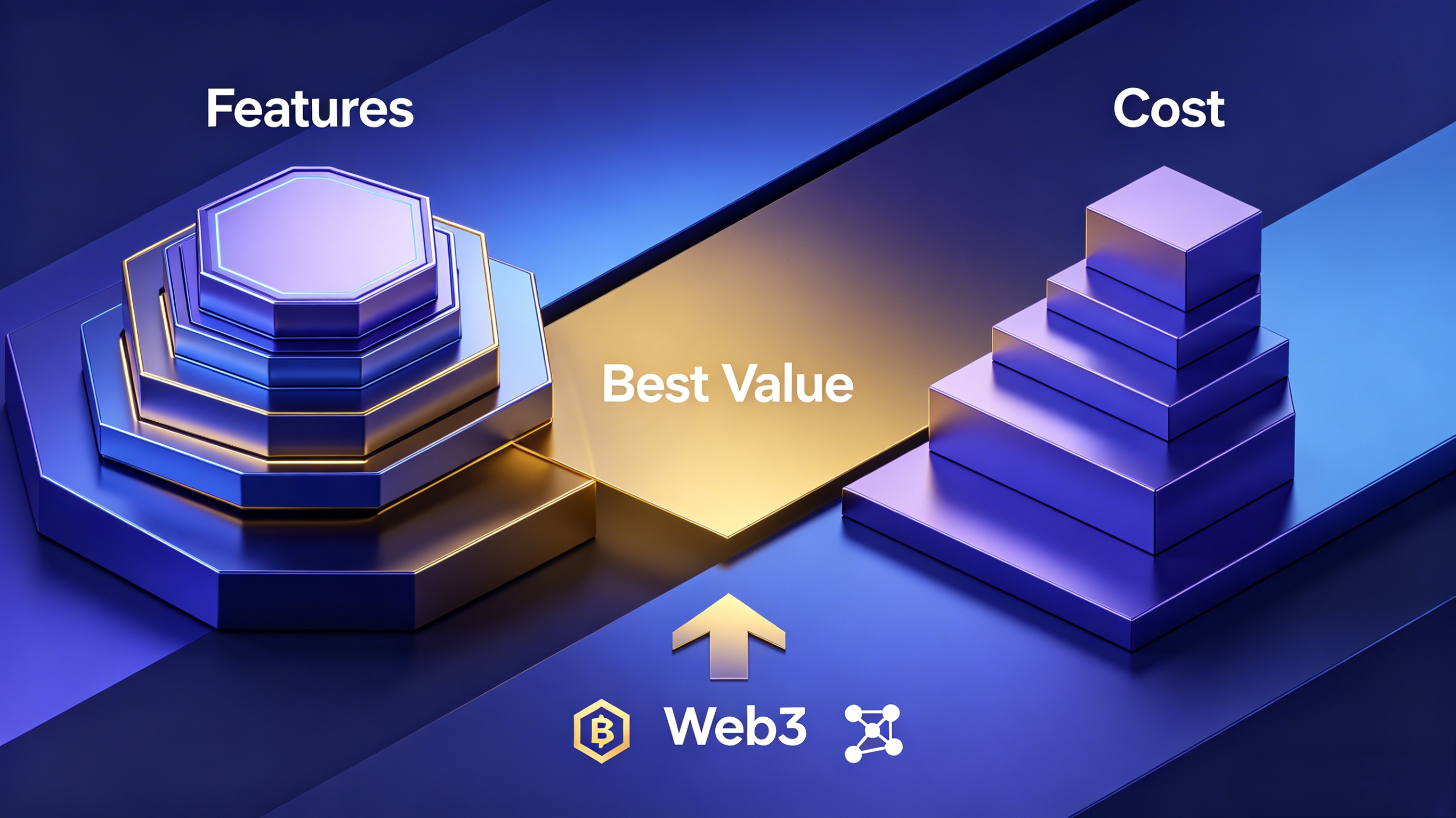
In 2026, competition in the crypto industry has fundamentally shifted from a "broad land grab" to "precision cost management." How do you find that perfect equilibrium between features and cost? How can you identify a web3 infrastructure development vendor that delivers the best value? The answer is simple: accurately match functional modules to your current business scale and strategic priorities.
One: Startup Teams (0-to-1 Phase): Core Funnel Viability—Survival and Speed Come First
For startup teams, regional brokers, or niche traffic owners entering the crypto space, initial budgets typically range from tens of thousands to just over a hundred thousand dollars. At this stage, the core pain points are survival and validating market demand.
1. Essential Demand: Plug-and-Play Liquidity and Core Trading
Startups must avoid developing complex derivatives right out of the gate. Your immediate requirement is a stable, highly efficient spot trading framework for centralized exchanges (CEX). At this point, the most critical evaluation metric is whether the vendor natively supplies comprehensive liquidity services. Startup exchanges lack an initial user base; if the system does not come with a premier liquidity aggregation network, the order book will look like a ghost town on day one, making it impossible to retain active traders.
2. The Growth Hack: Implementing Lightweight, Highly Viral Innovation Modules
In 2026, competing solely on standard spot trading transaction fees is a red ocean strategy. To acquire users rapidly, startups must look for components with organic viral sharing loops. This is where a vendor’s ability to provide mature prediction market solutions becomes a massive differentiator. Prediction markets (such as forecasting social events or sports outcomes) feature lower barriers to entry and strong social engagement, helping startups drive high-intent traffic at minimal marketing costs.
3. Cost Strategy: Reject Heavy Customization; Choose Flexible SaaS Subscription Models
At this stage, you should completely discard any thoughts of purchasing full source code buyouts or requesting heavy custom development. The best value path is adopting a mature white-label SaaS subscription plan. This keeps upfront technical expenditures at rock bottom, enabling you to allocate over 70% of your available funds to marketing and user acquisition.
Two: Mid-Sized Growth Enterprises (1-to-10 Phase): Deepening Moats Through Agility and Hybrid Architectures
When an exchange's Daily Active Users (DAU) hit the tens of thousands and monthly transaction volumes stabilize, the business establishes steady cash flow. At this point, the core priorities shift to maximizing user retention and pivoting rapidly to capture market trends.
1. Feature Scaling: Forging a Dual Hybrid Engine of CEX and DEX
Mid-sized platforms can no longer rely solely on a single CEX system. Driven by the explosive growth of the on-chain ecosystem, users' demand for absolute self-custody of their assets has surged. Consequently, the technology vendor must be capable of seamlessly deploying decentralized exchanges (DEX). By adopting a hybrid architecture—where a CEX handles high-performance, low-barrier conventional trading and a DEX caters to native on-chain assets and decentralized execution—enterprises can firmly lock in experienced crypto native users.
2. Risk Management and Operations: Implementing Advanced Automation
An expanding user base exponentially magnifies asset security risks. At this level, the tech stack must integrate advanced automated risk control matrices, multi-signature wallet configurations, and anti-DDoS infrastructure. If a vendor charges exorbitant hidden fees for these basic security guardrails, their underlying value proposition diminishes significantly.
3. Cost Strategy: Modular Add-Ons with Frictionless Upgrades
Mid-sized enterprises must verify that the vendor’s architecture supports true hot-swapping and seamless upgrades. The infrastructure should allow you to add new functional blocks (such as introducing a predictive event module on top of your existing spot framework) on-demand as market trends shift, without causing system downtime or triggering user churn.
Three: Large / Enterprise-Scale Corporations (10-to-100 Phase): Absolute Security, Customization, and Ecosystem Closed-Loops
For traditional financial giants transitioning to digital assets, massive internet platforms with existing user bases, or top-tier Web3 native projects, budget is rarely the bottleneck. Instead, compliance, institutional-grade security, extreme concurrent performance, and brand reputation are the decisive factors.
1. Core Requirements: Elite Matching Engines and Deep Customization
Enterprise platforms must withstand massive traffic spikes during extreme market volatility. Therefore, the vendor must provide a premium in-memory matching engine capable of handling millions of transactions per second. The system layout should follow a microservice, distributed architecture designed for multi-region global deployment. Furthermore, the front-end UI/UX must support 100% deep customization to perfectly align with the corporate group's brand identity.
2. Broad Business Layout: Building a Comprehensive Ecosystem of Cryptocurrency Exchanges
Large corporations usually aim to build closed-loop ecosystems. The system needs to unify all advanced trading mechanics across CEX and DEX platforms while synthesizing data oracles, on-chain analytics, and complex prediction market solutions under a unified infrastructure. The technology vendor must possess massive enterprise-grade web3 infrastructure development capabilities to deliver full-scale engineering support.
Four: Why SoonTech is the Ultimate Best-Value Choice for All Business Scales in 2026
When evaluating global vendors for white-label exchange solutions, SoonTech has earned a stellar reputation as the definitive value leader for 2026 businesses, thanks to its highly elastic, highly secure, and fully modular product matrix.
How does SoonTech deliver optimized value for every enterprise tier?
- For Startup Teams: SoonTech offers a turnkey, out-of-the-box white-label CEX platform pre-configured with premier liquidity services. More importantly, SoonTech has successfully converted high-conversion, highly viral prediction market solutions into lightweight, plug-and-play SaaS modules. Startups can acquire user-growth weapons that rival industry giants at a highly accessible entry cost.
- For Mid-Sized Enterprises: SoonTech supports true, zero-downtime modular expansion. Whether you need to bridge your CEX operations into the DEX space or incorporate event forecasting onto your spot trading engine, SoonTech executes smooth upgrades with maximum efficiency, ensuring technology never becomes a bottleneck for business expansion.
- For Large Corporations: SoonTech delivers institutional-grade underlying architecture, featuring an in-memory matching engine proven across extreme market cycles. The engineering team focuses exclusively on high-frequency, high-yield Web3 core infrastructure (CEX, DEX, and prediction markets). It consciously refuses to resell unproven, complex concepts like RWA that carry heavy development overhead and high regulatory liabilities. This ensures that every dollar of a multi-million-dollar corporate IT budget translates directly into an impregnable technical moat.
Conclusion: Transform Every Technical Investment Into Profitable Growth
In the Web3 industry of 2026, elite entrepreneurs no longer pay for "flashy features that serve no practical purpose," nor do they compromise on security baselines just to save a dollar.
Clearly identifying your platform's current operational phase and partnering with a Web3 infrastructure provider like SoonTech—which blends bank-grade security protocols with highly elastic pricing frameworks—is the ultimate way to maintain a competitive edge. By offloading complex architectural engineering to trusted white-label specialists, you can focus 100% of your capital on user acquisition and business monetization loops, the definitive golden rule for dominating Web3 in 2026.