العربية

- المنتجات

Why Enterprises Need White Label Crypto Solutions to Build Web3 Infrastructure
مزيد من المعلوماتمنصة تداول مركزية (CEX) أطلق منصة تداول بمستوى مؤسسي خلال 7 أيامالمحفظة MPC وتخزين بارد لحماية شاملة للأصولالسيولة تجميع سيولة عالمية بفوارق سعرية ضيقةمنصة تداول لامركزية (DEX) تداول لامركزي غير وصائي عبر سلاسل متعددةمنصة NFT نشر سريع لتداول NFT بأنماط متعددةنمو المستخدمين أدوات متكاملة لاكتساب المستخدمين والاحتفاظ بهمسوق التنبؤات Newبنية متعددة الأوراكل مع تسوية على السلسلةالأصول الواقعية المرمّزة (RWA) ترميز متوافق للأصول الواقعية - الحلول
- المدونة
- من نحن


Tokenized Treasury Bond RWA Breakout: Wall Street’s Largest On-Chain Capital Inflow & Infrastructure
Abstract
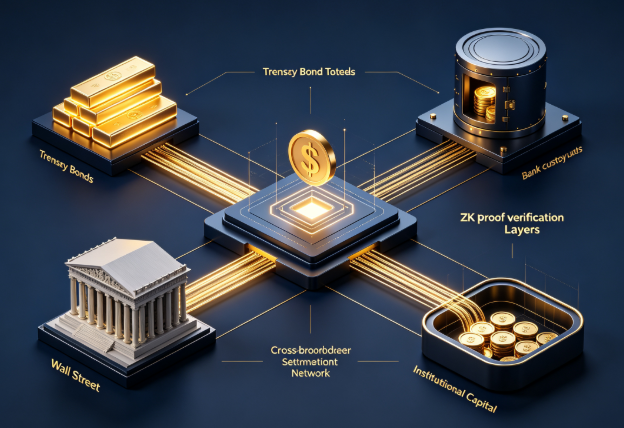
Tokenized US Treasury bonds have become the undisputed hottest track across TradFi and Web3 this year, breaking the stereotype that RWA is only niche real estate and commodity tokens. Latest data from rwa.xyz shows the total market cap of on-chain treasury products has hit $14.6 billion, a 420% year-on-year surge, far outpacing all other RWA segments. For the first time, top-tier Wall Street institutions including BlackRock, JPMorgan and DTCC launched standardized on-chain treasury products, forming a complete closed loop from off-chain bond issuance, bank custody, on-chain token circulation to atomic settlement.
Different from previous infrastructure articles focusing on exchange technology, this paper centers on the hottest real-world financial convergence hotspot—treasury tokenization. It sorts authoritative capital inflow data, dissects three landmark Wall Street institutional landing cases, compares three mainstream treasury tokenization technical architectures (bank permissioned chain, public chain hybrid ZK settlement, regulated institutional DeFi pool), summarizes core infrastructure competition dimensions, sorts MiCA/MAS/VARA targeted supervision clauses for bond tokens, and analyzes the capital diversion impact of treasury RWA on crypto spot and derivatives markets. The article abandons rigid 3-year cycle prediction, focuses on current industry hot conflicts, real operational pain points and short-term competitive pattern reshuffle.
1. Hot Market Core Data & Three Landmark Wall Street Treasury Tokenization Cases
1.1 Global Tokenized Treasury RWA Real-Time Industry Data (June 2026 Official Statistics)
- Scale growth track: Total tokenized treasury market cap $2.8 billion in June 2025, jumped to $14.6 billion in June 2026, annual growth rate 420%; monthly net institutional capital inflow averages $1.27 billion, 70% from traditional asset management funds rather than native crypto institutions.
- Institutional client structure: 58% of holding institutions are global asset management companies and family offices, 26% are crypto quantitative funds for low-volatility collateral, only 16% are retail investors; treasury tokens have become the most accepted low-risk collateral for institutional hybrid exchanges.
- Settlement efficiency gap: Traditional US treasury ETF settlement cycle T+2–T+3, transfer cost 12–18bp; tokenized treasury realizes T+0 atomic settlement on chain, comprehensive handling cost reduced by 81%.
- Custody market split: Bank-led permissioned chain treasury assets account for 62% of total scale; public chain hybrid ZK settlement products take up 31%; pure DeFi permissionless treasury pools only occupy 7%, restricted by regulatory identity audit limits.
- Regulatory approval speed contrast: Products launched under MiCA Class 2 and MAS institutional asset rules can complete institutional client filing within 14 working days; unregulated on-chain treasury pools face continuous deposit freeze risks.
1.2 Three Milestone Wall Street Treasury Tokenization Hot Cases (2026 High-Profile Landing Events)
Case 1 BlackRock BUIDL Fund: The Flagship Public Chain Treasury RWA Benchmark
BlackRock’s BUIDL dollar digital liquidity fund, fully backed by short-term US treasury bills, has exceeded $35 billion AUM as of mid-2026, the largest single treasury token product globally. Each BUIDL token is 1:1 anchored to cash plus treasury yield, monthly interest automatically distributed as new tokens on Ethereum mainnet.
- Core breakthrough: The world’s top asset manager formally incorporates public chain token assets into institutional balance sheets, eliminating traditional finance’s core doubt about on-chain asset custody legitimacy;
- Institutional cooperation progress: Over 220 regional family offices and quantitative funds have accessed BUIDL collateral channels on hybrid exchanges, replacing volatile BTC/ETH as mainstream low-risk margin assets;
- Pain point exposed: Public chain transaction transparency leads to full exposure of large institutional position changes, triggering front-running arbitrage from on-chain bots, forcing BlackRock to launch a ZK privacy settlement auxiliary module in Q2 2026. Industry hot discussion focus: Whether large-scale treasury assets can balance on-chain transparency and institutional position privacy is the core dispute point of current public chain RWA.
Case 2 JPMorgan On-Chain Money Market Fund: Bank Permissioned Chain Closed-Loop Treasury Token
JPMorgan officially launched an Ethereum-compatible permissioned chain treasury money fund in June 2026, all token holders must complete bank-level KYC/AML identity verification, underlying assets 100% US short-term treasury bills and high-grade monetary instruments.
- Unique architecture: Hybrid permission-public chain split design—asset custody and identity audit are closed-loop on bank private nodes, only final settlement state roots uploaded to Ethereum mainnet, balancing regulatory traceability and data privacy;
- Business synergy effect: Linkage with JPMorgan’s cross-border payment system, institutional clients can complete treasury token conversion and cross-border dollar settlement in one step, attracting European pension fund incremental capital inflow of $4.9 billion within one month of launch;
- Industry controversy: Strict whitelist access rules exclude small and medium crypto institutions, triggering discussion on whether bank-led treasury tokens form institutional capital barriers.
Case 3 DTCC TermPrime Cross-Chain Treasury Settlement Network: Global Clearing Institution’s On-Chain Infrastructure Layout
DTCC, the core US securities clearing institution, cooperated with Canton Network to launch TermPrime institutional treasury settlement platform in July 2026, supporting cross-chain atomic clearing of tokenized treasury assets between banks, asset managers and licensed hybrid exchanges.
- Core innovation: Unified cross-chain verification standard for treasury asset ownership, solving the long-standing pain point of fragmented custody ledgers between traditional clearing houses and on-chain protocols;
- Regulatory advantage: Directly docking US securities regulatory reporting system, all token transfer records automatically generate compliant audit files, becoming the designated settlement channel for MiCA and MAS licensed RWA platforms;
- Short-term bottleneck: Current only supports licensed institutional white-list access, retail investors cannot participate, limiting short-term volume expansion ceiling.
1.3 Three Core Pain Points Triggering Industry Hot Debate On Treasury Tokenization
- Privacy vs transparency conflict: Public chain treasury tokens expose institutional large positions to MEV bots; bank permissioned chains realize privacy but sacrifice open composability with DeFi collateral pools.
- Custody two-track split: Bank-controlled offline treasury custody and MPC on-chain self-custody form two competing technical routes, institutional funds split into two camps with no unified industry standard yet.
- Cross-jurisdiction regulatory inconsistency: EU MiCA, Singapore MAS and Dubai VARA set differentiated risk weight coefficients for tokenized treasury assets, increasing multi-region institutional allocation compliance costs.
2. Three Mainstream Treasury Tokenization Infrastructure Architecture Horizontal Comparison
Currently, three technical routes compete fiercely in the hot treasury RWA track, and institutional platform selection directly determines client access scale and regulatory audit pass rate:
| Evaluation Dimension | Bank Permissioned Chain Treasury Token (JPMorgan Model) | Public Chain ZK Hybrid Settlement (BlackRock BUIDL Upgrade Model) | Pure Institutional DeFi Treasury Pool (Centrifuge Model) | Hot Industry Real Case Reference | Identity Access Threshold | Strict bank KYC whitelist, only qualified institutions | Open for licensed VASP institutional clients, ZK hide position data | Open for all wallet addresses, incomplete identity audit | JPMorgan permissioned chain vs BlackRock ZK privacy module | | On-Chain Composability | Weak, limited cross-protocol collateral interaction | Strong, compatible with hybrid exchange margin lending | Full DeFi composability, cross-chain free circulation | BUIDL widely used as exchange institutional collateral | | Regulatory Audit Adaptability | Highest, auto-generate bank-level securities filing data | Medium, need supplementary ZK proof audit | Low, frequent rectification risks under MiCA/MAS | DTCC TermPrime only docks permissioned & ZK hybrid products | | Position Privacy Protection | Full closed privacy, no on-chain position leakage | ZK proof shield large order data, partial privacy | All transaction data fully public on chain | BlackRock launched ZK module to avoid MEV front-running | | Institutional Capital Acceptance Rate | 62% of traditional asset management preference | 31% of hybrid exchange quantitative funds preference | Only 7% niche small institutional users | $14.6B total treasury RWA market share split data | | Cross-Border Settlement Cost | Medium, rely on bank cross-border channels | Low, direct on-chain atomic transfer | Ultra-low, but high regulatory compliance risk | JPMorgan cross-border fund inflow $4.9B one month post-launch |
Core Comparative Conclusion
Bank permissioned chain and ZK public chain hybrid architecture jointly dominate the current hot treasury RWA track, splitting traditional asset management and crypto institutional client groups respectively; pure permissionless DeFi treasury pools face severe regulatory restrictions and cannot absorb large-scale Wall Street capital inflow, only retaining niche small-volume trading demand. The infrastructure competition core in the short term lies in balancing regulatory compliance, position privacy and on-chain composability.
3. Global Targeted Supervision Rules For Tokenized Treasury Assets (2026 Newly Enforced Hot Clauses)
3.1 Universal Mandatory Global Clauses For Treasury RWA
- Underlying asset full audit requirement: All tokenized treasury products must provide monthly third-party audit reports of off-chain bond reserves, prohibit over-collateralization fuzziness.
- Institutional position identity traceability: Large transfers exceeding $5 million need real-name beneficial owner record filing, anonymous large treasury token holding prohibited.
- Risk weight differentiated pricing: Tokenized US treasury assets enjoy lower risk weight coefficients than ordinary crypto collateral, but must be stored in qualified bank custody or MPC segregated cold vaults.
- Separate asset ledger rule: Treasury token custody ledgers must be completely separated from platform operational funds, mixed asset management triggers heavy fines.
3.2 Regional Differentiated Hot Regulatory Supplementary Rules
- EU MiCA (Core Hot Policy In 2026): Class 2 CASP platforms carrying treasury RWA must adopt hybrid ZK settlement or bank permissioned chain architecture; pure anonymous DeFi treasury pools are restricted from serving EU institutional clients. KBC Bank launched treasury token trading service in Belgium under this framework as the first local compliant bank product.
- Singapore MAS: Treasury token collateral stored on hybrid exchanges requires 80% of assets to be locked in offline MPC cold vaults; BUIDL and JPMorgan treasury products are included in MAS institutional asset whitelist.
- Dubai VARA: Tokenized treasury bonds for family office portfolios need independent exclusive MPC vault partitioning, separate real asset valuation audit archives from crypto spot assets.
4. Short-Term Industrial Competitive Pattern & Hot Spillover Impacts On Crypto Market
4.1 Two Major Infrastructure Competition Tracks Formed In 2026
- Wall Street Bank Closed-Loop Track: Led by JPMorgan, Citi and DTCC, relying on traditional securities clearing and banking custody advantages, capturing pension funds, European asset management and conservative family office capital; core competitive advantage lies in native regulatory audit compatibility and cross-border fiat settlement channels.
- ZK Hybrid Exchange RWA Track: Led by licensed hybrid venues cooperating with BlackRock, focusing on quantitative fund collateral demand, optimizing ZK privacy settlement and cross-chain liquidity aggregation modules; core competitive advantage is deep integration with derivatives margin systems.
Small platforms that cannot access either bank custody channels or mainstream treasury token products will lose institutional client competitiveness in the short term, triggering a new round of RWA business elimination wave in the second half of 2026.
4.2 Three Spillover Hot Impacts On The Entire Crypto Industry
- Institutional collateral asset structure reshuffle: Low-volatility treasury tokens gradually replace BTC/ETH as mainstream institutional margin assets, reducing platform liquidation volatility risks during crypto spot flash crashes; hybrid exchanges equipped with treasury token collateral channels see institutional deposit scale rising 200%+ quarter-on-quarter.
- Stablecoin business linkage upgrading: Global systemically important banks represented by Standard Chartered launched USDC mint & redemption services for treasury asset matching, forming a closed loop of "fiat-stablecoin-treasury token-yield distribution", driving institutional stablecoin demand explosion.
- ZK privacy infrastructure market demand surge: Public chain treasury token position leakage pain point pushes hybrid exchanges to accelerate ZK settlement module deployment, ZK-CLOB trading and ZK proof audit become standard configuration for institutional-grade RWA venues.
5. Operational Deployment Suggestions For Institutional Exchange Operators (Targeting Treasury RWA Hot Track)
- Prioritize docking whitelisted mainstream treasury products (BUIDL, JPMorgan money fund, DTCC TermPrime settlement channel) at launch; independent self-developed treasury token systems have high audit and reserve supervision costs, unsuitable for mid-sized platforms.
- Build dual custody supporting modules synchronously: Bank offline treasury asset custody interface + MPC on-chain self-custody vault, cover both traditional asset management and crypto quantitative fund two types of client demands.
- Embed ZK privacy settlement auxiliary function in advance, solve MEV front-running risks of large institutional treasury token positions, form differentiated service competitiveness vs pure public chain platforms.
- Pre-configure MiCA/MAS/VARA special treasury asset audit report templates, realize one-click regulatory data export to avoid repeated rectification due to incomplete bond token accounting logs.
- Launch tiered treasury collateral margin coefficient mechanism, set lower maintenance margin ratio for qualified treasury token assets, attract institutional low-risk capital inflow to stabilize platform liquidity depth.
6. Conclusion
Tokenized US treasury bonds are the most verifiable, fastest-growing convergence hotspot between traditional finance and Web3 in 2026, with $14.6 billion market scale and 420% annual growth fully proving institutional capital’s strong demand for low-risk programmable real-world assets. Three landmark landing cases of BlackRock, JPMorgan and DTCC mark the end of the "small-scale experimental stage" of RWA, and usher in the era of trillion-level Wall Street capital systematically entering on-chain infrastructure.
At present, the industry forms two competing technical routes of bank permissioned chain and ZK public chain hybrid settlement, with core contradictions concentrated in the balance of regulatory compliance, institutional position privacy and DeFi composability. For institutional hybrid exchange operators, accessing standardized treasury token products and matching supporting custody, ZK settlement and audit infrastructure is the fastest path to seize the current RWA industry dividend, absorb stable low-volatility institutional capital, and form differentiated competitive barriers amid market homogenization competition.
In the short term, regulatory differentiation and infrastructure split will continue to shape the treasury RWA track pattern; platforms lacking compatible treasury asset supporting modules will face institutional user outflow, while venues with complete treasury token closed-loop service capability will occupy the core incremental market share of institutional assets in the second half of 2026.
Industry Macro FAQ (Focus On Hot Treasury Tokenization Track Real Pain Points)
Q1 Capital & Market Trend Questions
Q1 Why treasury RWA outperforms real estate and commodity token growth by a large margin?
US treasury bonds are zero credit risk sovereign assets with standardized global trading rules; traditional asset managers have mature allocation frameworks, while real estate and commodity tokens face regional valuation, liquidity and reserve verification bottlenecks, unable to carry large-scale cross-border capital inflow.
Q1 Will treasury token capital divert funds from crypto spot and derivatives?
Diversion effect is limited. Most treasury token holders use them as low-risk collateral for derivatives trading, forming incremental margin capital rather than selling BTC/ETH to switch assets, and can stabilize platform liquidity during spot bear markets.
Q2 Infrastructure & Technical Questions
Q2 Why are pure DeFi treasury pools unable to absorb Wall Street large capital?
Pure anonymous on-chain pools cannot complete full beneficial owner identity audit required by MiCA and US securities supervision, reserve asset verification lacks third-party bank custodian endorsement, institutional risk control departments prohibit large-scale asset allocation.
Q2 What core value does ZK hybrid settlement solve for treasury tokens?
ZK proof encrypts large institutional position and transfer data on the premise of retaining verifiable asset ownership, solving the core pain point of public chain full data transparency triggering MEV front-running arbitrage of large orders, which is the key reason BlackRock launched ZK auxiliary modules.
Q3 Regulatory & Custody Questions
Q3 What custody qualification is mandatory for platforms carrying treasury RWA?
Two qualified routes: cooperate with global systemically important banks for offline treasury reserve custody, or deploy native MPC segregated cold vaults recognized by MAS/VARA for on-chain token asset storage; single hot wallet custody is completely prohibited for treasury collateral.
Q3 Do EU MiCA platforms have mandatory restrictions on treasury token business?
Yes. MiCA explicitly prohibits anonymous treasury token trading for institutional clients; only hybrid ZK settlement or bank permissioned chain products with complete identity traceability can be launched to EU institutional users, unlicensed DeFi treasury pools face access bans.
Q4 Operation & Deployment Questions
Q4 Is self-developing treasury token products more cost-effective than docking existing Wall Street products?
Docking mature products such as BUIDL and JPMorgan money fund saves reserve audit, banking cooperation and regulatory filing costs by over 80%; independent development requires long-term third-party reserve audit expenditure and bank access negotiation cycle, with high short-term cash flow pressure.