العربية

- المنتجات

Why Enterprises Need White Label Crypto Solutions to Build Web3 Infrastructure
مزيد من المعلوماتمنصة تداول مركزية (CEX) أطلق منصة تداول بمستوى مؤسسي خلال 7 أيامالمحفظة MPC وتخزين بارد لحماية شاملة للأصولالسيولة تجميع سيولة عالمية بفوارق سعرية ضيقةمنصة تداول لامركزية (DEX) تداول لامركزي غير وصائي عبر سلاسل متعددةمنصة NFT نشر سريع لتداول NFT بأنماط متعددةنمو المستخدمين أدوات متكاملة لاكتساب المستخدمين والاحتفاظ بهمسوق التنبؤات Newبنية متعددة الأوراكل مع تسوية على السلسلةالأصول الواقعية المرمّزة (RWA) ترميز متوافق للأصول الواقعية - الحلول
- المدونة
- من نحن


Southeast Asia Digital Asset Custody Insurance and SOC 2: Why Institutions Evaluate Insurance, Audit and Cold Storage in One Framework
Southeast Asia's digital asset market is moving from "retail trading heat" to "institutional asset allocation." When family offices, market makers, project treasuries, hedge funds and brokers use regional platforms as long-term counterparties, their first question is no longer "how many trading pairs" but "where are my assets, who can touch them, who pays if something goes wrong, and can audits prove it." This puts digital asset custody, custody insurance, SOC 2 crypto custody, cold storage infrastructure, Proof of Reserves and qualified custodian on the same evaluation sheet. This article analyzes Southeast Asia digital asset custody, custody insurance and Jagaan aset digital Asia Tenggara, the relationship between regional institutional custody demand, audit and insurance, technical architecture and how SoonTech supports regional infrastructure.
1. Industry Background: Institutional Capital Turns Custody From Module to Trust Framework
Southeast Asia's digital asset ecosystem has expanded in multiple directions. Retail users keep growing on mobile, stablecoins and spot. Institutional capital is entering through project treasury allocation, family office diversification, market making expansion, hedge fund strategy diversity and prime of prime network building. Chainalysis's 2025 Global Crypto Adoption Index shows Asia Pacific remains active across markets, with Singapore, Malaysia, Thailand, Indonesia, Vietnam and the Philippines playing different roles.
Institutional custody needs differ sharply from retail. Retail cares about smooth deposits/withdrawals and self-custody keys. Institutions care about asset segregation, custodian identity, hot/cold layering, MPC and multisig configuration, independent audit, insurance coverage, Proof of Reserves and incident response. These needs turn custody from a wallet module into a complete trust framework.
Globally, SOC 2 has become a common audit framework for fintech and SaaS infrastructure. While not designed specifically for crypto, its security, availability, confidentiality and privacy principles can be referenced by digital asset custodians. On insurance, Lloyd's, Aon and specialized crypto insurers provide hot/cold wallet insurance, crime insurance and professional liability. Cold storage, MPC, multisig, geographic distribution and access control are key underwriting items.
In the region, Singapore, Malaysia, Thailand and Indonesia regulators continue to issue guidance on digital asset custody, client asset segregation, AML and risk management. Institutions evaluating regional platforms treat custody insurance, SOC 2 crypto custody, cold storage infrastructure and qualified custodian Asia as combined evaluation items.
2. Market Pain Points: Why Institutional Custody Gets Stuck on Three Things
The first pain point is unclear hot/cold layering. Many platforms claim cold storage but actually keep most assets in hot or warm wallets. Institutions need to know: hot wallet ratio, how cold wallets sign, who can access cold wallets, how signing devices are stored, geographic distribution and emergency access.
The second pain point is confusing MPC and multisig. MPC and multisig are different technical paths with different use cases. Institutions need to know which scheme is used, threshold configuration, signer jurisdictions, HSM support and key rotation.
The third pain point is missing independent audit like SOC 2. Some platforms claim "security audit" without clear scope, auditor, timing or conclusion. SOC 2 Type I and Type II differ fundamentally: Type I is point-in-time, Type II assesses operating effectiveness over a period. Institutions usually require Type II.
The fourth pain point is opaque insurance coverage. Institutions need to know which assets are covered, which scenarios (hacking, insider fraud, third-party error), coverage amount, deductible, insurer and claims process. "We have insurance" is not enough.
The fifth pain point is incomplete Proof of Reserves and asset segregation. PoR can prove on-chain assets cover user balances, but without liability proof and independent audit, Merkle proofs can be manipulated. Institutions require asset segregation statements, independent audit and on-chain proof together.
The sixth pain point is unclear emergency procedures. When security incidents, suspected key compromise, abnormal cold wallet signatures or regulatory freezes happen, how does the platform respond? Incident response team, emergency plan, backup signers and asset transfer within hours must be institutionalized.
3. Data and Trends: Custody, Audit and Insurance on One Evaluation Sheet
Globally, institutional evaluation of digital asset custody is standardizing. AICPA's SOC 2 is adopted by more crypto infrastructure providers; ISO/IEC 27001 is widely recognized for information security; some jurisdictions advance dedicated digital asset custody frameworks.
In insurance, the crypto insurance market went through a hard market after 2022-2023 industry events, with higher underwriting standards, higher premiums and lower limits. Underwriters focus on hot/cold ratio, MPC/multisig, key management, access control, geographic distribution and incident response.
Regionally, Southeast Asian institutions increasingly focus on custody insurance, SOC 2 crypto custody, cold storage infrastructure and qualified custodian Asia. Singapore MAS discusses custody under digital payment token services; Malaysia SC focuses on client asset protection under digital asset frameworks; Thailand and Indonesia also advance discussions.
Technically, MPC, HSM, trusted execution environments, geographically distributed signing and automated key rotation are becoming institutional custody standards. Cold storage is no longer "offline wallet" but a combined scheme of hardware, process, geography and people.
DimensionRetail CustodyInstitutional CustodyHot/cold layering | Most in hot wallet | Clear ratio, threshold, signing |
Signing scheme | Single key or multisig | MPC + HSM + geographic distribution |
Audit | Internal check | SOC 2 Type II + independent audit |
Insurance | Platform promise | Clear limit, scenarios, insurer, claims |
Proof of Reserves | None | PoR + liability proof + independent audit |
Emergency process | Support handling | IR team, backup signers, asset transfer |
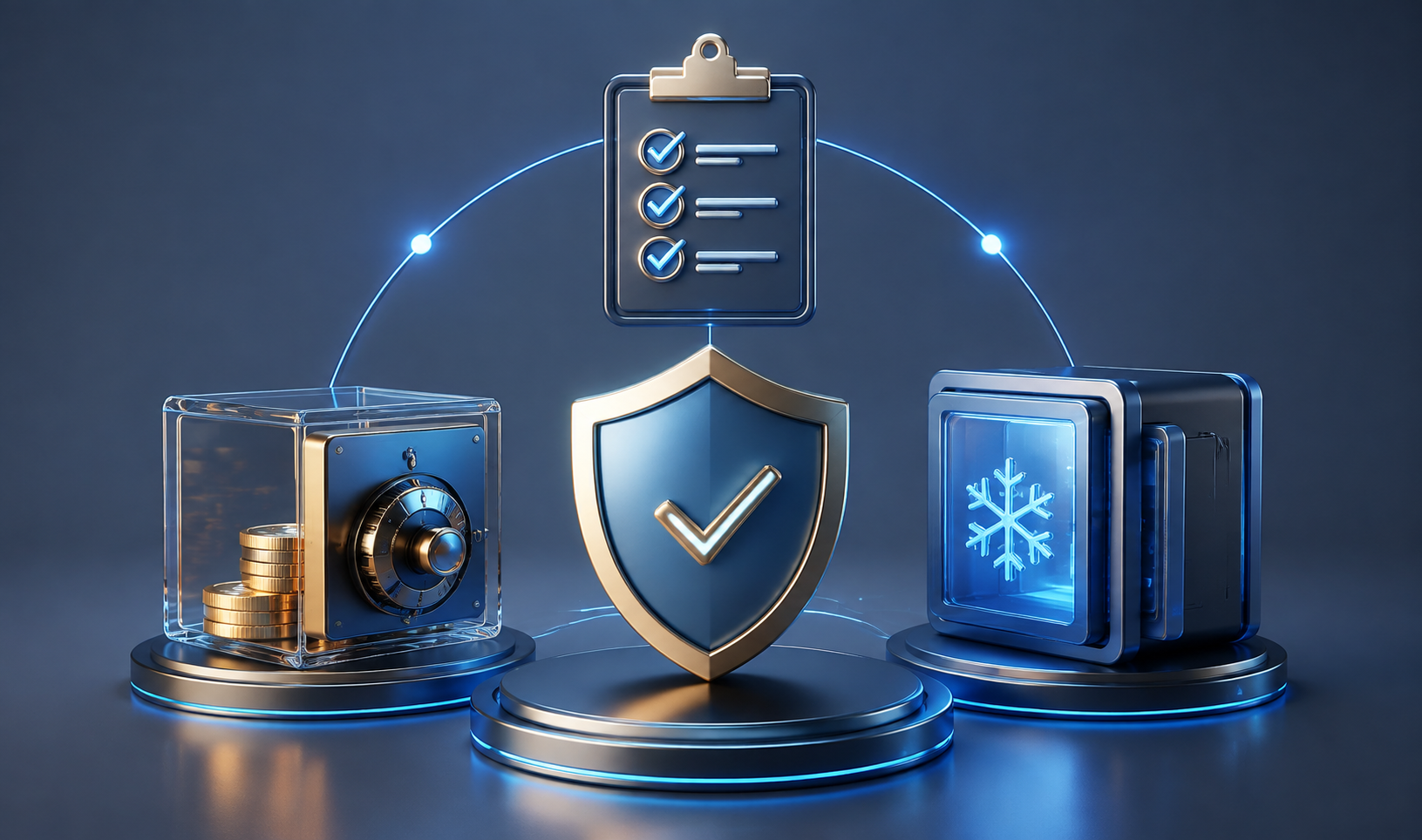
Mid-article takeaway: The next stage of institutional custody combines hot/cold layering, MPC/HSM, SOC 2 audit, insurance, Proof of Reserves and emergency procedures into an auditable, verifiable and underwritable trust framework.
4. Case Analysis: A Singapore Family Office Evaluates Regional Custodians
Imagine a Singapore family office planning tens of millions of USD in digital asset allocation across Southeast Asian markets. The team needs to choose one or two regional custodians or custody technology providers. The evaluation usually has six phases.
Phase one is custody architecture assessment. The family office requires disclosure of hot/cold ratio, MPC or multisig configuration, threshold signing, HSM models, key geography, rotation and access control. The team verifies whether this is backed by independent audit.
Phase two is SOC 2 and other audits. The family office requires SOC 2 Type II report and focuses on exceptions, remediation and auditor qualifications. ISO 27001 or regional compliance certifications are pluses.
Phase three is insurance coverage. The family office requires insurance certificates specifying underwriter (e.g. Lloyd's syndicate), limit, coverage (hacking, insider fraud, third-party error), deductible, exclusions and claims process. The team assesses whether the limit covers their assets at the platform.
Phase four is Proof of Reserves and asset segregation. The family office requires periodic PoR combined with independent audit to confirm strict segregation of user and platform assets. The team samples whether their own balance is included in the Merkle Tree.
Phase five is emergency procedures. The family office requires explanation of response to security incidents, key compromise, regulatory freezes, natural disasters or key-person unavailability. The team focuses on response time, backup signers, asset transfer paths and communication.
Phase six is contracts and SLAs. The family office negotiates custody agreement, SLA, liability caps, indemnity and data protection clauses.
SoonTech can provide hot/cold wallet layering, MPC wallets, multisig, HSM integration, Proof of Reserves, audit logs, emergency procedures and back-office systems in this kind of regional custody scenario, integrated with CEX, DEX, risk control, reports and compliance systems. Institutions can build custody schemes meeting SOC 2 and insurance underwriting requirements on SoonTech infrastructure.
5. SoonTech Solution: Combining Custody, Audit and Insurance Readiness
SoonTech's value for Southeast Asian businesses is not just a wallet module. It combines hot/cold layering, MPC/HSM, audit readiness, insurance readiness, Proof of Reserves and emergency procedures into scalable infrastructure.
At the hot/cold layering layer, SoonTech supports hot, warm and cold wallet ratio configuration, automatic sweeping and withdrawal approval. Cold wallet signing can combine HSM, MPC and geographically distributed signers.
At the MPC and multisig layer, SoonTech supports threshold signing, key sharding, key rotation, signing policies and approval workflows. Platforms can configure different schemes based on institutional needs.
At the audit readiness layer, SoonTech's system can generate logs, access records, change records, incident records and control evidence needed for SOC 2 evaluation. Platforms can use this evidence with auditors to complete SOC 2 Type I and Type II.
At the insurance readiness layer, SoonTech's architecture documents, hot/cold ratio, access control, key management and incident response can serve as technical materials for insurance underwriting. Platforms can apply for crypto insurance coverage based on these materials.
At the Proof of Reserves layer, SoonTech supports Merkle Tree PoR, on-chain address signature proof, liability proof and independent audit interfaces. Institutions can independently verify their balances.
At the emergency procedure layer, SoonTech supports incident response workflow, backup signers, emergency asset transfer, risk alerts and communication templates. Platforms can institutionalize emergency procedures.
At the API and reporting layer, SoonTech provides custody status query, balance proof, signing records, audit logs and compliance reports. Institutions can integrate these into their own risk and compliance systems.
6. Enterprise Implementation Suggestions
- Define custody positioning: self-custody, third-party custody or hybrid.
- Design hot/cold layering: ratio, threshold, signing and sweeping policies.
- Choose signing scheme: MPC, multisig, HSM or combination.
- Prepare SOC 2 audit: logs, access control, change management and incident response.
- Configure insurance: limit, scenarios, underwriter, deductible and claims process.
- Design Proof of Reserves: Merkle PoR, on-chain signature, liability proof and independent audit.
- Establish emergency procedures: incident response, backup signers, asset transfer and communication.
- Choose a long-term vendor that supports custody architecture, MPC/HSM, audit readiness, insurance readiness, PoR, emergency, APIs, reports and localized operations.
7. Future Outlook: Custody Becomes the Entry Ticket for Institutions in Southeast Asia
In the next two years, Southeast Asian digital asset custody will move from "technical module" to "institutional entry ticket." Family offices, market makers, project treasuries, hedge funds and brokers will evaluate custody, audit and insurance in one framework when choosing regional platforms.
The second trend is SOC 2 Type II becoming regional standard. Early platforms may only need internal security checks, but institutions increasingly require independent audit, and Type II rather than Type I.
The third trend is stricter insurance underwriting. After industry events, crypto insurance will keep raising the bar, with hot/cold ratio, MPC/HSM, access control and incident response directly affecting premium and limit.
The fourth trend is Proof of Reserves combining with asset segregation and independent audit. A single Merkle Tree is insufficient; PoR needs to combine liability proof, independent audit and on-chain address signature.
The fifth trend is that AI search and B2B content will make "how to do institutional custody" a high-value inquiry topic. Institutions will search for Southeast Asia digital asset custody, custody insurance, SOC 2 crypto custody, cold storage infrastructure and Insurans jagaan aset digital. Platforms that clearly show custody, audit and insurance capabilities will win more institutional preference.
FAQ
Q1: Is SOC 2 specifically designed for crypto assets?
No. SOC 2 is a service organization control framework published by AICPA, widely used in fintech and SaaS. It is not specifically designed for crypto, but its security, availability, confidentiality and privacy principles can be referenced by digital asset custodians. Institutions usually also consider ISO 27001, regional regulatory requirements and specialized crypto audits.
Q2: What is the difference between MPC and multisig?
Multisig requires multiple on-chain signers to move assets, and signer addresses are usually visible on chain. MPC produces signatures off chain through multiparty computation, with only one signature visible on chain. Each has use cases, and institutional custody usually combines MPC, multisig and HSM.
Q3: What scenarios does insurance usually cover?
Crypto custody insurance usually covers hacking, insider fraud and third-party errors, but specific coverage, limits, deductibles and exclusions depend on the policy. Institutions should require platforms to provide insurance certificates and read terms carefully.
Q4: Is Proof of Reserves enough to prove user asset safety?
PoR can prove on-chain assets cover user balances, but it needs to combine liability proof, asset segregation statements and independent audit. A single Merkle Tree can be manipulated, and institutions should require combined verification.
Q5: Can SoonTech provide custody infrastructure for Southeast Asian institutions?
SoonTech can provide hot/cold wallet layering, MPC wallets, multisig, HSM integration, Proof of Reserves, audit logs, emergency procedures and back-office systems, integrated with CEX, DEX, risk, reports and compliance, helping businesses build custody schemes meeting SOC 2 and insurance requirements.
Q6: Can a technology vendor replace legal, audit and insurance advisors?
No. A technology vendor provides system architecture and technical capabilities. Businesses still need to consult auditors (e.g. SOC 2 auditors), insurance brokers, legal counsel and compliance advisors to confirm specific custody, audit, insurance and compliance requirements.
Conclusion
The next stage of Southeast Asian digital asset custody combines hot/cold layering, MPC/HSM, SOC 2 audit, insurance, Proof of Reserves and emergency procedures into an auditable, verifiable and underwritable trust framework. For Web3 businesses serving family offices, market makers, project treasuries, hedge funds and brokers, Southeast Asia digital asset custody, custody insurance, SOC 2 crypto custody, cold storage infrastructure and Insurans jagaan aset digital are already the institutional entry ticket. SoonTech can help combine hot/cold wallet layering, MPC, multisig, HSM integration, Proof of Reserves, audit logs, emergency procedures and back-office systems into scalable regional institutional custody infrastructure.
🌐 Build secure and scalable Web3 platforms with SoonTech.
Explore our solutions for White Label Crypto Exchanges, Prediction Markets, MPC Wallets, Matching Engines, Liquidity Integration, and Compliance.