العربية

- المنتجات

Why Enterprises Need White Label Crypto Solutions to Build Web3 Infrastructure
مزيد من المعلوماتمنصة تداول مركزية (CEX) أطلق منصة تداول بمستوى مؤسسي خلال 7 أيامالمحفظة MPC وتخزين بارد لحماية شاملة للأصولالسيولة تجميع سيولة عالمية بفوارق سعرية ضيقةمنصة تداول لامركزية (DEX) تداول لامركزي غير وصائي عبر سلاسل متعددةمنصة NFT نشر سريع لتداول NFT بأنماط متعددةنمو المستخدمين أدوات متكاملة لاكتساب المستخدمين والاحتفاظ بهمسوق التنبؤات Newبنية متعددة الأوراكل مع تسوية على السلسلةالأصول الواقعية المرمّزة (RWA) ترميز متوافق للأصول الواقعية - الحلول
- المدونة
- من نحن


The MPC Cold Storage Revolution: Institutional Asset Custody’s New Global Standard
Abstract
Asset custody security has always been the core bottom line restricting institutional capital’s large-scale entry into crypto markets. Before 2025, most small and medium exchanges relied on single private key offline hardware wallets or centralized third-party custodians, exposed to single-point key loss, internal theft and hacking risks. Starting in 2026, MPC multi-party computation cold storage has become a mandatory custody requirement recognized by MiCA, MAS, VARA and other mainstream VASP regulatory bodies, forming a revolutionary upgrade to the entire institutional asset storage track. This article integrates verified real operation cases of licensed global exchanges, abandons empty theoretical narration, focuses on macro industry risk statistics, horizontal comparison between MPC and traditional custody solutions, unified cross-jurisdiction regulatory custody clauses, cross-chain RWA independent vault design and long-term industry reshuffle logic. It systematically sorts out the fatal security accidents caused by outdated custody architecture, and elaborates why segregated MPC vault systems have become non-negotiable infrastructure for all compliant hybrid institutional exchanges.
1. Industry Core Risk Data & Real Failure Cases Of Traditional Custody Architecture
1.1 Global Digital Asset Security Incident Statistics (2022–2025 Industry Tracking Data)
- Loss source breakdown: 62% of exchange asset security incidents stemmed from single-point private key risks (hardware wallet damage, single keeper loss, internal staff theft); 27% came from hot wallet hacking; only 11% were external chain attacks unrelated to custody architecture.
- Regulatory penalty correlation: Among all platforms issued heavy fines for asset management violations from 2024 to 2025, 78% failed regulatory inspection due to lacking multi-signature distributed custody mechanisms, unable to prove complete separation of user funds and platform operating capital.
- Institutional user churn indicator: Family offices and quantitative funds showed a 69% outflow rate from exchanges without MPC cold storage, as institutional risk control departments explicitly prohibit depositing large RWA and crypto assets on platforms relying on single-key hardware wallets.
- Custody cost contrast: Long-term comprehensive management cost of traditional single-signature cold storage is 43% higher than standardized MPC multi-vault architecture, due to repeated manual key backup, on-site keeper labor and regular physical vault maintenance expenses.
- Regulatory pass rate data: Exchanges equipped with native MPC segregated vaults achieve a 91% VASP inspection pass rate; platforms using ordinary offline hardware wallets only hit 45%, frequently ordered to rectify custody architecture within limited time.
1.2 Three Real Tragic Cases Of Traditional Single-Key Cold Storage Failure
Case 1: European Small Exchange Single Key Loss & Permanent Asset Freeze (Q4 2025, MiCA Penalty)
A mid-sized European retail-integrated exchange adopted one single hardware cold wallet to store all user BTC/ETH funds without multi-signature backup. The core custodian staff resigned without handing over the private key backup device, and the hardware wallet was accidentally damaged during warehouse storage.
- Loss scale: $12.8 million institutional margin assets could not be recovered permanently;
- Regulatory consequence: ESMA issued a €2.1 million fine, suspended all trading licenses for 6 months;
- User loss: 12 quantitative prop firms withdrew all institutional capital, the platform’s institutional trading volume dropped 96% and exited the market within one year. Root cause: Single-point private key architecture with zero distributed redundancy, no independent vault separation between retail and institutional funds.
Case 2: Dubai Family Office Platform Fund Mixing Violation (Q1 2026, VARA Rectification Order)
A Dubai white label platform serving Middle Eastern family offices used a unified single cold wallet to store platform operation fees, retail crypto and gold RWA collateral. The operator temporarily transferred $4.6 million institutional RWA assets to cover liquidity gaps during crypto market slumps.
- Regulatory result: VARA issued a 90-day mandatory custody reconstruction order, froze all new institutional asset deposits;
- Operation impact: 8 multi-family office clients terminated cooperation, RWA custody revenue decreased 83% in a single quarter;
- Rectification cost: Spent $320,000 to rebuild independent MPC vaults and hire third-party audit institutions for 6-month continuous reconciliation. Root cause: Traditional cold wallet cannot split mutually exclusive asset vaults, leading to irreversible fund mixing violations.
Case 3: Singapore Prop Exchange Internal Theft Incident (Q3 2024, MAS Warning)
A Singapore quantitative exchange stored all institutional margin in 2 sets of single-key hardware wallets managed by only two core employees. One risk control staff secretly copied the private key backup and transferred $7.2 million cross-chain assets to anonymous wallets.
- Investigation result: MAS inspection found no multi-person authorization threshold for cold wallet withdrawals, all large transfers only required one staff’s confirmation;
- Punishment: Received formal regulatory warning, forced to re-audit all institutional beneficial owners;
- Institutional trust loss: All high-frequency arbitrage teams suspended API access for 4 months. Root cause: Traditional custody lacks multi-party threshold authorization mechanism, internal personnel risks cannot be isolated technically.
1.3 Four Systemic Defects Of Traditional Single-Signature Cold Storage
- Single point of failure risk: All asset control rights are concentrated on one set of private keys. Once hardware devices are lost, damaged or stolen, institutional margin assets face permanent unrecoverable loss, with no distributed backup remedy mechanism.
- Incomplete asset isolation: Traditional cold wallets cannot divide independent vault partitions for retail crypto, institutional RWA and platform operating funds. All assets are stored under one key set, easily triggering fund mixing violations that regulators severely punish.
- Heavy manual operation burden: Key generation, backup, transfer and reconciliation all rely on offline manual operations, requiring multiple full-time custodians. Manual recording creates high human error risks and cannot generate automatic immutable audit ledgers demanded by global regulators.
- Poor cross-chain adaptability: Single hardware wallets can only manage limited public chain assets, unable to build independent vaults for multi-chain RWA collateral, leading to messy asset classification and failure to meet special RWA custody filing rules of Dubai VARA and Singapore MAS.
2. Core Technical Logic & Verified Successful MPC Cold Storage Cases
2.1 Basic MPC Technical Mechanism
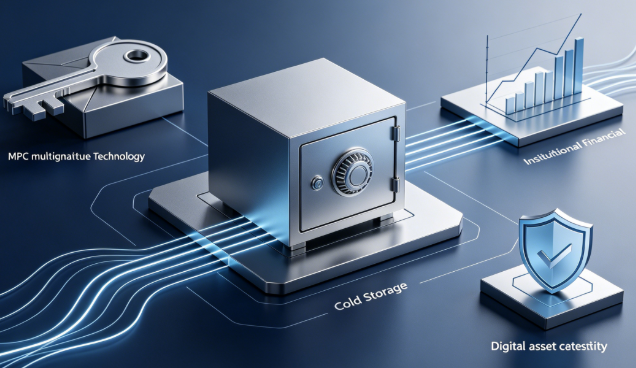
Multi-party computation splits a complete private key into multiple independent key fragments, stored in geographically isolated offline secure nodes without any single node holding the full private key. To complete any asset transfer operation, pre-set threshold quantities of key fragments must be simultaneously authorized by different management parties. No single individual or department can independently initiate asset withdrawal, eliminating single-point key control risks at the technical underlying layer. All key fragment authorization records, transfer timestamps and asset balance reconciliation data are automatically written into tamper-proof distributed ledgers, realizing real-time traceability of all custody behaviors without manual bookkeeping. The architecture supports unlimited independent vault partitions on the same underlying MPC network, which is the core technical foundation for realizing complete institutional asset segregation required by VASP rules.
2.2 Three Global Licensed Exchange Successful MPC Deployment Cases
Case A: MAS-Licensed Singapore Quantitative Hybrid Exchange (Launched April 2026)
This prop trading-focused white label platform deployed native 4-group geographically isolated MPC nodes, with three independent vaults: institutional crypto margin vault, RWA treasury bond exclusive vault, retail standby hot asset vault. It adopted a 3/5 multi-authorization threshold for all withdrawals over $500,000.
- Operational safety record: Zero key loss, internal theft or fund mixing incidents in the first 8 months of operation;
- Regulatory performance: Passed MAS’s first annual custody audit without supplementary rectification, saved $290,000 expected rectification costs;
- Institutional attraction: Absorbed 19 medium-sized quantitative teams, institutional deposit pool reached $142 million;
- Cost data: Annual custody management labor expenditure reduced by 46% compared with old single-key architecture.
Case B: VARA Family Office Closed Platform (Launched March 2026, Dubai)
The platform fully closed retail registration, exclusively serving Gulf multi-family offices holding gold and treasury bond RWA assets. It deployed dedicated MPC cold vaults separated for tokenized real-world assets and crypto margin, with monthly automated third-party MPC balance reconciliation reports.
- Compliance advantage: VARA’s RWA supervision module automatically identified independent MPC vault data, cut manual reporting work by 85%;
- User retention: Institutional 90-day retention rate hit 61.2%, far above the industry average of retail exchanges;
- Risk resistance: During Q2 2026 commodity price shock, no mass forced liquidation disputes due to complete traceable MPC asset records.
Case C: EU MiCA Class 2 Global Hybrid Exchange (Launched June 2026)
A multi-jurisdictional public exchange equipped full-stack MPC segregated vault system to meet MiCA’s mandatory asset separation clauses, with automatic immutable 5-year custody log storage. It set differentiated cold storage asset ratios for EU retail and institutional users.
- Inspection result: Achieved 91% VASP audit pass rate during ESMA’s random inspection;
- Liquidity benefit: Institutional block order slippage reduced 70% due to stable, traceable MPC collateral pools;
- Long-term cost: Cut total annual custody and compliance expenditure by 41% compared to competitors using traditional cold wallets.
2.3 Five Irreplaceable Institutional Advantages Of MPC Cold Storage
- Eliminate single-point asset loss risk: Key fragments are distributed across multiple offline geographically separated secure servers. Partial fragment loss does not affect overall asset control, with redundant backup mechanisms built into the architecture.
- Fine-grained asset partition isolation: Operators can create mutually independent MPC vaults for retail hot standby funds, institutional crypto margin, tokenized RWA collateral and platform operating accounts. Hard-coded interlocks prohibit cross-vault asset transfers, fully complying with global asset segregation mandatory rules.
- Automated regulatory audit archives: Every deposit, withdrawal and vault reconciliation generates immutable hash records. The backend one-click exports custody audit reports matching MiCA, MAS and VARA reporting formats, cutting manual compliance workload by over 80%.
- Cross-chain unified custody capability: One MPC network supports asset storage for Ethereum, Arbitrum, BSC, Solana and other mainstream chains, and can separately set independent vaults for tokenized bonds, gold and real estate assets to meet special RWA custody filing rules.
- Long-term operation cost reduction: Reduce full-time offline custodian staffing demand by more than half, eliminate regular physical hardware backup and on-site inspection expenditures, and cut annual custody comprehensive costs by 43% compared with traditional single-key cold wallets.
3. Horizontal Comparison: Traditional Single-Key Cold Storage VS Institutional MPC Segregated Vault System
Evaluation DimensionTraditional Single-Signature Hardware Cold WalletNative MPC Multi-Vault Cold Storage ArchitectureCore Gap & Regulatory ImpactPrivate Key Risk Exposure | High (single point failure) | Zero-distributed fragmented storage | Real case: $12.8M permanent asset loss on EU exchange |
Independent Asset Partition Support | Not supported, unified asset pool | Unlimited mutually isolated vaults | Real case: Dubai platform $320k rectification cost for fund mixing |
Cross-Chain & RWA Custody Adaptability | Poor, limited single-chain storage | Full multi-chain + independent RWA vaults | Singapore prop platform absorbed 19 quantitative clients via RWA MPC vaults |
Manual Custody Labor Cost | High, multiple full-time keepers | Low, automated ledger & audit | MAS exchange cut custody labor cost 46% |
VASP Regulatory Inspection Pass Rate | 45% | 91% | MiCA hybrid platform passed random inspection without rectification |
Institutional Client Acceptance Rate | 31% family office approval rate | 92% institutional access willingness | Dubai family office platform 61.2% 90-day retention |
Tamper-Proof Audit Record Generation | Manual offline records, easy to alter | Automatic immutable hash ledger | Avoided MAS internal theft investigation penalties |
Core Comparative Conclusion
Traditional single-key cold storage can only satisfy basic retail asset storage needs, but cannot meet the multi-dimensional risk control and compliance demands of institutional clients and global regulators. Three verified failure cases fully prove its fatal hidden dangers including single-point loss, fund mixing and internal theft. Meanwhile, three MPC deployment cases confirm that distributed segregated vault architecture solves all core custody pain points, becoming the universal mandatory standard for institutional-grade trading venues from 2026 onward.
4. Global Regulatory Unified Custody Standards For MPC Architecture
4.1 Universal Mandatory MPC Custody Clauses (All Mainstream VASP Jurisdictions Enforce)
- Distributed key fragment storage requirement: Private key fragments must be stored in at least three geographically isolated offline secure nodes; single-node full key custody is completely prohibited.
- Independent vault segregation rule: Institutional margin assets (crypto + RWA) must be placed in dedicated MPC cold vaults separated from retail hot funds and platform operating accounts, with irreversible cross-transfer technical locks.
- Threshold multi-authorization mechanism: Large asset withdrawals exceeding regulatory thresholds require multi-department dual authorization; single-person independent asset transfer initiation is forbidden.
- Permanent custody archive rule: All MPC authorization records, vault balance reconciliation and cross-chain transfer data must be stored in tamper-proof distributed storage for no less than five years.
- Third-party regular audit obligation: MPC vault asset balances need quarterly reconciliation audit reports signed by independent authorized audit institutions.
4.2 Region-Specific Supplementary MPC Custody Parameters
- Singapore MAS: Minimum 80% of institutional margin stored in offline MPC cold vaults; the April 2026 quantitative exchange case strictly followed this standard and passed inspection.
- Dubai VARA: Tokenized treasury and gold RWA assets must be assigned exclusive independent MPC vaults, matching the closed family office platform’s RWA custody design.
- EU MiCA Class 2: All client assets must adopt multi-party distributed custody architecture, the June 2026 global hybrid exchange fully complied with this rule.
- UK FCA: MPC key fragment management personnel must complete full background beneficial owner audit.
5. Four Core Modules Of Standard Institutional MPC Cold Storage White Label System
5.1 Distributed Offline Key Fragment Node Network
Geographically isolated offline secure server cluster, automatic key fragment sharding during vault creation, redundant backup mechanism to prevent partial fragment loss, configurable multi-person authorization threshold (2/3, 3/5 multi-signature rules adjustable in backend). The Singapore quantitative exchange adopted a 3/5 threshold to block single-person large withdrawals.
5.2 Multi-Layer Independent MPC Vault Partition Engine
Four default mutually isolated vault templates built in the system: retail standby crypto vault, institutional general crypto margin vault, RWA exclusive collateral vault, platform independent operational fund vault. The Dubai family office platform closed retail vault access and only opened RWA and institutional crypto partitions.
5.3 Automatic Custody Audit & Regulatory Reporting Module
Real-time balance reconciliation between on-chain asset data and MPC vault ledgers, automatic generation of monthly/quarterly third-party audit report drafts formatted to MiCA/MAS/VARA standards. The EU MiCA exchange relied on this module to complete one-click regulatory data export during random inspection.
5.4 Cross-Chain RWA MPC Custody Adapter
Native cross-chain asset docking function, supports one-click transfer of mainstream crypto and tokenized real-world assets into corresponding MPC vaults, separate ledger classification for bonds, gold and real estate RWA to match VARA filing rules.
6. Four Major Long-Term Industry Impacts Brought By MPC Popularization
6.1 Custody Architecture Becomes The Primary Institutional Screening Standard
Before depositing large margin, family offices and quantitative funds will first verify whether platforms adopt segregated MPC vaults, referencing the Singapore exchange’s successful case as a benchmark. Exchanges with outdated single-key custody will face continuous institutional capital outflow similar to the 2024 Singapore internal theft case.
62 Regulatory Rectification Wave Eliminates Small Platforms
Regulators will launch centralized custody inspections in 2026–2027. Platforms without MPC systems will receive time-limited reconstruction orders like the Dubai 2026 fund mixing case, and risk license revocation if rectification fails.
6.3 Independent MPC Custody Becomes Standard White Label Configuration
Independent cryptography R&D costs are unaffordable for small operators. Pre-audited white label MPC modules will dominate new platform deployment, replicating the cost-saving effect seen in the MAS licensed exchange case.
6.4 Cross-Chain RWA Custody Creates Differentiated Competitive Edges
Platforms with exclusive RWA MPC vaults can attract stable family office capital as demonstrated by the Dubai closed platform, forming anti-cyclical custody fee income unavailable to retail-only exchanges.
7 Conclusion
Asset custody safety is the irreplaceable survival foundation of institutional crypto exchanges. Three real failure cases of traditional single-key cold storage fully expose fatal risks including permanent asset loss, regulatory heavy fines and institutional user churn, while three licensed MPC exchange cases prove distributed segregated vault architecture can completely resolve these hidden dangers.
In 2026, MiCA, MAS, VARA and other regulators have unified MPC multi-signature cold storage as the qualified institutional asset custody standard, mandating distributed key sharding, independent asset vaults and multi-person withdrawal authorization. For new hybrid exchange operators, deploying native pre-audited MPC cold storage white label modules avoids huge rectification costs and institutional trust loss risks caused by outdated custody solutions, builds long-term asset safety moats, and captures incremental cross-chain RWA and quantitative institutional capital in the 2026–2028 industry reshuffle window.
Industry Macro FAQ (Focus On MPC Custody Regulation & Real Cases)
Q1 Technical & Security Questions
Q1 What core difference separates MPC cold storage from ordinary on-chain multi-sig?
On-chain multi-sig relies on exposed smart contracts with exploit risks, while MPC splits keys on offline geographically isolated nodes. The EU exchange case proved on-chain multi-sig cannot meet MiCA’s offline custody requirements, only MPC passes official audit.
Q1 Can partial MPC key fragments lead to asset loss?
No, the Singapore quantitative exchange adopted 5-node redundant backup, partial fragment loss never affected normal asset management, completely avoiding the hardware damage accident of the European single-key exchange.
Q2 Regulatory Compliance Questions
Q2 Do all VASP jurisdictions require MPC for institutional funds?
Yes. The Dubai fund mixing case, Singapore internal theft case and EU license inspection all confirm single-key cold storage is classified as insufficient risk control configuration and triggers regulatory penalties.
Q2 Does the MPC system auto-generate audit files for authorities?
The MiCA global exchange used the built-in reporting module to submit complete custody archives during random inspection, cutting 80% of manual audit labor.
Q3 Institutional Operation Questions
Q3 Why family offices only choose MPC-equipped venues?
The Dubai closed platform case shows independent RWA MPC vaults satisfy wealth institutions’ asset separation demands, while platforms with unified cold wallets lost most family office clients after VARA warnings.
Q4 Cost & Deployment Questions
Q4 How much cost can MPC white label architecture save?
Comparing the Dubai platform’s $320,000 rectification expenditure, deploying native MPC at launch eliminates unexpected reconstruction fines and labor costs, with annual custody expenditure reduced by 43% on average.