العربية

- المنتجات

Why Enterprises Need White Label Crypto Solutions to Build Web3 Infrastructure
مزيد من المعلوماتمنصة تداول مركزية (CEX) أطلق منصة تداول بمستوى مؤسسي خلال 7 أيامالمحفظة MPC وتخزين بارد لحماية شاملة للأصولالسيولة تجميع سيولة عالمية بفوارق سعرية ضيقةمنصة تداول لامركزية (DEX) تداول لامركزي غير وصائي عبر سلاسل متعددةمنصة NFT نشر سريع لتداول NFT بأنماط متعددةنمو المستخدمين أدوات متكاملة لاكتساب المستخدمين والاحتفاظ بهمسوق التنبؤات Newبنية متعددة الأوراكل مع تسوية على السلسلةالأصول الواقعية المرمّزة (RWA) ترميز متوافق للأصول الواقعية - الحلول
- المدونة
- من نحن


Malaysia Crypto Broker and Institutional API Trading Gateway: How FinTech Businesses Build Crypto Services With Sub-Accounts, Liquidity and Risk Controls
Malaysian Web3 and FinTech businesses do not always need to operate a full CEX from day one. For brokers, payment companies, wallet providers, wealth platforms, projects and regional FinTech firms, a more practical path may be to build crypto broker infrastructure Malaysia through institutional crypto API Malaysia, sub-accounts, liquidity connectivity, custody wallets, KYC/AML and risk-control systems. This article explains how businesses can enter digital asset markets through API-based trading gateways, and how SoonTech can support CEX, wallet, liquidity and institutional back-office modules as a neutral technology provider.
1. Industry Background: Not Every Malaysian Business Needs a Full Exchange First
When discussing crypto exchange development Malaysia, many teams assume the goal is to build a full exchange: registration, KYC, wallet, matching, order book, market data, admin console, app, fiat gateway and customer support all at once. This path can work for companies with strong resources, clear licensing plans and long-term operating teams, but it is not the right path for every Malaysian business.
Many FinTech companies, brokers, payment firms, Web3 wallets and projects already have customer relationships, but do not necessarily want to operate a complete exchange immediately. What they need is an embeddable crypto trading gateway. Users complete identity and account workflows inside the existing platform, while the back end connects to trading, liquidity, market data, wallets and reports through institutional crypto API Malaysia. For these businesses, the goal is not to copy a global exchange, but to make digital asset trading part of their own financial service.
Malaysia's market structure supports this layered path. Public information from Securities Commission Malaysia covers digital assets, Recognized Market Operators and Digital Asset Exchanges, while Bank Negara Malaysia AML/CFT documents emphasize identity, source-of-funds and risk management. If a company is not ready to operate a full regulated digital asset exchange Malaysia, it can start by evaluating technical architecture, customer segmentation, API connectivity and compliance boundaries.
2. Market Pain Points: Broker Gateways Follow a Different Logic From Traditional Exchanges
First, broker gateways care more about customer account relationships. A traditional CEX opens a complete trading interface to end users. A broker or FinTech platform usually already has its own customer accounts, CRM, KYC and fund systems. Crypto trading capability must fit into those account relationships, so sub-accounts, master accounts, permissions, fee tiers and customer ownership are critical.
Second, institutional API stability defines user experience. Broker users may not see the underlying exchange system, but they will feel quote delay, failed execution, balance mismatch and order status errors. If the API is unstable, a polished front end will not retain customers. The core of institutional crypto API Malaysia is not the number of endpoints. It is whether orders, balances, market data, risk controls and reports run reliably.
Third, liquidity connectivity is the foundation of the commercial model. A broker may not build its own order book, but it must solve quote quality, execution, spread, slippage and exposure. Platforms can connect external liquidity, market making systems or upstream depth, but they need clear design for price sources, fee model, order routing and abnormal market handling.
Fourth, compliance boundaries should be confirmed early. A broker gateway may involve client introduction, trade execution, custody, API trading, fiat funding or investment product distribution. Different roles carry different requirements. Technology cannot replace legal advice, but systems must support KYC/AML, audit logs, permissions, transaction records and risk notices.
Fifth, localized content still affects B2B acquisition. Malaysian buyers may search in English, Malay and Chinese for terms such as crypto broker infrastructure Malaysia, API dagangan kripto institusi, Akaun sub pertukaran kripto and Sistem pertukaran kripto Malaysia. Website content should explain business models, system modules and implementation steps, not only repeat white label exchange keywords.
3. Data and Trends: Institutional Trading Gateways Are Becoming a Malaysia B2B Opportunity
From a regional perspective, Chainalysis's 2025 global crypto adoption research continued to highlight strong on-chain activity growth in Asia Pacific, and Southeast Asian markets remain active. Malaysia is not the largest trading market, but it has multilingual users, fintech foundations, cross-border business links and regional connectivity. B2B crypto infrastructure demand is therefore likely to continue.
From an enterprise demand perspective, many Malaysian leads are not pure exchange startups. They are companies that already have customers, channels or vertical use cases. Their questions are more specific: can we open sub-accounts for existing customers? Can orders be placed through API? Can we access stablecoin and mainstream crypto liquidity? Can we set different fee tiers? Can we export trading reports? Can we control limits for each customer or institution?
From a system trend perspective, CEX, broker, wallet and institutional API capabilities are converging. A platform may look like a wealth app, payment app or wallet on the front end, while the back end needs exchange matching, liquidity aggregation, custody wallet, KYC/AML, risk control and reporting. For a CEX system provider Malaysia, competitiveness is no longer only about building an exchange. It is about making trading capability embeddable, configurable and auditable.
Demand DimensionCommon Malaysia Business QuestionSystem ImplicationCustomer accounts | How to separate brokers, institutions and end users | Master accounts, sub-accounts, permissions and customer ownership |
API trading | Are orders, balances and market data reliably synchronized | Institutional APIs, rate limits, signatures and callbacks |
Liquidity | How to reduce spreads and slippage | Market making, external depth and order routing |
Risk control | How to control limits and abnormal trading | Risk rules, audit logs and customer risk levels |
Reporting | How to reconcile internally and with clients | Trade, asset, fee and commission reports |
Mid-article takeaway: Malaysian companies are entering crypto trading in more segmented ways. A full exchange is one path, but broker APIs, sub-accounts and embedded trading gateways can be a lighter path for B2B validation.
4. Case Analysis: How a Kuala Lumpur Broker Could Build Crypto Trading Through APIs
Imagine a Kuala Lumpur broker serving local high-net-worth users and small institutions. It wants to add digital asset trading inside its existing platform. Phase one supports BTC, ETH, USDT and USDC quotes, buy/sell, asset balances and trade reports. Phase two adds institutional APIs, sub-accounts, whitelisted addresses and stablecoin withdrawals. Phase three expands to RWA, OTC quotes and regional customers.
If the company builds a full CEX from scratch, it needs teams for matching, wallets, front end, mobile, fiat, support, risk, operations and security. The cycle may be long and the cost high before business validation. A more practical first step is to connect its customer system with configurable trading infrastructure. Customers complete identity and risk workflows inside the broker platform, the back end retrieves market data and places orders via API, assets are recorded by custody wallet and account systems, and completed trades generate client reports and internal reconciliation records.
In this model, sub-accounts are essential. The broker can own a master account, while different institutional clients or end users map to different sub-accounts. The system should support sub-account balances, orders, fee tiers, trading permissions, withdrawal permissions, API keys, whitelisted IPs and risk limits. This lets the broker keep customer relationships while standardizing trade execution, wallet operations, liquidity and reporting.
In this case, SoonTech can act as a CEX system provider Malaysia and Web3 infrastructure partner, offering institutional APIs, sub-account systems, account ledgers, multi-chain wallets, liquidity aggregation, market making, risk-control back office and audit reports. SoonTech does not replace licensing decisions or compliance advice, but it can help companies modularize crypto trading capability and reduce the technical burden of building a full exchange from scratch.
5. SoonTech Solution Reference: Turning CEX Capability Into Broker-Ready Institutional Modules
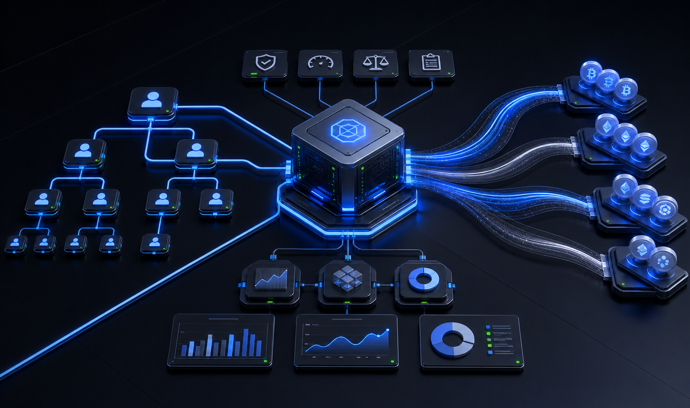
SoonTech's value for Malaysian brokers and FinTech companies is in turning complete exchange capability into composable modules. A company does not need to launch a full exchange front end immediately. It can first connect accounts, market data, orders, wallets, liquidity, risk controls and reporting, then decide whether to expand into an independent CEX later.
At the account layer, SoonTech can support master accounts, sub-accounts, institutional clients, end users, fee tiers, permissions and user risk levels. At the API layer, it can support market data, order placement, cancellation, order status, balance query, deposit and withdrawal records, report export and callbacks. At the liquidity layer, it can support market making, external depth, order routing, trading pair management and abnormal market handling. At the wallet layer, it can support multi-chain addresses, deposit recognition, withdrawal review, hot-cold wallets and MPC wallets.
At the risk and operations layer, SoonTech can support KYC/AML integrations, admin permissions, audit logs, customer limits, API key management, IP whitelists, abnormal order monitoring and finance reports. For Malaysian businesses, these modules can serve B2B clients and existing user bases first, then expand into a more complete white label crypto exchange Malaysia or regional Web3 finance platform.
6. Enterprise Implementation Suggestions: Checklist Before Building a Crypto Broker Gateway
Vendor selection checklist:
- Does the system support master accounts, sub-accounts, institutional clients and end-user layers?
- Does it support orders, market data, balances and report APIs required by institutional crypto API Malaysia?
- Does it support API keys, signatures, IP whitelists, rate limits and permission controls?
- Does it support external liquidity, market making, order routing and trading pair configuration?
- Does it support multi-chain wallets, deposits, withdrawals, MPC, hot-cold wallets and withdrawal review?
- Does it support KYC/AML, risk levels, trading limits and audit logs?
- Does it support fee tiers, commission calculation and broker reports?
- Can it expand from broker mode into full CEX, wallet, RWA or regional platform operations?
Risk TypeTypical SymptomResponseAPI risk | Delayed order status or balance mismatch | Use stable APIs, callbacks and reconciliation jobs |
Liquidity risk | Wide spreads, failed execution or visible slippage | Add market making and liquidity aggregation |
Account risk | Unclear boundaries between master and sub-accounts | Build sub-account ledgers, permissions and reports |
Compliance risk | Customer identity, source of funds or role boundaries are unclear | Add KYC/AML, risk levels and audit records |
Operational risk | API key leakage or excessive permissions | Use IP whitelists, permission tiers and key rotation |
Implementation steps:
- Define the business role: broker, wallet, payment company, wealth platform or exchange operator.
- Define customer types: retail users, institutions, high-net-worth clients, projects or cross-border merchants.
- Design the account model: master account, sub-accounts, fees, permissions and customer ownership.
- Design API scope: launch market data, orders, balances and reports first, then expand withdrawals and institutional trading.
- Plan liquidity: define trading pairs, price sources, market making and abnormal market handling.
- Plan risk and compliance: configure KYC/AML, limits, audit logs, API key permissions and risk notices.
7. Future Outlook: Malaysian Crypto Services Will Move From Exchange Pages to Embedded Trading Capability
Over the next two years, Malaysia's crypto trading market will not have only one entry point. Full CEX platforms, broker APIs, wallet trading, stablecoin payments, RWA platforms and institutional APIs will coexist. For many businesses, the best first step is not launching a full exchange, but embedding crypto trading capability into an existing service to validate customer demand, fund flows and operating models.
The second trend is that sub-accounts and institutional APIs will become more important. As brokers, payment companies, wealth platforms and projects enter the market, systems need to support more customer layers, more permission models and more detailed reporting. Companies that connect trading, wallets, liquidity, risk control and customer management will be better positioned to serve B2B clients.
The third trend is that AI search and GEO content will influence inquiry quality. Malaysian businesses may search for "crypto broker infrastructure Malaysia", "institutional crypto API Malaysia", "Akaun sub pertukaran kripto" or "crypto liquidity API Malaysia". Website content that explains broker models, system architecture, API capability and implementation steps will attract more serious business leads.
FAQ
Q1: Why should Malaysian businesses consider a crypto broker model?
Because not every company should operate a full exchange from day one. The broker model allows FinTech firms, payment companies, wallets and wealth platforms with existing customer relationships to validate crypto trading demand through APIs, sub-accounts, liquidity and custody modules.
Q2: What is the value of a crypto exchange sub-account system?
A sub-account system helps brokers separate institutional clients, end users, trading permissions, fees, API keys and asset reports. It lets companies keep customer ownership while standardizing execution and back-office operations.
Q3: What capabilities matter for institutional crypto API Malaysia?
Important capabilities include market data, order placement, cancellation, order status, balance queries, deposit and withdrawal records, report export, callbacks, signatures, IP whitelists, permission control and rate limits.
Q4: What can SoonTech provide for Malaysian brokers and FinTech companies?
SoonTech can provide CEX systems, institutional APIs, sub-accounts, account ledgers, multi-chain wallets, MPC wallets, liquidity aggregation, market making, risk-control back office, audit logs and reporting to help companies build crypto trading gateways step by step.
Conclusion
Malaysia's Web3 and FinTech opportunity does not belong only to full exchanges. Brokers, payment companies, wallet platforms and wealth businesses can also embed crypto trading through institutional APIs, sub-accounts, liquidity and risk-control modules. The key is not to copy a large exchange blindly, but to define customer relationships, compliance boundaries, trading paths and system modules before choosing a technology provider that can scale over time.
🌐 Build secure and scalable Web3 platforms with SoonTech.
Explore our solutions for White Label Crypto Exchanges, Prediction Markets, MPC Wallets, Matching Engines, Liquidity Integration, and Compliance.