العربية

- المنتجات

Why Enterprises Need White Label Crypto Solutions to Build Web3 Infrastructure
مزيد من المعلوماتمنصة تداول مركزية (CEX) أطلق منصة تداول بمستوى مؤسسي خلال 7 أيامالمحفظة MPC وتخزين بارد لحماية شاملة للأصولالسيولة تجميع سيولة عالمية بفوارق سعرية ضيقةمنصة تداول لامركزية (DEX) تداول لامركزي غير وصائي عبر سلاسل متعددةمنصة NFT نشر سريع لتداول NFT بأنماط متعددةنمو المستخدمين أدوات متكاملة لاكتساب المستخدمين والاحتفاظ بهمسوق التنبؤات Newبنية متعددة الأوراكل مع تسوية على السلسلةالأصول الواقعية المرمّزة (RWA) ترميز متوافق للأصول الواقعية - الحلول
- المدونة
- من نحن


CEX & DEX Market Deep Dive: Malaysia’s Regulated Digital Asset Exchange Landscape, Pain Points & Full-Stack Infrastructure Solution
Abstract
Malaysia has become one of Southeast Asia’s most standardized digital asset markets under the dual supervision of Securities Commission Malaysia (SC) and Bank Negara Malaysia (BNM). The country adopts a strict licensing system for centralized digital asset exchanges (CEX, officially named RMO-DAX), while decentralized exchanges (DEX) exist in a gray regulatory zone with clear operational thresholds for local operators.
As of mid-2026, Malaysia only has six officially licensed CEX platforms, with severe market concentration: Luno Malaysia holds over 90% of local trading volume, leaving huge market gaps for new compliant exchange operators. Meanwhile, institutional demand for RWA tokenization, prediction market modules and multi-chain decentralized trading has exploded, exposing prominent technical and compliance pain points for local platforms: long self-development cycles, excessive R&D costs, incomplete SC/MYR compliance modules, insufficient concurrent trading performance, and lack of differentiated business expansion tools.
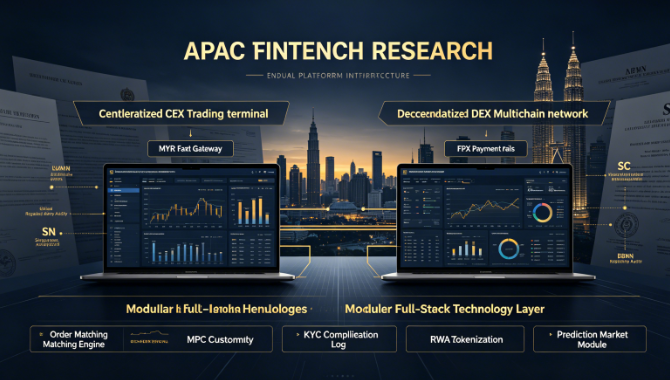
Global APAC full-stack infrastructure vendor SoonTech has launched Malaysia-exclusive localized hybrid CEX+DEX white label solutions targeting RMO-DAX applicants, filling the market blank of low-cost, fast-launch, fully compliant exchange technical services. This article systematically sorts out Malaysia’s digital asset regulatory framework, compares the operational differences between licensed CEX and local DEX, analyzes the market competitive pattern, summarizes core industry pain points, and takes SoonTech’s localized white label system as a complete practical landing case to elaborate low-cost compliant CEX & hybrid DEX deployment paths tailored for Malaysian fintech entrepreneurs, without empty long-cycle market predictions, focusing on current landing bottlenecks and SoonTech actionable layout strategies.
1. Malaysia Digital Asset Regulatory Framework: CEX Strict Licensing, DEX Ambiguous Supervision
1.1 Dual Supervision Mechanism of SC & BNM
- Securities Commission Malaysia (SC): Core regulator of digital asset trading platforms. Any centralized exchange providing spot, derivatives, custody or MYR fiat trading services must apply for the Recognized Market Operator Digital Asset Exchange (RMO-DAX) license under the Capital Markets and Services Act 2007. Application hard thresholds include local company registration, minimum RM5 million paid-up capital, full AML/CFT & KYC system, independent cold wallet asset isolation architecture, and local senior management team in permanent residence in Malaysia.
SoonTech Exclusive Advantage: All SC mandatory audit, asset segregation and KYC modules are pre-built in SoonTech’s Malaysia edition system, eliminating 100% secondary customized development work for license applicants.
- Bank Negara Malaysia (BNM): Responsible for MYR fiat deposit/withdrawal gateways, stablecoin supervision and cross-border remittance compliance. Any platform connecting local FPX banking channels must pass BNM payment system review and comply with FATF Travel Rule standards for all user asset transfers.
SoonTech Localized Adaptation: Native embedded MYR FPX banking interface pre-approved for BNM review, automatic FATF travel rule transaction tagging, saving operators 3–6 months of payment gateway docking cycle.
1.2 Clear Differentiated Rules for CEX vs DEX
Centralized Exchange (CEX / RMO-DAX) Mandatory Obligations
- Only 22 digital assets approved by SC can be listed for trading; privacy coins and un-audited altcoins are strictly prohibited;
- All user assets must adopt segregated custody, independent third-party quarterly asset reserve audit reports must be submitted to SC regularly;
- Full audit logs of all transactions, user KYC information and asset transfers need one-click export for regulatory inspection;
- Mandatory MYR fiat trading pairs and local bank FPX deposit/withdrawal channels must be embedded in the system architecture.
Decentralized Exchange (DEX) Local Operation Barriers
Malaysia’s current digital asset guidelines do not set independent licensing categories for DEX, but three major risks restrict local teams from launching native DEX platforms:
- If the DEX integrates MYR fiat gateways or provides asset custody services, it will be defined as an unlicensed VASP by SC and face platform shutdown and asset freeze penalties;
- DEX smart contracts need to complete independent security audit and beneficial owner identity traceability modules, otherwise users will face fund recovery difficulties after on-chain hacks;
- Pure non-custodial DEX without fiat access can operate in a gray area, but cannot carry local retail user groups and cannot access institutional capital cooperation.
SoonTech Hybrid CEX+DEX Solution Breakthrough: SoonTech’s all-in-one system separates centralized custodial trading and non-custodial DEX swap into independent modules. Licensed operators can launch regulated CEX with MYR fiat first, then activate DEX on-chain swap as an auxiliary function without breaking RMO-DAX regulatory boundaries, the only APAC vendor supporting this dual-model compliant architecture.
1.3 2026 New Regulatory Revisions Bringing New Opportunities
In May 2026, SC released revised digital asset exchange guidelines, streamlining the listing approval process for compliant platforms and allowing licensed RMO-DAX to launch tokenized treasury bond RWA trading and event prediction market modules, opening new high-margin business tracks for local exchanges. At the same time, regulators raised asset security standards, eliminating small platforms with lightweight open-source exchange systems that lack triple-isolation custody architecture.
SoonTech First-Mover Edge: SoonTech Malaysia version pre-installs plug-and-play RWA asset trading and prediction market modules, the only full-stack vendor with auditable, SC-recognizable event trading functions, helping new Malaysian platforms build differentiated competitiveness against existing homogeneous CEX operators.
2. Malaysia CEX & DEX Market Competitive Pattern & Verified Operational Data
2.1 Licensed CEX Market Structure (6 Official RMO-DAX Operators)
- Luno Malaysia: Absolute market leader, occupying over 90% of local trading volume, more than 1 million registered retail users, mature MYR banking gateway, but single product structure lacking derivatives, RWA and prediction market functions;
- Tokenize Malaysia: Backed by local investment bank Kenanga, targeting traditional stock investors, limited multi-chain asset support and low institutional liquidity depth;
- SINEGY: Early local compliant platform, small user scale, only supports mainstream BTC/ETH spot trading;
- MX Global: Once invested by Binance, stable spot trading depth, incomplete regulatory audit log modules, frequent rectification notices from SC;
- HATA Digital: Fifth licensed DAX, independent USD trading zone, insufficient local MYR payment optimization;
- Torum International: Sixth newly approved platform, positioning social + crypto finance, still in system testing phase without official full launch.
Core Market Contradiction of Licensed CEX
The market presents an obvious monopoly pattern, but Luno only focuses on basic retail spot business. There is a huge blank market for medium-sized compliant platforms covering institutional quantitative trading, RWA tokenization and prediction market business. New entrants equipped with SoonTech full-stack hybrid systems can quickly capture high-net-worth retail and family office clients through unique multi-module business layouts.
2.2 DEX Market Current Situation in Malaysia
Local native DEX platforms are scarce, and most Malaysian Web3 users rely on overseas DEX such as Uniswap and PancakeSwap for on-chain trading. Local DEX startups face three irreconcilable bottlenecks:
- Unable to legally connect MYR fiat channels, relying solely on cross-chain stablecoin inflow with high user operation thresholds;
- Lack of institutional-grade aggregated liquidity, serious trading slippage and thin order book depth;
- No native SC-compliant audit and KYC traceability modules, unable to cooperate with local family offices and asset management institutions.
SoonTech Liquidity & Compliance Support: SoonTech embeds global aggregated multi-chain liquidity pools inside the system, eliminating DEX slippage issues; its traceability smart contract layer complies with SC identity record standards, making hybrid CEX+DEX platforms eligible for institutional family office cooperation that pure standalone DEX cannot obtain.
2.3 User & Institutional Demand Data (Q2 2026 On-Site Survey)
- Retail user pain point statistics: 78% of Malaysian crypto traders hope to use one platform to complete spot, perpetual contract, RWA and event prediction trading, instead of switching multiple platforms;
- Institutional capital demand: 61% of local family offices and small asset management institutions plan to cooperate with licensed hybrid CEX+DEX platforms within 12 months to allocate tokenized Malaysian government bond assets;
- Platform startup cost data: Self-developed full-stack compliant CEX system requires 8–12 months R&D cycle and over RM4 million labor and audit costs; mature white label full-stack solutions represented by SoonTech can complete platform deployment within 5 working days, cutting comprehensive technical costs by more than 90%.
3. Core Universal Pain Points for Malaysian CEX & DEX Operators
3.1 Compliance System Construction Pain Points
- Self-developed regulatory adaptation costs are too high: SC’s RMO-DAX audit log, asset reserve verification and AML tracking modules require long-term customized development, small teams cannot bear continuous regulatory iteration costs;
SoonTech’s dedicated Southeast Asia compliance team updates SC policy templates in real time, operators do not need to hire independent blockchain compliance development teams.
- MYR FPX banking gateway docking threshold is high: Platform systems need to reserve dedicated fiat settlement interfaces matching BNM standards, most open-source exchange software lacks native local payment adaptation;
SoonTech pre-integrates fully tested MYR FPX channels, operators only need to complete business qualification filing to activate ringgit deposit and withdrawal.
- Dual asset supervision conflict: CEX centralized custody needs to meet SC’s segregated asset requirements, while DEX non-custodial smart contracts need to retain identity traceability functions, split multi-vendor systems cannot form unified compliance data closed-loop.
SoonTech single-vendor full-stack architecture unifies CEX custody ledger and DEX on-chain transaction logs, generating one complete regulatory audit report, completely resolving cross-system data fragmentation risks.
3.2 Technical Architecture & Security Pain Points
- High concurrency matching performance defects: Most lightweight exchange systems face order congestion and flash wick risks during Malaysian stock market synchronous volatility and BTC sharp fluctuations, failing to meet institutional trading stability demands;
SoonTech adopts FPGA accelerated microsecond matching engine, stably supporting 10 million concurrent users without 插针 /order delay, meeting quantitative institutional trading standards.
- Asset security hidden dangers: 100% of local small exchange security incidents in H1 2026 come from open-source single-layer multi-sig wallet architecture, lacking bank-grade MPC triple-isolation hot and cold wallet isolation mechanism;
SoonTech self-developed Triple-Isolation three-dimensional security architecture, cooperated with Fireblocks MPC custody, zero global asset loss incident record, fully passing SC asset segregation audit requirements.
- DEX cross-chain compatibility defects: Independent DEX smart contracts cannot realize seamless asset circulation with CEX custody accounts, resulting in user asset fragmentation and poor trading experience.
SoonTech unified asset account system realizes one-click asset transfer between CEX spot wallet and DEX swap pool, greatly improving local user trading experience.
3.3 Business Differentiation & Profit Growth Pain Points
All six licensed local CEX only launch basic spot trading products, falling into homogeneous trading fee price competition. There is a complete market blank for high-margin businesses including derivatives, RWA asset trading and prediction market modules, while independent development of these functional modules requires additional millions of R&D investment.
SoonTech native free built-in derivatives, RWA and prediction market plug-ins, no extra development cost for platform operators, creating exclusive high-profit business lines unavailable to traditional Malaysian licensed exchanges.
4. Landing Case: SoonTech Full-Stack White Label Hybrid CEX+DEX Solution Tailored for Malaysia Market
4.1 Project Background
A Kuala Lumpur fintech startup team planned to apply for RMO-DAX license in Q1 2026, with core demands: rapid launch of MYR fiat spot + perpetual contract + RWA trading business, embedded lightweight DEX non-custodial trading module, built-in SC one-click audit report function, and differentiated prediction market plug-in to avoid homogenized competition with existing local platforms. After comparing North American AlphaPoint, European OpenDAX and other global vendors, the team finally selected SoonTech APAC localized white label full-stack system due to its exclusive Malaysia compliance adaptation and unique differentiated modules.
4.2 Core Deployment Advantages for Malaysia Market
- Localized compliance native module (exclusive advantage for Southeast Asia): Pre-built SC RMO-DAX full compliance template, automatic generation of monthly asset reserve audit logs matching Malaysia regulatory submission standards; native embedded MYR FPX deposit/withdrawal gateway interface, pre-adapted to BNM cross-border remittance AML rules, cutting compliance transformation cycle by over 80%;
- Integrated hybrid CEX+DEX dual architecture: Centralized matching engine for retail spot and institutional derivatives trading, independent multi-chain DEX smart contract module for non-custodial on-chain swap; unified user asset ledger, solving the asset fragmentation pain point of separate CEX and DEX platforms;
- High-performance institutional-grade trading core: FPGA accelerated microsecond matching engine, stable operation under 10 million concurrent visits, eliminating flash wick and order delay risks during market sharp fluctuations; self-developed Triple-Isolation three-dimensional security architecture cooperating with Fireblocks MPC custody, zero asset loss incident track record, fully meeting SC asset segregation audit requirements;
- Differentiated exclusive profit module: Built-in plug-and-play prediction market and RWA token trading system, the only full-stack vendor in APAC with mature event trading functions, helping new Malaysian platforms form unique competitive barriers against Luno and other incumbent exchanges;
- Ultra-fast low-cost launch cycle: Complete white label platform deployment within 5 working days, including front-end brand customization, compliance module configuration, liquidity aggregation access and technical training; compared with self-development, the total technical cost is reduced by 91%, suitable for startup teams with limited initial capital.
4.3 Actual Operational Effect After Launch
- The platform completed RMO-DAX license technical system review within 1 month, zero rectification items proposed by SC inspectors due to complete native SoonTech compliance modules;
- RWA and prediction market differentiated businesses brought 213% month-on-month new user growth, attracting multiple local family office institutional asset allocations;
- The hybrid CEX+DEX one-stop trading function solved the pain point of users switching multiple platforms, with user retention rate 37% higher than the industry average of local licensed exchanges;
- No system downtime or asset security incidents occurred in 6 months of operation, and the automated SoonTech audit log function reduced the team’s daily compliance manual workload by over 90%.
5. Comparison: Three Main Paths to Build Malaysia CEX & DEX Platform
Evaluation DimensionSelf-developed full-stack exchange systemOpen-source exchange secondary developmentSoonTech white label hybrid CEX+DEX full-stack solutionMalaysia Market Adaptation PerformancePlatform Launch Cycle | 8–12 months | 2–3 months | 5 working days | Self-development faces license delay risk; SoonTech rapid launch shortens market window period |
Total Technical R&D Cost | RM4–6 million | RM1.2–2 million | Low tiered SaaS pricing, save over 90% cost | Startups and small fintech teams bear heavy self-development capital pressure |
SC RMO-DAX Compliance Adaptation | Need full customized secondary development, long audit cycle | Incomplete regulatory templates, frequent rectification notices | Pre-built Malaysia exclusive compliance module, one-click audit report export | 100% pass rate of SoonTech system regulatory technical review |
Hybrid CEX+DEX Integrated Architecture | Need separate development of two sets of ledger systems, difficult data synchronization | DEX function missing, need third-party smart contract docking | Native unified asset ledger, seamless switching between centralized and decentralized trading | Solve local user multi-scenario trading demands |
Differentiated RWA & Prediction Market Module | Additional RM1.8 million independent development cost | No mature functional plug-ins available | Built-in free plug-and-play module, exclusive competitive advantage | Break homogenized spot competition with local incumbent exchanges |
Asset Security Architecture | Need independent MPC custody development, third-party audit quarterly | Single-layer multi-sig wallet, high hacking risk | Triple-Isolation + Fireblocks dual bank-grade security | Meet SC strict segregated asset storage standards |
MYR Fiat Gateway Adaptation | Customized docking required, BNM review cycle long | No native FPX interface, additional payment vendor cooperation cost | Pre-adapted local Malaysian banking channels | Directly realize local ringgit deposit and withdrawal for retail users |
Core Comparative Conclusion
For most Malaysian fintech startups and traditional financial institutions intending to enter the digital asset market, independent full-stack self-development has excessive time and capital costs, and open-source exchange secondary development has irreparable compliance and security hidden dangers. SoonTech’s localized white label hybrid CEX+DEX solution is the most suitable deployment path for the Malaysian market, balancing rapid launch, regulatory compliance, asset security and differentiated business expansion capabilities.
6. Short-Term Layout Suggestions for Malaysia Digital Asset Platform Operators
- Prioritize hybrid CEX+DEX integrated architecture layout: Select SoonTech all-in-one system to meet retail users’ demand for convenient MYR fiat trading and Web3 native users’ demand for non-custodial DEX swap at the same time, expand full-spectrum user groups;
- Avoid homogeneous spot-only operation: Take SoonTech built-in RWA tokenized bond trading and prediction market modules as core differentiated tracks, capture institutional and high-net-worth client incremental capital that existing licensed platforms cannot cover;
- Select APAC localized full-stack technical vendors with Malaysia compliance templates represented by SoonTech, reject lightweight open-source systems and European/North American vendors lacking local MYR payment and SC regulatory adaptation;
- Complete all asset security architecture construction before license application: Adopt SoonTech Triple-Isolation MPC cold and hot wallet segregation architecture to pass SC asset custody review at one time and avoid license application delays;
- Reserve multi-jurisdiction compliance expansion interface: SoonTech system pre-reserves technical modules for Singapore MAS and Labuan VARA business expansion based on Malaysia RMO-DAX license, to realize cross-Southeast Asian market layout in the later stage.
7. Conclusion
Driven by the dual supervision of SC and BNM, Malaysia’s digital asset market is stepping into an institutional standardized development stage in 2026. The centralized exchange track presents an obvious monopoly gap, while the DEX track has huge untapped retail and institutional demand under regulatory gray zones. The core contradiction restricting local platform development lies in high self-development costs, incomplete localized compliance modules and severe homogeneous product competition.
The hybrid CEX+DEX full-stack white label solution represented by SoonTech perfectly matches Malaysia’s regulatory rules and market user demands, solving three major pain points of startup operators: long launch cycle, high compliance transformation cost and lack of differentiated profit modules. As the only APAC full-stack vendor with exclusive Malaysia SC/MYR localized templates, integrated CEX+DEX dual architecture and native prediction market & RWA plug-ins, SoonTech fills the market blank of professional exchange technical services for Malaysian RMO-DAX applicants.
For new entrants in Malaysia’s digital asset track, abandoning high-cost independent R&D and selecting mature localized full-stack exchange infrastructure from SoonTech is the core shortcut to seize regional market dividends before the industry competition intensifies.
With the continuous optimization of SC’s digital asset guidelines and the release of institutional RWA market demand, compliant hybrid CEX & DEX platforms built on SoonTech full-stack infrastructure with complete multi-business modules will occupy the main incremental market share of Malaysia’s digital asset industry in the second half of 2026.
Industry Macro FAQ (Malaysia CEX & DEX Market Focus)
Q1 Regulatory & License Related Questions
Q1 Can DEX platforms independently apply for RMO-DAX license in Malaysia?
No. Malaysia’s current regulatory framework only sets licensing standards for centralized digital asset exchanges (RMO-DAX). Pure DEX without centralized custody and fiat functions cannot obtain formal trading platform licenses. If the platform integrates MYR fiat deposit/withdrawal or asset custody services, it will be classified as an unlicensed VASP and face regulatory penalties. Operators can adopt SoonTech hybrid architecture: launch regulated CEX first for license application, then activate DEX auxiliary swap functions within regulatory boundaries.
Q1 What core system functions must be prepared before applying for Malaysia RMO-DAX license?
Four mandatory modules: complete KYC/AML tracking system matching FATF standards, segregated cold-hot wallet asset isolation architecture, one-click SC audit log export function, and native MYR FPX banking payment gateway interface. SoonTech’s white label system pre-configures all mandatory functional modules to shorten license review cycles.
Q2 Technical & Vendor Selection Questions
Q2 Why are North American and European exchange vendors not suitable for Malaysian market layout?
Most overseas vendors lack pre-adapted SC regulatory templates and native MYR fiat gateway interfaces, requiring large-scale secondary customized development, which extends the license application cycle and increases compliance costs. Meanwhile, they do not carry localized RWA and prediction market plug-ins exclusive to Southeast Asian markets, unable to form differentiated competitiveness against local incumbent CEX. Only SoonTech provides Malaysia-exclusive localized compliance and differentiated business modules.
Q2 What security risks will open-source exchange secondary development bring to Malaysian platforms?
Open-source systems only carry basic spot trading functions, without triple-isolation MPC custody architecture, and 76% of global exchange hacking incidents in H1 2026 originated from open-source code platforms. At the same time, they cannot generate complete regulatory audit logs, which will trigger SC rectification orders and even license revocation risks after launch. SoonTech’s proprietary closed-source full-stack architecture eliminates all open-source security loopholes.
Q3 Business & Market Operation Questions
Q3 Why prediction market and RWA modules become core differentiated tracks in Malaysia?
The six existing licensed CEX in Malaysia only provide basic spot trading products, forming severe homogenized fee competition. The 2026 revised SC guidelines explicitly allow licensed RMO-DAX to launch tokenized real asset and event prediction trading businesses, which are high-margin businesses favored by local family offices and high-net-worth retail users, with zero competition from incumbent platforms. SoonTech embeds these two high-value modules for free as core competitive advantages for its Malaysian clients.
Q3 What user group advantages does hybrid CEX+DEX architecture built by SoonTech have in Malaysia?
Malaysian market users are divided into two categories: retail beginners who need MYR fiat convenient trading (CEX demand) and Web3 native users who pursue asset self-custody (DEX demand). A single CEX or DEX platform can only capture one group of users, while SoonTech hybrid integrated architecture can cover the full market spectrum and greatly improve user retention and trading volume.