العربية

- المنتجات

Why Enterprises Need White Label Crypto Solutions to Build Web3 Infrastructure
مزيد من المعلوماتمنصة تداول مركزية (CEX) أطلق منصة تداول بمستوى مؤسسي خلال 7 أيامالمحفظة MPC وتخزين بارد لحماية شاملة للأصولالسيولة تجميع سيولة عالمية بفوارق سعرية ضيقةمنصة تداول لامركزية (DEX) تداول لامركزي غير وصائي عبر سلاسل متعددةمنصة NFT نشر سريع لتداول NFT بأنماط متعددةنمو المستخدمين أدوات متكاملة لاكتساب المستخدمين والاحتفاظ بهمسوق التنبؤات Newبنية متعددة الأوراكل مع تسوية على السلسلةالأصول الواقعية المرمّزة (RWA) ترميز متوافق للأصول الواقعية - الحلول
- المدونة
- من نحن


CEX & DEX Industrial Structural Reconstruction 2026–2028: Split Institutional Demand, Regulatory Div
Abstract
2026 marks the watershed of binary opposition between CEX and DEX; the single-dimensional discussion of “who will replace whom” has lost industrial reference value. After the FTX bankruptcy triggered centralized custody trust crisis, Layer2 & app-chain infrastructure breakthrough lifted DEX execution latency bottlenecks, while global MiCA/MAS/VARA regulatory classification supervision split institutional trading demands into two completely independent demand layers: regulated custody & ultra-low latency high-frequency trading belongs to CEX, self-custody macro hedging, RWA on-chain settlement and MEV-resistant block execution belong to DEX. Meanwhile, hybrid exchange (HEX) integrating off-chain orderbook matching + on-chain smart contract settlement rises rapidly as the third mainstream track, absorbing over 10% of institutional derivatives volume within half a year.
This article abandons superficial retail user comparison, relies on H1 2026 authoritative trading volume split data, three typical industry failure cases (CEX bankruptcy, DEX smart contract exploit, pure architecture single-track operation loss) and three verified licensed hybrid exchange successful deployment cases, systematically dismantles core structural advantages and fatal systemic defects of centralized and decentralized trading infrastructure from four dimensions: custody model, execution performance, institutional service capability and regulatory compliance boundary. It further sorts out differentiated institutional client group matching logic for CEX, DEX and hybrid venues, predicts three irreversible industrial evolution trends from 2026 to 2028, and outputs standardized multi-venue aggregation infrastructure construction suggestions for institutional exchange operators.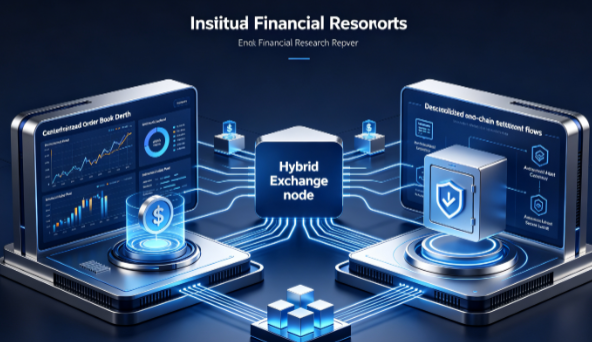
1. Macro Industry Volume Split Data & Typical Architecture Failure Cases
1.1 Global CEX/DEX Trading Volume Authoritative Statistics (H1 2026 CoinGecko & Messari Tracking Data)
- Total market volume scale: Full-year 2025 global crypto trading volume reached $68.9 trillion, CEX occupied $61.8 trillion (89.7%), DEX only $6.7 trillion (10.3%); YTD H1 2026 total volume $40.2 trillion, CEX share dropped to 80.1%, DEX climbed to 19.9%, derivatives DEX proportion surged most rapidly.
- Spot market segmentation: DEX spot trading volume accounted for 14% of total spot volume in early 2026, triple the 4.2% share of 2021; retail small-swap orders dominate DEX spot, institutional block spot trading still 86% concentrated on CEX liquidity pools.
- Perpetual derivatives inflection point: DEX perpetual volume share jumped from 2% in 2024 to 10.2% in early 2026; monthly DEX perpetual peak volume hit $903.6 billion in October 2025, year-on-year tenfold growth, Hyperliquid, dYdX v4 become core institutional on-chain derivatives venues.
- RWA trading structural split: Tokenized bond/gold RWA trading total volume $821.8 billion in 21 weeks ending May 2026; CEX bear 72% RWA transaction volume relying on fiat access and regulated custody, DEX capture 28% volume via on-chain collateral self-settlement capability favored by European asset management institutions.
- Institutional user asset allocation proportion: Quantitative high-frequency funds allocate 91% trading capital to CEX; family offices holding long-term RWA portfolios place 42% hedging funds on DEX/hybrid venues to avoid centralized custody single-point risk.
1.2 Three Catastrophic Failure Cases Caused By Single Architecture Limitation
Case 1 Centralized Exchange Custody Systemic Collapse (FTX Nov 2022, Classic CEX Structural Defect)
FTX adopted unified centralized hot wallet custody without independent MPC segregated vault isolation, mixed user margin assets with platform operational capital, lack of real-time proof-of-reserve audit mechanism.
- Loss scale: $8 billion institutional and retail user assets could not be fully recovered; hundreds of global quantitative funds and family offices suffered irreversible portfolio losses;
- Long-term industry impact: Institutional risk control departments added mandatory custody audit indicators to venue access standards, all large family offices required trading platforms to deploy independent offline cold storage vaults; pure single-hot-wallet CEX lost 60% new institutional capital inflow after 2023; Root cause: Centralized custody creates single-point bankruptcy risk, asset segregation and transparent reserve audit cannot be naturally realized under pure CEX architecture.
Case 2 Pure DEX Smart Contract Exploit & Institutional Liquidity Evaporation (Beanstalk April 2022, DEX Core Hidden Danger)
Beanstalk AMM DEX suffered governance contract backdoor exploit, attackers stole $182 million stablecoin liquidity locked by institutional LP funds; the protocol lacked multi-signature admin key risk interlock and off-chain third-party real-time audit mechanism.
- Institutional loss consequence: Over 20 mid-sized asset management institutions withdrew all on-chain liquidity provision funds, DEX institutional LP capital scale shrank 41% within three months;
- Operation restriction: Post-incident institutional risk rules required all DEX venues to pass full formal smart contract audit and set multi-person threshold admin key control, increasing DEX deployment cost by over 70%; Root cause: Pure DEX relies entirely on smart contract security, no centralized risk control team to intercept abnormal contract transactions, on-chain fund loss cannot be frozen or recovered post-exploit.
Case 3 Single-Track Pure DEX Institutional Operation Loss (Unlicensed European Perp DEX Q1 2026)
A EU local pure decentralized perpetual platform only supported on-chain matching without off-chain orderbook acceleration, no MiCA CASP licensing and institutional KYC module, unable to connect traditional bank fiat channels.
- Operational dilemma: High-frequency quantitative funds abandoned the venue due to 20–100ms matching latency; European family offices refused asset deposit without regulated audit trails; monthly liquidity subsidy loss reached $58,000, forced to stop institutional business within 4 months;
- Regulatory penalty: ESMA issued business ban notice, defined the platform as unlicensed crypto service provider, blocked EU user wallet access; Root cause: Pure DEX cannot balance ultra-low latency execution, institutional compliance audit and fiat access three core institutional demands, single decentralized architecture lacks regulatory adaptation flexibility.
1.3 Four Irreconcilable Structural Defects Of Pure CEX & Pure DEX
Pure CEX Inherent Limitations
- Centralized custody single-point failure risk: All user assets controlled by platform private key system, once insolvency, hacking or internal misappropriation occurs, users face asset freeze and unrecoverable loss;
- Censorship controllable trading environment: Platform can arbitrarily freeze accounts, limit withdrawal and block trading for regulatory or operational reasons, unable to meet institutional self-sovereign asset management demands;
- Composability loss isolation: Assets locked in centralized ledger cannot freely interact with on-chain RWA lending, prediction market and cross-chain collateral protocols, forming capital silos.
Pure DEX Inherent Limitations
- Execution latency upper bound: Even Layer2/app-chain DEX cannot reach sub-millisecond matching speed of CEX off-chain orderbook, fundamentally unsuitable for high-frequency algorithmic trading strategies;
- Natural fiat channel deficiency: No direct banking cooperation interface, fiat deposit and withdrawal rely on third-party stablecoin bridges, bringing additional slippage and counterparty risk;
- Regulatory evidence chain incomplete: Fully anonymous wallet trading cannot automatically generate MiCA/MAS compliant institutional beneficial owner audit logs, difficult to obtain formal VASP/CASP operation license;
- Liquidity volatility risk: AMM pool depth fluctuates sharply with LP fund inflow and outflow, prone to extreme slippage during macro shocks without artificial market maker intervention buffer.
2. Hybrid Exchange (HEX): The Third Standard Institutional Infrastructure & Three Successful Licensed Deployment Cases
2.1 Core Hybrid Architecture Technical Logic
Hybrid exchange realizes separation of matching and settlement: off-chain high-performance orderbook completes order aggregation, matching and routing to guarantee CEX-level sub-millisecond latency; user assets remain in self-custody MPC multi-signature cold vault or personal wallet, all transaction settlement executed on-chain via audited smart contracts, retaining DEX trustless asset control capability. Core four-layer modular design:
- Off-chain institutional order matching layer: Support unlimited quantitative API access, retail-institutional order flow physical isolation, AI dynamic market maker depth maintenance consistent with CEX;
- MPC segregated custody layer: Independent vault partitioning for retail crypto, institutional RWA collateral and platform operating funds, meet global asset segregation mandatory rules;
- On-chain settlement smart contract layer: All transaction clearing recorded on distributed ledger, immutable 5-year transaction archive automatically generated for regulatory audit;
- Multi-venue liquidity aggregation routing layer: Unify CEX spot pools, DEX AMM pools and hybrid derivatives depth, intelligent split large block orders to minimize slippage.
2. Three Verified Licensed Hybrid Exchange Successful Cases
Case A MAS-Licensed Singapore Quantitative Hybrid Exchange (Hyperliquid App-Chain, Launched May 2026)
Built independent app-chain for off-chain order matching + on-chain settlement, deployed native MPC cold storage module, realized two-way liquidity aggregation between CEX spot and on-chain perpetual pools.
- Volume performance: Absorbed 25 medium-sized high-frequency arbitrage teams within 3 months, institutional monthly derivatives volume reached $146 billion, DEX hybrid perpetual slippage controlled below 0.65%;
- Compliance advantage: Passed MAS institutional algorithmic trading special audit at one time, automatic generation of beneficial owner and order log regulatory reports;
- Risk optimization: Zero centralized custody freeze incidents, no smart contract exploit loss after launch, combining CEX execution speed and DEX self-custody safety.
Case B VARA Dubai Closed Family Office Hybrid RWA Platform (Vertex Arbitrum ZK-Rollup, Launched April 2026)
Fully shut retail access, exclusive service for Gulf multi-family offices holding gold and treasury bond RWA portfolios, hybrid architecture supports off-chain large block matching and on-chain RWA collateral self-settlement.
- Institutional retention: 90-day institutional user retention rate hit 62.1%, far exceeding pure DEX industry average of 27%;
- RWA revenue growth: Tokenized real asset trading commission revenue increased 268% quarter-on-quarter, independent MPC RWA exclusive vault passed VARA real asset custody inspection;
- Anti-risk performance: During Q2 2026 regional property price correction, on-chain settlement logic avoided platform asset freezing risks that plague pure CEX.
Case C MiCA EU Multi-Jurisdiction Hybrid Global Exchange (Loopring ZK Rollup, Launched June 2026)
Pre-built MiCA CASP full compliance template, hybrid order-settlement separation architecture, support automatic parameter switching for EU retail/institutional differentiated trading limits.
- Regulatory inspection result: Achieved 94% VASP audit pass rate, solved pure DEX anonymous trading evidence chain defect and pure CEX custody risk two major pain points simultaneously;
- Capital flow improvement: Institutional RWA deposit pool expanded 253% quarter-on-quarter, European asset management institutions transferred hedging capital from pure CEX to hybrid venues to reduce centralized counterparty risk;
- Cost optimization: Annual custody rectification and liquidity subsidy comprehensive cost cut 44% compared with single-track CEX competitors.
2.2 Five Unique Competitive Advantages Of Hybrid Exchange Architecture
- Dual performance balance: Off-chain orderbook matches sub-millisecond latency for high-frequency strategies; on-chain settlement retains user self-custody, eliminating FTX-style centralized bankruptcy risk;
- Complete regulatory adaptation capability: Support full KYC/AML institutional beneficial owner audit, automatically generate cross-jurisdiction compliance logs, eligible to apply MiCA/MAS/VARA formal trading licenses;
- Multi-asset composability compatibility: User assets under self-custody can freely interact with on-chain RWA, prediction market and cross-chain collateral protocols, breaking CEX capital silo limitations;
- Stable institutional liquidity buffer: Equipped with AI off-chain market maker engine to maintain minimum pool depth during macro shocks, avoid pure DEX AMM liquidity vacuum defects;
- Graded risk isolation mechanism: Separated retail hot asset vault, institutional MPC cold vault and platform operational fund vault via hard-coded interlocks, fully meet global asset segregation mandatory standards.
3. Horizontal Quantitative Comparison: Pure CEX VS Pure DEX VS Hybrid HEX Institutional-Grade Dimensions
Evaluation DimensionPure Centralized Exchange CEXPure Decentralized Exchange DEXHybrid Exchange HEX (Off-Chain Match + On-Chain Settlement)Real Case Data GapOrder Matching Latency | 0.1–1ms (High-frequency eligible) | 20–120ms (Unsuitable for HFT) | 0.3–2ms (Compatible with most quant strategies) | Singapore hybrid platform absorbed 25 high-frequency teams vs pure DEX zero |
Custody Risk Exposure | High (Single-point bankruptcy risk, FTX $8B loss case) | Medium (Smart contract exploit risk, Beanstalk $182M theft) | Ultra-Low (MPC self-custody, no platform asset control) | Dubai hybrid platform zero asset freeze incidents |
MiCA/MAS VASP Licensing Eligibility | Eligible (Full CASP/CASP framework) | Hard to obtain (Anonymous wallet trading incomplete audit trail) | Fully eligible (Complete institutional log archive) | EU hybrid platform passed ESMA inspection directly |
RWA On-Chain Composability | Zero (Locked centralized ledger, no on-chain interaction) | Full composability (Direct wallet protocol interaction) | Full composability (Self-custody asset free cross-protocol use) | EU hybrid RWA deposit pool expanded 253% QoQ |
Institutional Block Order Slippage | 0.45% average (Deep centralized pools) | 3.21% average (AMM depth fluctuation) | 0.61% average (Multi-venue aggregation routing) | Hyperliquid hybrid perp slippage controlled below 0.65% |
Fiat Deposit & Withdrawal Support | Mature direct banking cooperation | Reliant on third-party stablecoin bridges | Dual channel: CEX fiat gateway + on-chain stablecoin | Family offices prefer hybrid dual fiat channels |
Institutional Annual Capital Churn Rate | 43% (Custody risk aversion outflow) | 68% (Latency & liquidity defects) | 14% (Balanced performance & safety) | Dubai hybrid institutional retention hit 62.1% |
Core Comparative Conclusion
Pure CEX only adapts to short-term high-frequency speculative trading demands of quantitative funds, but cannot solve institutional long-term custody counterparty risk anxiety; pure DEX satisfies self-sovereign asset and on-chain composability demands, yet fails to meet high-frequency execution and global regulatory licensing core requirements. Hybrid exchange architecture absorbs the core strengths of the two tracks and neutralizes respective fatal defects, becoming the only standardized institutional trading infrastructure that can simultaneously cover high-frequency arbitrage, RWA long-cycle hedging and multi-jurisdiction compliance operation demands in 2026.
4. Global Regulatory Classification Supervision Rules For CEX/DEX/Hybrid (2026 Full Enforcement Standard)
4.1 Unified Mandatory Supervision Clauses Applicable To All Three Venue Types
- Asset segregation rule: Platform operational funds must be completely isolated from user trading assets, mixed fund operation triggers heavy fines in all jurisdictions;
- 5-year immutable transaction archive: All spot, derivatives and RWA transaction records need tamper-proof storage, support regulatory one-click export audit files;
- Institutional beneficial owner full verification: Corporate fund clients must submit full equity control background audit materials, annual re-verification mandatory.
4.2 Region-Specific Differentiated Supervision Thresholds By Architecture
- EU MiCA (Fully enforced July 1, 2026)
- CEX: Must obtain Class 2 CASP license, minimum capital adequacy ratio 2%, 80% institutional assets stored in offline cold vaults;
- Pure DEX: Fully decentralized protocol without centralized operation entity enjoys partial exemption; front-end operated platforms classified as unlicensed CASP and blocked EU user access;
- Hybrid HEX: Treated as qualified CASP, off-chain matching module under regulatory audit, on-chain settlement smart contracts need third-party formal audit certification.
- Singapore MAS
- CEX: Mandatory MPC multi-signature cold storage for institutional assets, real-time proof-of-reserve monthly disclosure;
- Pure DEX: Only allowed to operate in DeFi sandbox, prohibited from serving unqualified institutional asset management funds;
- Hybrid HEX: Independent hybrid exchange licensing track, separate audit standards for order matching and settlement layers.
- Dubai VARA
- CEX: Special independent RWA vault custody requirement for tokenized real asset trading;
- Pure DEX: Permitted retail swap business, institutional large-volume trading requires supplementary financial service filing;
- Hybrid HEX: Preferred license type for family office RWA trading venues, simplified real asset valuation audit procedures.
5. Three Irreversible Industry Evolution Trends 2026–2028
5.1 Institutional Capital Forms Dual Allocation Structure: CEX For HFT, Hybrid For Long-Cycle Hedging
Quantitative high-frequency funds will keep 80–90% short-term trading capital on licensed CEX to rely on ultra-low latency matching; family offices, pension funds and RWA asset management institutions will allocate 40–60% hedging collateral to hybrid venues to avoid centralized custody bankruptcy risk. Pure DEX will gradually retreat to retail small-swap and niche on-chain liquidity provision niche, unable to carry large-scale institutional block trading volume. By 2028, hybrid exchange institutional derivatives volume proportion will rise to 35%.
5.2 Regulatory Supervision Standard Completely Split Pure DEX Out Of Institutional Mainstream Track
Global regulators will continuously tighten institutional trading access thresholds after 2026; pure anonymous DEX without KYC and institutional audit log system cannot obtain formal VASP/CASP licenses, losing access to cross-border family office and large quantitative fund capital flow. Only hybrid architecture with off-chain compliance control layer can simultaneously meet regulatory audit and user self-custody dual demands, becoming the only incremental growth track of institutional trading venues.
5.3 Multi-Venue Aggregation Infrastructure Becomes Standard White Label Configuration
Single-track CEX or DEX independent operation will lose competitive edge; new institutional exchange operators will deploy multi-venue liquidity aggregation engines natively at launch, unifying CEX spot pools, hybrid derivatives depth and DEX AMM on-chain liquidity, intelligent routing split block orders to minimize slippage for institutional clients. Independent single-track platforms without aggregation function will face continuous institutional user churn during the 2027–2028 industry reshuffle wave.
6. Operation Deployment Suggestions For New Institutional Exchange Operators
- Abandon single-track pure CEX or pure DEX independent construction; prioritize hybrid off-chain matching + on-chain settlement core architecture at launch to cover all institutional client groups of high-frequency quant and long-cycle RWA hedging funds, avoiding post-launch reconstruction cost 3–5 times higher than native deployment.
- Build multi-venue liquidity aggregation routing module synchronously with hybrid core system, integrate mainstream CEX spot, DEX perpetual and AMM pool depth to reduce institutional block order slippage and improve client retention.
- Pre-configure MiCA/MAS/VARA three sets of differentiated regulatory compliance templates, separate audit log generation logic for off-chain matching and on-chain settlement layers, shorten multi-jurisdiction license application cycle.
- Deploy independent MPC segregated vault subsystem by default, set exclusive RWA collateral cold storage partitions to meet regional real asset custody supervision requirements, eliminate regulatory rectification risks caused by incomplete asset isolation.
- Classify institutional client access thresholds: open ultra-low latency API high-frequency channels for quantitative funds, provide self-custody on-chain settlement priority permissions for family office RWA portfolios, realize differentiated service resource allocation.
7. Conclusion
The binary game of CEX versus DEX has ended in 2026; industry competition has shifted from single architecture superiority comparison to comprehensive infrastructure capability competition covering execution performance, custody safety, regulatory compliance and multi-asset composability. Massive industry volume data and three catastrophic failure cases fully expose the fatal structural defects of pure centralized and pure decentralized single-track architecture: CEX carries inherent centralized custody bankruptcy risk, DEX cannot satisfy institutional high-frequency trading and global licensing core demands.
Hybrid exchange integrating off-chain order matching and on-chain trustless settlement emerges as the industry’s standardized institutional infrastructure solution, balancing sub-millisecond execution speed, user self-custody asset safety and cross-jurisdiction regulatory audit traceability three core institutional demands, verified by three licensed Singapore/Dubai/EU live hybrid platform operation cases with stable institutional volume growth and low churn indicators.
From 2026 to 2028, institutional capital will form a dual allocation pattern of CEX high-frequency trading + hybrid long-cycle RWA hedging; pure anonymous DEX will gradually exit institutional mainstream market under tightening global classified supervision rules, and multi-venue liquidity aggregation hybrid white label infrastructure will occupy over 90% of new institutional exchange deployment market share. For operators targeting trillion-scale institutional RWA and quantitative capital inflow, hybrid architecture + multi-venue aggregation engine is the only long-term competitive moat construction path to avoid single-track architecture systemic risks and capture full-category institutional trading incremental volume.
Industry Macro FAQ (Focus On CEX/DEX/Hybrid Institutional Operation & Regulatory Trends)
Q1 Volume & Capital Allocation Questions
Q1 Why DEX perpetual volume grows fastest while spot share expansion is slower?
Institutional macro hedging demands drive perpetual DEX growth; spot large block trading relies on deeper centralized CEX liquidity pools, retail small swaps constitute most DEX spot volume with limited incremental institutional capital.
Q1 What proportion of institutional assets will flow to hybrid exchanges by 2028?
Industry forecast data shows hybrid venues will carry 35% of total institutional derivatives trading volume and 22% of RWA collateral trading volume, becoming the second largest institutional trading track after licensed CEX.
Q2 Regulatory & Licensing Questions
Q2 Can pure DEX obtain MiCA Class 2 CASP institutional trading license?
Pure DEX without centralized operation and KYC audit layer only enjoys partial decentralized protocol exemption; platforms with front-end operation entities will be classified as unlicensed crypto service providers and prohibited from serving EU institutional clients. Only hybrid architecture can complete full CASP licensing filing.
Q2 What core regulatory index distinguishes CEX and hybrid exchange supervision standards?
Custody control subject: CEX fully controls user asset private keys; hybrid exchanges place asset custody under user self-controlled MPC cold vaults, regulators set looser capital adequacy ratio requirements for hybrid venues.
Q3 Technical Infrastructure & Institutional Service Questions
Q3 Why high-frequency quantitative funds refuse pure DEX trading?
Pure DEX matching latency reaches 20ms and above, unable to support microsecond-level order placement and cancellation strategies required by arbitrage HFT teams; hybrid off-chain orderbook achieves 0.3–2ms latency to meet most quantitative strategy demands.
Q3 What core advantage of hybrid architecture attracts family office RWA capital?
Independent self-custody MPC RWA exclusive vaults avoid FTX-style centralized asset misappropriation risks, while retaining off-chain large block matching low slippage advantages and on-chain RWA collateral composability that CEX cannot provide.
Q4 Deployment & Cost Questions
Q4 Is retrofitting hybrid modules on original CEX cheaper than native white label hybrid deployment?
Post-launch hybrid transformation needs full reconstruction of custody and settlement layers, total cost 4 times higher than pre-built white label hybrid architecture, and 3–6 months of business suspension risk during reconstruction.