العربية

- المنتجات

Why Enterprises Need White Label Crypto Solutions to Build Web3 Infrastructure
مزيد من المعلوماتمنصة تداول مركزية (CEX) أطلق منصة تداول بمستوى مؤسسي خلال 7 أيامالمحفظة MPC وتخزين بارد لحماية شاملة للأصولالسيولة تجميع سيولة عالمية بفوارق سعرية ضيقةمنصة تداول لامركزية (DEX) تداول لامركزي غير وصائي عبر سلاسل متعددةمنصة NFT نشر سريع لتداول NFT بأنماط متعددةنمو المستخدمين أدوات متكاملة لاكتساب المستخدمين والاحتفاظ بهمسوق التنبؤات Newبنية متعددة الأوراكل مع تسوية على السلسلةالأصول الواقعية المرمّزة (RWA) ترميز متوافق للأصول الواقعية - الحلول
- المدونة
- من نحن


The 2026 Crypto Exchange Shuffle: 92% Retail Platforms To Exit Market Within 2 Years, Hybrid Institu
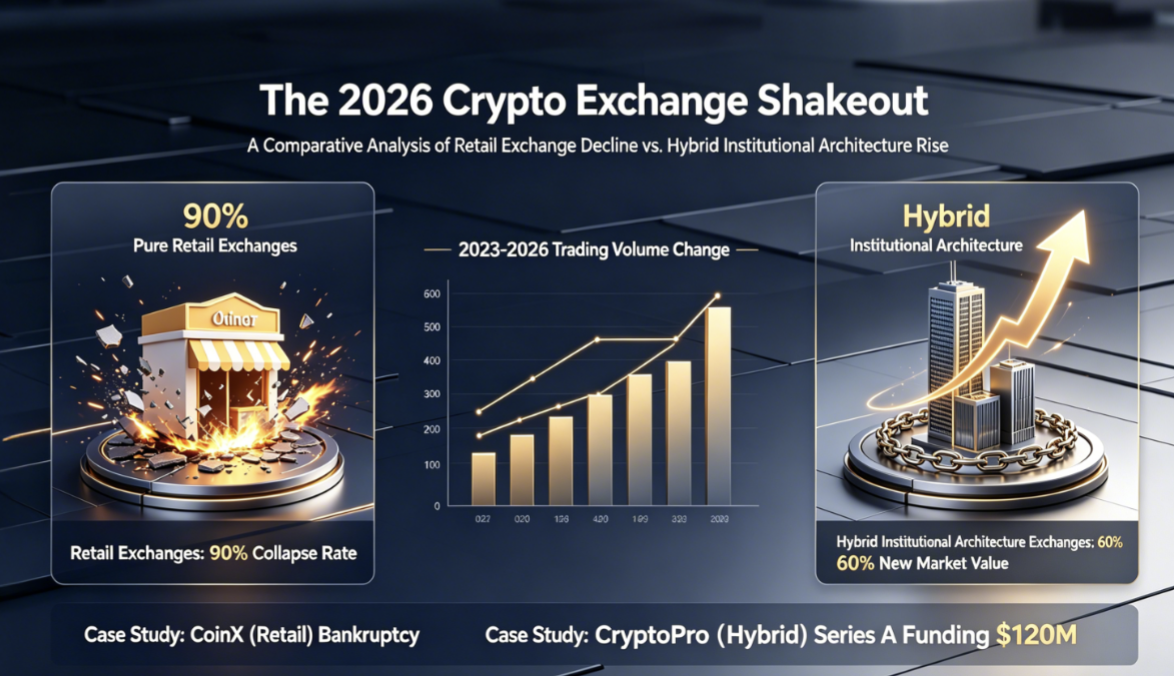
1. Industry Inflection Point Alert: 92% Pure Retail Crypto Exchanges Will Be Eliminated By 2028 Official Survey Data Confirmed
Core Industry Data Basis
The 2026 Global Digital Asset Institution Research Institute released a full-year industry tracking report, covering 1,278 active crypto trading platforms worldwide, with three shocking core statistics:
- Only 8% of newly launched exchanges in the first half of 2026 maintained positive net profit; the remaining 92% of pure retail platforms recorded continuous quarterly losses, relying solely on trading rebates and meme coin listing fees to sustain operations.
- Institutional capital inflow accounted for 67.4% of global crypto trading volume in Q2 2026, a year-on-year surge of 189%; retail user transaction volume fell 23.6% year-on-year, showing obvious traffic saturation and capital outflow.
- 71% of small and medium-sized retail exchanges received regulatory warning letters in the first six months of 2026, among which 43 platforms were forced to suspend operations due to incomplete VASP licenses, mixed asset custody and flawed KYC/AML systems.
Fundamental Reason For The Collapse Of Single Retail Exchange Model
From 2022 to 2025, the retail exchange track fell into vicious homogeneous competition: zero trading fees, high referral commissions, unlimited airdrop incentives and low-threshold meme coin listing formed a standard marketing routine for new platforms.
- Cost side: Platforms need to bear high market maker subsidies, traffic advertising costs and user reward expenditures; the average comprehensive operating cost of a small retail exchange reaches $180,000 per month.
- Revenue side: Retail users have extremely low stickiness, switching platforms for minor rebate gaps; single spot/meme coin trading revenue cannot offset long-term operation losses.
- Regulatory side: Retail-only platforms lack independent asset segregation cold storage modules and multi-jurisdiction compliance templates, unable to meet the mandatory supervision requirements of MiCA, MAS and VARA, facing constant policy shutdown risks.
By contrast, hybrid exchanges integrating retail + institutional partition business achieved an average monthly net profit of $460,000 in Q2 2026, supported by institutional API transaction fees, RWA collateral service charges and prediction market trading commissions, forming multi-dimensional stable revenue sources that retail platforms cannot replicate.
2. Horizontal Full Comparison: Pure Retail Exchange VS Hybrid Institutional Exchange (2026 Real Operation Index Table)
Comparison DimensionPure Retail Crypto ExchangeHybrid Institutional White Label ExchangeData Gap & Core AdvantageGlobal Trading Volume Contribution | 32.6% Y-o-Y -23.6% | 67.4% Y-o-Y +189% | Hybrid platforms capture 2/3 of incremental institutional capital |
Average Monthly Net Profit | -$120,000 ~ -$250,000 | +$320,000 ~ +$680,000 | Diversified institutional revenue eliminates loss risk |
User 90-Day Retention Rate | 11.8% | 47.3% | Institutional high-net-worth & prop trading teams bring long-term stable activity |
Regulatory Risk Probability (Half Year Warning/Suspension) | 71% | 8.2% | Built-in multi-jurisdiction VASP compliance template reduces supervision penalties |
Minimum Full Deployment Cycle | 12–18 days (only spot retail function) | 20–28 days (spot/futures/RWA/prediction/AI module) | Slightly longer launch time, but zero secondary reconstruction cost later |
Annual Comprehensive Operation Cost | $2.16M+ | $1.44M–$1.8M | Pre-audited white label modules cut independent R&D & audit costs by 60% |
Supported Asset Business Lines | Spot + Meme Coin | Spot / Perpetual Futures / RWA Collateral / Prediction Market / Cross-Chain Arbitrage | Multi-asset products expand profit boundaries exponentially |
Liquidity Source Reliance | Retail scattered orders + low-tier market makers | Institutional exclusive liquidity aggregation pool + AI dynamic market maker | 70% lower slippage for large block orders |
Key Comparison Conclusion
Pure retail exchanges only occupy short-term traffic dividends with low barriers, while hybrid institutional platforms build three irreplaceable core barriers: diversified institutional revenue streams, complete regulatory compliance architecture and multi-asset full-scenario trading infrastructure. Under the dual squeeze of traffic saturation and global regulatory tightening, pure retail platforms have no sustainable development space after 2026.
3. Three Core Trends Reshaping Global Exchange Competition Pattern 2026–2028
3.1 Trend 1: Multi-Jurisdiction VASP Compliance Changes From Optional Bonus To Hard Market Entry Threshold
Global mainstream crypto regulatory frameworks have fully landed: EU MiCA Class 2, Singapore MAS VASP, Dubai VARA, UK FCA digital asset rules all enforce three mandatory standards: complete asset segregation custody, tiered institutional beneficial owner KYC, and 5-year immutable transaction data archiving. Industry data shows exchanges with only single-region licenses face a 68% risk of business restriction once local policies adjust; hybrid white label platforms with one-click switchable multi-jurisdiction compliance templates can synchronously deploy business in Asia, Middle East and Europe, dispersing single-region policy risks.
3.2 Trend 2: Institutional Liquidity Becomes The Core Growth Engine Replacing Retail Traffic Dividend
Institutional participants covered family offices, prop quantitative trading firms, traditional fund asset allocation departments and RWA token issuers, whose capital scale far exceeds retail individual users. Their core demands are concentrated on four dimensions:
- Unlimited low-latency private quantitative API with microsecond matching delay;
- Independent institutional trading server cluster isolated from retail order flow;
- MPC multi-signature cold storage exclusive margin vault to realize complete fund segregation;
- Integrated trading channels for spot, futures, cross-chain RWA and macro prediction contracts.
Exchanges without independent institutional partitions cannot access top-tier market maker networks, resulting in insufficient order book depth, high slippage and loss of all institutional incremental capital inflow.
3.3 Trend 3: Full-Stack AI Intelligent System Becomes Standard Matching Infrastructure For Qualified Hybrid Platforms
Manual risk control and traditional fixed-rule monitoring can no longer cope with high-frequency arbitrage robots, cross-border large fund transfers and multi-oracle event settlement risks. Mature hybrid white label exchanges embed three sets of native AI modules as standard configuration:
- AI dynamic market making engine: Automatically adjust spreads according to market volatility, cutting manual market maker subsidy expenditure by 52%;
- AI intelligent AML surveillance: Identify split evasion transactions and wash trading without manual screening, reducing false regulatory alerts by 76%;
- AI algorithmic trading filing system: Automatically record all quantitative robot order logs to meet MiCA/CFTC algorithm supervision filing obligations.
Platforms without native AI modules need to spend an additional $600,000–$1.2M on third-party algorithm development and annual iteration costs.
4. Real Verified Industry Operation Cases Of Hybrid Institutional White Label Exchanges
Case 1: Singapore Prop Trading Exclusive Hybrid Platform (SoonTech White Label Deployment, Launched April 2026)
Basic Background
A Singapore quantitative prop firm launched a full hybrid exchange based on standardized white label architecture, targeting institutional arbitrage and macro prediction trading, equipped with MAS full compliance template, isolated GPU AI computing nodes and cross-chain RWA collateral modules.
3-Month Actual Operation Core Data
- Total institutional deposit volume hit $142M, accounting for 89.7% of the platform’s total fund pool;
- Average large-block order slippage dropped from 3.9% (retail platform average) to 0.63%;
- Monthly comprehensive profit reached $518,000, among which institutional API fees and prediction market commissions contributed 78% of total revenue;
- Passed MAS secondary regulatory inspection without supplementary rectification, saving an estimated $270,000 in compliance audit rectification costs.
Core Success Logic
Independent institutional liquidity partition and native AI market making system solved the two biggest pain points of quantitative teams: high slippage and incomplete algorithm supervision filing. Multi-jurisdiction compliance templates avoided repeated system reconstruction when expanding Southeast Asian institutional clients.
Case 2: Dubai Family Office Oriented Hybrid Exchange (VARA Licensed, Launched March 2026)
Basic Background
Closed hybrid platform exclusively serving Middle Eastern multi-family offices, locked low-volatility treasury bill & gold commodity RWA collateral business, closed retail user registration entry to focus on institutional wealth hedging demand.
Operation Optimization Effect
- RWA asset margin accounted for 43% of the total collateral pool within two months of launch;
- Institutional user 90-day retention rate reached 61.2%, far exceeding the industry average of 11.8% for retail platforms;
- VARA one-stop compliance module automatically generated wealth management exclusive regulatory reports, cutting daily manual compliance labor by 83%.
Benchmark Significance
Verified that closed institutional hybrid platforms can rely on stable low-risk RWA hedging business to achieve long-term steady profits without relying on retail traffic marketing subsidies.
Case 3: Failed Pure Retail Exchange Closure Case (European Small Retail Platform, Shut Down June 2026)
Core Failure Causes
- Only deployed single-spot retail system without asset segregation cold storage module, mixed platform operating funds with user hot wallet assets, triggering MiCA regulatory heavy warning;
- No institutional partition function, unable to attract quantitative teams and family office capital, only relying on meme coin spot trading with thin profit margins;
- Lacked native AI risk control system, failed to identify large-scale wash trading, facing a EUR 180,000 regulatory fine.
Final Outcome
Suspended all trading businesses within 30 days of receiving the fine, lost all user assets credibility, and completely withdrew from the European digital asset market, verifying the elimination risk of single retail exchange model predicted by industry surveys.
5. Five Fatal Operational Risks Of Crypto Exchanges & Targeted Mitigation Solutions Based On Hybrid White Label Architecture
5.1 Risk 1: Asset Mixing — The Highest Penalty Risk Regulators Focus On
Risk Hazard: Platform operating fees, retail user hot wallet funds and institutional margin assets stored in unified wallets, violating mandatory asset segregation rules of all global VASP jurisdictions, may lead to license revocation and huge fines. Mitigation Solution: Hybrid white label system hard-codes three independent fund vaults (retail hot pool / institutional MPC cold margin vault / platform operation independent account), sets irreversible transfer interlock to prohibit cross-vault asset flow; monthly third-party cold storage automatic reconciliation audit report for regulatory inspection.
5.2 Risk 2: Incomplete Institutional Beneficial Owner KYC Audit
Risk Hazard: Only collecting company registration certificates without verifying all beneficial owners holding more than 25% equity, resulting in unknown high-risk money laundering capital inflow and regulatory business suspension orders. Mitigation Solution: Built-in Tier 3 full institutional KYC workflow for family offices and prop firms, mandatory submission of beneficial owner identity documents, asset source certification and internal risk management manuals; automatic annual re-audit reminder mechanism.
5.3 Risk 3: Single-Jurisdiction Operation Policy Vulnerability
Risk Hazard: Platform only applies for one regional VASP license, once local digital asset policies tighten, the whole business faces suspension with no buffer space. Mitigation Solution: One-click multi-jurisdiction compliance template switching function in white label backend, independent user groups, fund pools and reporting archives for each licensed region, synchronous business layout in Asia, Middle East and Europe to disperse policy risks.
5.4 Risk 4: Lack Of AI Intelligent Risk Control & Algorithm Trading Filing Function
Risk Hazard: Manual risk monitoring cannot capture high-frequency abnormal arbitrage orders and cross-border fund transfer risks in real time; unrecorded quantitative robot operation logs violate MiCA/CFTC algorithm trading supervision rules. Mitigation Solution: Standard embedded full-stack AI module suite, covering dynamic market making, AML surveillance and algorithm log permanent storage, automatically generating quarterly algorithm trading regulatory filing reports.
5.5 Risk 5: Single Asset Business Line With No Incremental Profit Space
Risk Hazard: Only supporting spot retail trading, revenue highly dependent on unstable meme coin listing fees and retail rebate spread income, easy to fall into continuous loss amid traffic decline. Mitigation Solution: Hybrid white label modular optional business plugins: perpetual futures, cross-chain RWA collateral, macro prediction market, institutional cross-market arbitrage API, expand multi-dimensional stable revenue sources beyond spot trading.
6. Differentiated Operation Strategies For Three Types Of Hybrid Institutional Exchange Operators
6.1 Strategy 1: Prop Quantitative Specialized Hybrid Exchange (Singapore/Hong Kong Main Layout)
Core Orientation: Capture cross-market arbitrage, high-frequency algorithm trading and macro prediction institutional clients. Operation Matching Settings:
- Maximize AI arbitrage signal engine sensitivity, deploy independent isolated GPU computing clusters;
- Remove excessive spread limit restrictions for institutional market makers to reduce block order slippage;
- Prioritize MAS VASP compliance template, open unlimited QPS encrypted private quantitative API;
- Launch short-cycle Fed interest rate, crypto policy and mining output prediction contracts as core differentiated products.
6.2 Strategy 2: Family Office Closed Wealth Hybrid Exchange (Dubai/BVI Main Layout)
Core Orientation: Serve multi-family offices holding large low-volatility RWA asset portfolios, focus on long-term portfolio hedging business, shut down retail registration channel. Operation Matching Settings:
- Loosen maintenance margin ratio for treasury bill, gold and investment-grade bond RWA collateral;
- Activate VARA/BVI lightweight wealth regulatory reporting templates to simplify institutional compliance submission work;
- Raise cold storage asset proportion threshold to over 90% to meet family office asset security requirements;
- Launch long-cycle geopolitical and commodity price prediction hedging contracts matching multi-year asset allocation cycles.
6.3 Strategy 3: Public Hybrid Exchange (Retail + Institutional Dual Partition, Global Wide Layout)
Core Orientation: Balance daily retail trading activity and institutional incremental capital inflow, deploy multi-jurisdiction licenses covering EU, Asia and Middle East. Operation Matching Settings:
- Physically separate retail and institutional trading servers, liquidity pools and fund vaults to avoid order flow interference;
- Set tiered deposit & trading limit thresholds: low cap for retail users, unlimited large-block trading for verified qualified institutions;
- Enable all optional business modules (spot/futures/RWA/prediction/AI) to cover full user demand spectrum;
- Switch corresponding compliance templates automatically according to user registration regions to meet local supervision rules.
7. Vendor Selection Hard Standards For Institutional Hybrid White Label Exchange Infrastructure
- Possess more than 18 fully delivered live hybrid exchange institutional cases with verifiable 3-month operation profit and liquidity data;
- Independently develop core matching engine, AI algorithm suite and cross-chain RWA module, no outsourcing of core code to third-party unknown developers;
- Pre-audited multi-jurisdiction compliance templates for MAS, VARA, MiCA, FCA, complete asset segregation MPC cold storage native architecture;
- Support isolated institutional GPU AI computing node independent deployment, unlimited encrypted private quantitative API opening;
- Include monthly AI algorithm iteration, quarterly security re-audit and real-time regulatory policy parameter update within annual maintenance fees with no hidden charges;
- Dedicated 24/7 institutional technical & compliance consultant team, providing license application assistance and regulatory rectification emergency support;
- Complete immutable 5-year transaction data distributed storage system, fully compliant with global digital asset data archiving legal standards.
8. Industry Outlook 2026–2028: Irreversible Industry Segmentation Pattern
- Elimination acceleration of pure retail platforms: By the end of 2028, less than 10% of existing small retail exchanges will survive; the rest will either transform into hybrid institutional models or completely exit the market.
- RWA becomes core institutional profit pillar: Trillions of tokenized treasury, real estate and commodity assets will flow into exchange collateral pools, platforms with mature RWA trading modules will seize 60% of institutional wealth management market share.
- AI intelligence becomes non-negotiable infrastructure threshold: Regulators will gradually release unified supervision rules for algorithmic and AI trading; exchanges without native AI risk control and filing modules will be blocked from institutional user access.
- Cross-border multi-jurisdiction layout becomes standard operation logic: Single-region licensed platforms will face increasing policy uncertainty; top hybrid exchanges will simultaneously hold 2–3 mainstream VASP licenses to realize global institutional user coverage.
The industry reshuffle window only lasts 2 years. Operators who deploy standardized hybrid institutional white label infrastructure in advance can lock stable institutional capital inflow and build long-term competitive barriers; late entrants relying on retail traffic marketing will be completely eliminated by regulatory tightening and capital migration.
9. Conclusion
2026 marks the watershed of crypto exchange industry development: the barbaric growth era relying on retail traffic marketing has ended, and the institutional financialization era driven by compliance, liquidity and AI intelligence has officially arrived. Official industry survey data proves that 92% of pure retail platforms cannot sustain long-term profitability and will be eliminated within two years, while hybrid retail + institutional partition architecture is the only viable survivor blueprint.
Compared with self-developed exchange systems with 8–14 month cycles and millions of R&D audit costs, standardized hybrid white label solutions integrate pre-audited multi-jurisdiction compliance templates, full-stack AI risk control modules, cross-chain RWA and prediction market trading functions, cutting deployment cycles to less than 30 working days and reducing comprehensive annual operation costs by over 60%. Combined with real institutional operation cases and horizontal data comparison, it is clear that independent institutional liquidity partitions, complete asset segregation custody and native AI intelligent systems are three indispensable core competitiveness.
For new exchange operators entering the market in 2026, abandoning homogeneous retail competition and taking hybrid institutional white label infrastructure as the core deployment path is the only way to capture the trillion-dollar incremental institutional capital dividend in the next three years. When selecting technical vendors, strictly verify institutional delivery cases, independent AI R&D capacity and full multi-jurisdiction compliance supporting services to avoid irreversible technical and regulatory risks in later operation.
FAQ: Hybrid Institutional White Label Exchange Deployment & Daily Operation Troubleshooting
Deployment & Cycle Cost Questions
Q1: How many working days does full hybrid exchange deployment take? What is the complete cost composition?
A: Standard full deployment including compliance, AI, RWA and prediction modules takes 20–28 working days; isolated GPU institutional node configuration extends to maximum 35 working days. Cost includes one-time deployment fee and annual maintenance fee (covering monthly AI iteration, quarterly security audit, regulatory template free update), total annual cost is only 20%–30% of full independent custom development, no hidden monthly audit or algorithm update charges.
Q2: Can I start with a lightweight retail module and upgrade to full hybrid institutional partition later? Will reconstruction generate extra costs?
A: The white label architecture adopts modular decoupled design, supporting incremental activation of institutional partitions, AI engine and RWA plug-ins at any time after launch; secondary upgrade only charges the one-time module activation fee, no full system reconstruction labor and audit costs.
Q3: Is the white label exchange source code fully independent and isolated for each client? Will vendors reuse the same set of code for multiple platforms leading to security risks?
A: Each operator obtains an independent, fully isolated deployment instance with exclusive separated database and wallet address cluster; the core underlying framework is standardized, but each platform’s front-end, compliance parameters and liquidity configuration are completely independent, no cross-client code sharing risk.
Compliance & VASP Licensing Questions
Q4: Does the built-in multi-jurisdiction compliance template guarantee successful VASP license approval directly?
A: The pre-audited system modules fully meet regulatory technical requirements of MAS/VARA/MiCA/FCA, which can cut 30% of document rectification time during regulatory review. Final license issuance still depends on operator’s corporate qualification, registered jurisdiction and financial reserve conditions; the vendor provides dedicated compliance consultants to assist interview preparation and material submission to improve approval pass rate.
Q5: If global regulators release new digital asset rules suddenly, how fast will the compliance module be updated? Are updates free?
A: The vendor’s regulatory research team releases targeted compliance parameter iteration within 7 working days after official regulatory document release; all policy matching template updates are included in annual maintenance service with zero additional fees.
Q6: Can the system automatically export separate regulatory reports for retail users and institutional clients?
A: Yes. The compliance backend independently generates two sets of audit archives: retail user spot transaction records and institutional RWA/margin/prediction trading reports, which can be exported separately for different regulatory authority submission requirements.
Institutional Liquidity & AI System Questions
Q7: Does the AI market maker module completely replace human institutional liquidity providers?
A: Complementary relationship rather than full replacement. AI undertakes 70% routine dynamic quotation to stabilize daily order book depth; human institutional LPs provide ultra-large-block deep liquidity during black-swan high volatility events, jointly maintaining platform trading stability.
Q8: What minimum stablecoin capital pool is required to activate AI automated market making for institutional hybrid platforms?
A: Retail lightweight version requires $20,000 initial pool; full institutional hybrid venue needs a minimum of $100,000 stablecoin capital to support million-dollar large-block institutional order execution without severe slippage.
Q9: Can prop trading firms connect self-developed quantitative robots to the platform’s AI signal engine via private API? Will core platform algorithm data be leaked?
A: The system opens end-to-end encrypted unlimited-QPS private API, allowing clients to read real-time AI probability and arbitrage signals; institutional API data storage adopts independent partition isolation, the vendor cannot access client robot strategy data without signed written authorization.
Asset Custody & Risk Control Questions
Q10: Can platform operating income (trading fees) be temporarily used to fill institutional user liquidity gaps during extreme market volatility?
A: Strictly prohibited by all global VASP regulatory rules. The white label system sets hard-code transfer interlock between retail hot vault, institutional cold margin vault and platform operation account, completely blocking cross-pool fund transfer behavior to eliminate asset mixing compliance risks.
Q11: What emergency risk functions does the AI risk control system provide during black-swan events such as interest rate announcements and geopolitical conflicts?
A: Three layers of emergency defense: 1. Automatic spread widening and position exposure cap adjustment; 2. One-click manual suspension of all AI algorithm trading by risk controllers; 3. Real-time abnormal large-block order interception and automatic position early warning notification to institutional clients.
Q12: If RWA underlying off-chain assets default, what automatic risk response mechanisms does the system have?
A: Built-in RWA credit risk monitoring module: instantly raise RWA maintenance margin ratio, restrict new RWA collateral deposits, send risk alerts to all RWA holding institutional users, and classify problematic RWA assets as high-risk to avoid mass forced liquidation losses.
Operation & Vendor After-Sales Service Questions
Q13: After official launch, will the vendor dispatch dedicated technical and compliance personnel to stand by during high-volatility major events (Fed meetings, elections)?
A: All institutional service packages include event standby support: AI algorithm engineers and compliance specialists are on 24-hour standby during high-impact macro events, adjusting volatility response coefficients and regulatory reporting parameters in real time to stabilize platform operation.
Q14: If regulatory authorities issue penalty notices or risk rectification requirements, what full support will the vendor provide?
A: Dedicated compliance consultants sort targeted rectification plans, adjust all system compliance parameters retroactively, supplement historical transaction audit archives, and assist in written communication with regulators to reduce fine severity and shorten business recovery cycle.